
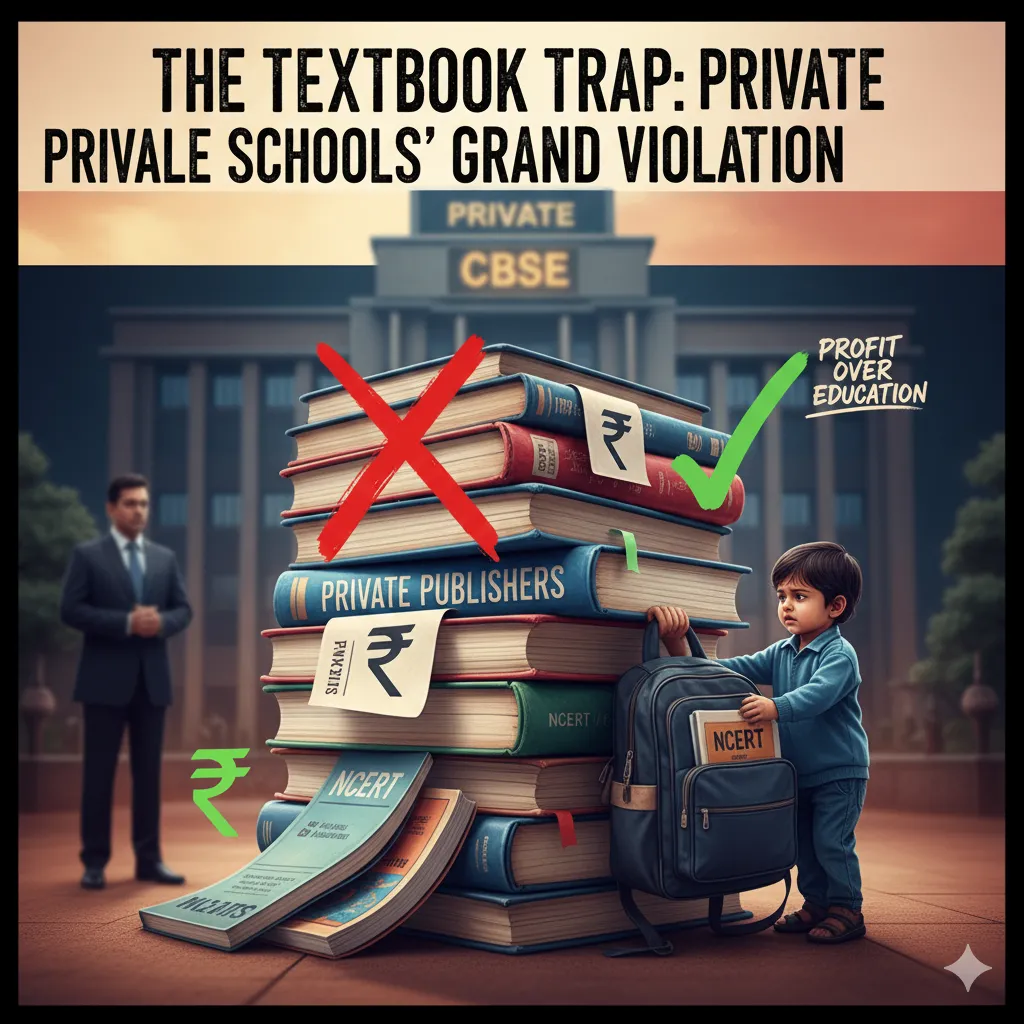
Key Takeaways (Private Schools’ Textbook Dilemma)
- Private schools in India pressure families to purchase costly textbooks from private publishers, sidestepping official NCERT guidelines.
- CBSE mandates the use of NCERT textbooks. However, many schools enforce the purchase of expensive ‘kits’. They restrict access to required materials.
- This practice violates the Right to Education Act and disproportionately affects Economically Weaker Section students, creating educational inequalities.
- Parents report coercive tactics used by schools, including insinuations about NCERT books being inadequate and mental harassment towards students.
- The lack of enforcement by authorities perpetuates the ‘Textbook Syndicate.’ This undermines public education policies and the financial sustainability for families. (Private Schools’ Textbook Dilemma)
The Great Textbook Trap: How Private Schools Sidestep CBSE Norms
In recent years, a growing trend has emerged in private schools across India. The Private Schools’ Textbook Dilemma is evident as schools mandate families to buy expensive textbooks from private publishers. This is instead of using the standard, government-approved NCERT or SCERT books. The Private Schools’ Textbook Dilemma raises concerns. Schools frame this as “value addition.” However, it frequently places significant financial strain on families. It also directly violates educational mandates.
1. The Core Issue: Private Profits vs. Public Policy
The Central Board of Secondary Education (CBSE) has repeatedly issued advisories and circulars directing schools to prioritize NCERT textbooks. However, despite this:
- Mandated Sales: Many schools allegedly force students to buy “kits”. These kits contain private books that can cost up to 10 times more than their NCERT equivalents.
- Monopolistic Practices: Consequently, schools often direct parents to specific, designated vendors. Furthermore, they sell these books directly on school premises, which ultimately violates CBSE affiliation bye-laws.
- Exclusion of EWS Students: Unfortunately, this manufactured inflation systematically excludes children from the Economically Weaker Section (EWS). As a result, they cannot afford these additional materials. Consequently, this situation defeats the objective of the Right to Education (RTE) Act.
2. CBSE Guidelines: What the Rules Say (Private Schools’ Textbook Dilemma)
The CBSE’s stance is clear, though enforcement remains a challenge:
- Commercial Activities Prohibited: Rule 19.1 (ii) of the CBSE Affiliation Bye-Laws requires that schools run as a community service, not as a business.
- NCERT Primacy: For Classes I to VIII, CBSE strongly recommends NCERT or SCERT textbooks; therefore, students should prioritize these resources. Furthermore, for Classes IX to XII, the use of NCERT textbooks is mandatory, ensuring a consistent curriculum across all grades.
- Transparency Requirements: Schools must publicly disclose the list of prescribed books on their websites. They must also provide a written declaration signed by the Manager and Principal, who take responsibility for the content.
3. Coercion Tactics Used by Institutions
Parents and advocates have reported several common methods used to pressure families into buying non-mandatory books: (Private Schools’ Textbook Dilemma)
- Mental Harassment: Students may face discrimination or neglect in the classroom if they only use NCERT-approved books.
- The “Inadequate” Myth: Teachers may falsely claim that NCERT books are “not enough” for board exams to justify private publications.
- Value Addition Pretext: Educators often bundle additional books as “supplementary materials” or “digital packages.” However, students largely leave them unused during the academic year.
4. The Impact on Students and Parents
The consequences of this practice extend beyond the wallet:
- Physical Strain: Using multiple, heavy private textbooks significantly increases the weight of school bags. This violates the National School Bag Policy 2020.
- Subpar Content: In the race for profit, some private books may bypass official content sensitivity reviews, potentially including objectionable material.
- Financial Exploitation: Families often find themselves trapped in “commercial arrangements” they cannot afford, leading to widespread dissatisfaction and psychological pressure.
Seeking Accountability (Private Schools’ Textbook Dilemma)
If you are a parent facing these pressures, remember that educational institutions are not commercial establishments. Both the RTE Act and CBSE regulations protect your right to transparency and affordable education.
This structured post highlights the legal conflict. It also addresses the systemic failure of oversight. This failure allows private institutions to prioritize profits over pedagogical standards. They do so at the expense of public interest.
The Textbook Syndicate: How Schools Defy CBSE and State Mandates
In a clear violation of educational equity, many private institutions affiliated with the CBSE are bypassing official mandates. They are forcing students to purchase expensive books from private publishers. Despite explicit guidelines from both central and state authorities, a “Commercial Syndicate” between schools and private writers continues to thrive. Local government officials often silently support this practice.
1. The Legal Mandate: NCERT vs. Private Publishers
The Central Board of Secondary Education (CBSE) has maintained a long-standing directive regarding the use of textbooks:
- The Rule: For secondary and senior secondary classes, the use of NCERT textbooks is mandatory.
- The Directive: Schools must not compel parents to buy books from specific vendors. They must avoid dealing with private publishers that bypass official curricula.
- State Policy: In Uttar Pradesh, the Department of Basic Education has issued specific office memos. These memos and advisories mandate NCERT books in schools, nurseries, and kindergartens.
2. Institutional Defiance and Local Collusion
The problem is not a lack of rules; rather, it is a lack of enforcement. In fact, private schools use “cryptic methods” to pressure students and guardians into buying non-NCERT books.
- Allegations of Corruption: There are serious allegations against school governing bodies. Specifically, they earn significant illegal income from the sale of private writers’ books. Furthermore, this income sometimes exceeds ₹16,00,000 in a single school alone.
- Pressure Tactics: Schools openly pressurise students and guardians to purchase these books, creating a “mala fide” environment of coercion.
- Lack of Accountability: Local government officials, such as the Basic Shiksha Adhikari (BSA), often receive accusations. These accusations are for failing to take action. They neglect to address issues against these institutions despite receiving formal grievances.
3. The RTI Stand off: A Government Shielding the Schools? (Private Schools’ Textbook Dilemma)
The gravity of the situation is most visible in the lack of transparency from the Department of Basic Education. When citizens seek information via the Right to Information (RTI) Act, the response is often a wall of silence:
- Deemed Refusal: Generally, Public Information Officers (PIOs) frequently fail to provide information on action taken reports against schools. Consequently, this failure leads to a “deemed refusal” under Section 7(2) of the RTI Act.
- Stalling Tactics: The PIO marks their stance with cryptic status updates like “REQUEST RECEIVED” for several months. Consequently, this indicates a deliberate attempt to withhold information. Furthermore, the withheld information concerns inquiries into private school corruption.
- Failure of Appeal Authorities: First Appellate Authorities (FAA) often fail to adjudicate appeals within the statutory time limit. Consequently, this failure frustrates the legal process meant to hold these schools accountable.
4. Why This Matters: The Cost of Corruption
The failure of the government to take this issue seriously has far-reaching consequences:
- Financial Burden: Parents must pay for “kits” that cost significantly more than NCERT books.
- Policy Erosion: Consequently, state educational policies are obstructed in their enforcement, leading to a breakdown in transparency and accountability.
- Educational Inequality: This system creates a divide. It determines access to education based on the ability to pay for inflated, private-label materials. (Private Schools’ Textbook Dilemma)
Conclusion: The Path to Accountability (Private Schools’ Textbook Dilemma)
The current stand-off before the State Information Commission highlights the need for strict disciplinary proceedings. Officials who shield these institutions must face necessary actions. Furthermore, the PIOs and local education authorities must accept personal liability for their inaction. Otherwise, the “Textbook Syndicate” will continue to exploit families under the guise of education.
In legal and administrative terms, the Central Government’s responsibility does not vanish the moment they click “forward.” Moreover, under the Centralised Public Grievance Redress and Monitoring System (CPGRAMS), there is a continuous chain of accountability. This chain remains unbroken. In addition, the RTI Act, 2005 also contributes to this framework of responsibility.
1. The Monitoring Responsibility (Private Schools’ Textbook Dilemma)
When the Ministry of Education (Central) forwards grievance DOSEL/E/2025/0003990 to the Principal Secretary (Basic Education, UP), the Central Department must categorise its duties as follows:
- Supervisory Oversight: The Central Government serves as the “Originating Authority.” It ensures that the state authority, to which they forwarded the matter, actually provides a resolution.
- The “Disposal” Fallacy: Central Departments often mark a case as “Closed” once they forward it. However, under Citizen Charters, a grievance is only truly settled in two conditions. First, when an Action Taken Report (ATR) is uploaded. Second, when the citizen expresses satisfaction. Therefore, both conditions must be met for complete resolution.
- Policy Compliance: The grievance involves the violation of NCERT mandates. Consequently, these mandates are a Central policy. Thus, the Central Government has a vested interest in ensuring that the state enforces these guidelines.
2. The Link to your RTI and Second Appeal
The failure of the State PIO to provide information is a major problem. It essentially indicates a failure to demonstrate that the Central Government’s “forwarding” resulted in any real work.
- State Inaction: Your RTI seeks the name and designation of the staff processing the grievance forwarded by the Center. By refusing this, the State PIO is hiding whether the Central Government’s order was even opened or acted upon.
- Mala Fide Obstruction: The “cryptic status” of your request for over two months suggests an issue. It may indicate that the local state authorities are actively blocking the feedback loop. This information should return to the Central Government.
3. Can you go back to the Central Government? (Private Schools’ Textbook Dilemma)
Yes. If the State Government remains silent or supports the private institutions:
- Re-registration: You can file a “Feedback” or “Escalation” on the CPGRAMS portal. State that the state authority (Basic Education Dept) has failed to provide the ATR. The Center has ordered this provision.
- Non-Compliance of RTI: You can inform the Central Ministry. Their reference is being used as a shield by the State PIO to avoid giving a clear answer.
Summary of Duty (Private Schools’ Textbook Dilemma)
| Authority | Status of Duty | Current Reality in Your Case |
| Central Govt (Ministry of Education) | To ensure the state acts on their reference. | Matter forwarded but outcome is unknown due to State silence. |
| State Govt (Principal Secretary) | To conduct an inquiry and issue an ATR. | Allegations of supporting private school stands through inaction. |
| State PIO (Pradeep Kumar Singh) | To provide proof of that action via RTI. | Willful Defiance of the Commission’s order to provide the ATR. |
Next Step: Would you like me to draft a “Notice of Non-Compliance”? You can send it back to the Central Ministry of Education. Inform them that their referral to the UP Basic Education Department has been met with a “Deemed Refusal.” It has also been met with total administrative silence.
Based on the documents and RTI records provided, here are the specific identification details. This includes the contact information and web links related to your case.
Core Identity & Case Reference IDs (Private Schools’ Textbook Dilemma)
- Welcome ID: UPICR20250005050
- Appeal Registration Number: A-20250902248
- File Number (State Information Commission): S08/A/1513/2025
- Diary Number (New Submission): D-060120260010
- Original RTI Registration Number: DPBED/R/2025/60991
- RTI Transaction ID: DPBEDR20250000001338
- First Appeal Registration Number: DPBED/A/2025/60406
- Central Grievance Reference (Originating Authority): DOSEL/E/2025/0003990
Contact Details (Appellant & Respondents) (Private Schools’ Textbook Dilemma)
| Entity | Mobile Number | Email Address |
| Shivam Verma (Appellant) | 6387947427 / 6386936345 | shivamverma38075[at]gmail[dot]com |
| PIO – Pradeep Kumar Singh | 05222213197 / 9151990335 | upgov.basic3[at]gmail[dot]com |
| FAA – Ved Prakash Rai | 9454411244 | upgov.basic3[at]gmail[dot]com |
| State Info Commission | Not provided in text | hearingcourts8.upic[at]up.gov.in |
Web Links & Online Portals (Private Schools’ Textbook Dilemma)
- UP State Information Commission Portal: https://upic.up.gov.in (Used for tracking appeal status and online hearings)
- UP RTI Online Portal: https://rtionline.up.gov.in (Used for filing the original application and first appeal)
- Specific RTI Request Detail Link: [https://www.google.com/search?q=https://rtionline.up.gov.in/request/regdetails.php%3FregId%3DrecfSkXa7tuk5wz9pasM%252BW7%252B]
- Central Grievance Portal (CPGRAMS): https://pgportal.gov.in (Related to the original reference DOSEL/E/2025/0003990)
Next Strategic Move (Private Schools’ Textbook Dilemma)
The PIO has missed the 15-day deadline set in the November order. The Diary Number D-060120260010 is now your most important reference for the February 9, 2026 hearing.


Facing a similar challenge? Share the details in the box below, and our team of experts will do their best to help.