
Key Takeaways
- Smt. Sugna Nishad’s case highlights systemic failures in the Mirzapur Police’s refusal to register an FIR, violating legal mandates.
- The Supreme Court in Lalita Kumari vs. Govt. of U.P. establishes that police must register an FIR when informed of a cognizable offence without preliminary inquiry.
- Mirzapur Police improperly dismissed Nishad’s complaints, instead using preventive actions under Section 170 BNSS, evading their investigative duties.
- The police’s bias and misconduct undermine public trust, as evidenced by prejudicial language and obstructions in the investigation process.
- To restore justice, Smt. Nishad must file a complaint directly with the Magistrate to compel the police to register the FIR.
🚨 The Gatekeepers of Justice: Why Mirzapur Police Refused an FIR, Violating the Law
The Grievance: A Fight for Mandatory Justice
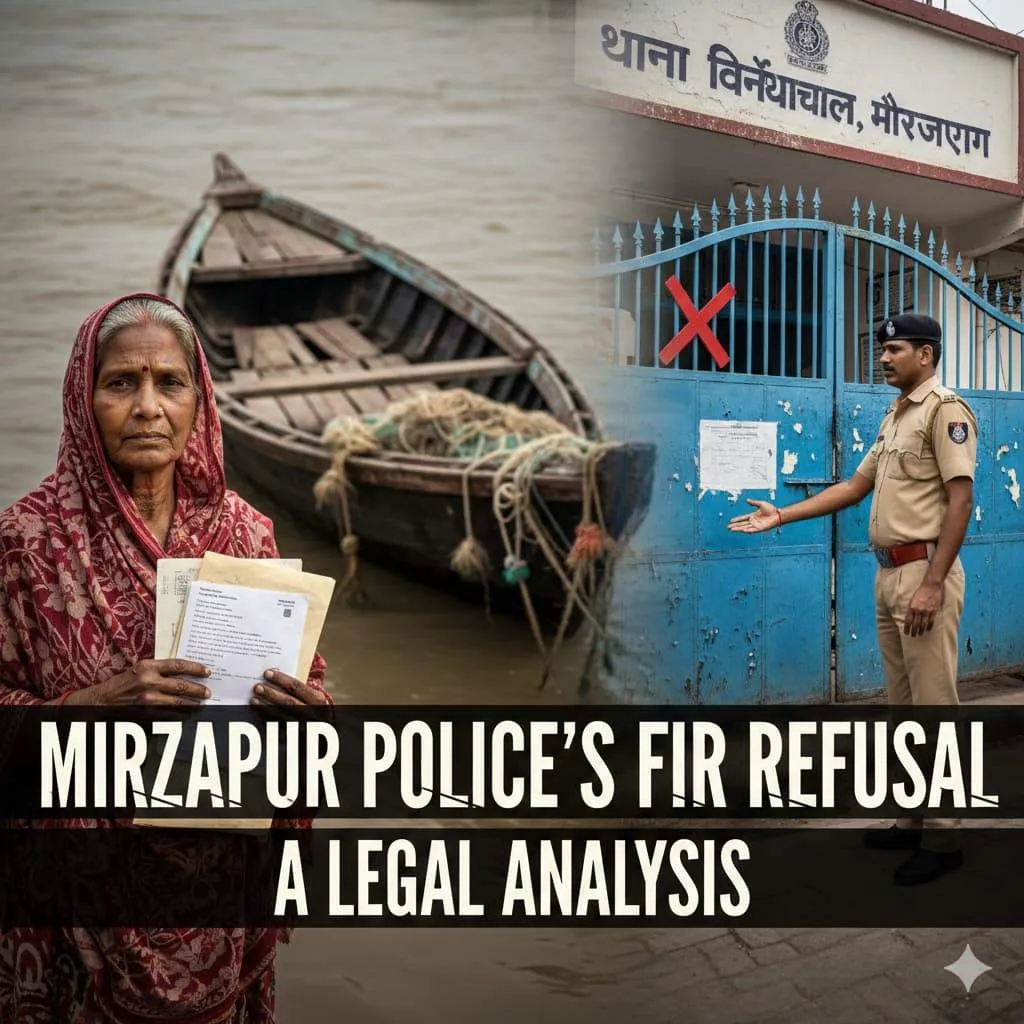
The case of Smt. Sugna Nishad from Mirzapur, Uttar Pradesh, serves as a clear example of a systemic failure within the police administration. This is specifically illustrated by Mirzapur Police’s FIR Refusal. This failure is due to the pervasive and illegal reluctance to register a First Information Report (FIR). An FIR is the fundamental key that unlocks the criminal justice system. When the police, the mandated gatekeepers of this system, unilaterally deny this key, they cause significant harm. They do more than just close a case. Moreover, they commit a grave injustice. They also violate the highest judicial guidelines of the land.
This analysis is based on a grievance filed by Smt. Sugna Nishad to the Chief Minister’s Office. The grievance registration number is GOVUP/E/2025/0132974. Smt. Nishad details the Vindhyachal Police Station’s refusal to register her complaint. She claims that opponents deliberately destroyed her property. This property includes her boat and fishing net, which were submerged in the river.
The Law They Broke: The Lalita Kumari Mandate (Mirzapur Police’s FIR Refusal)
The central pillar of this controversy rests on the Supreme Court’s definitive ruling in Lalita Kumari vs. Govt. of U.P. (2014). This judgment made the legal position unequivocally clear:
- Mandatory Duty: If the information received by the police discloses the commission of a cognizable offence. This refers to a serious crime where police can arrest without a warrant. Examples include Mischief/Damage to Property, in this case. The police officer MUST register an FIR.
- No Preliminary Inquiry: Police are strictly prohibited. They cannot conduct a lengthy preliminary inquiry to determine the truth or falsity of the complaint. This must be done before registering the FIR. Registration is only the first step; investigation follows.
The Police’s Reluctant Approach:
The Mirzapur police directly circumvented this mandate. The complaint indicates that the police conducted an “investigation.” The Additional Superintendent of Police concluded that the matter was “false and fabricated” based solely on an alleged motive. The motive was to “exert pressure” in an unrelated family case involving the opponent.
This is the very essence of the reluctance. By declaring the complaint false before registration, the police are essentially deciding the case’s merits at the initial stage. This practice is often employed to keep crime statistics low. It shields the station from showing an increase in registered cases. This is a form of administrative negligence that comes at the cost of victim justice. (Mirzapur Police’s FIR Refusal)
The Misuse of Prevention as a Substitute for Investigation (Mirzapur Police’s FIR Refusal)
One concerning aspect of the police’s final action is their inappropriate use of Section 170. This section is part of the Bharatiya Nagarik Suraksha Sanhita. This aspect is troubling. This misuse raises serious worries. BNSS is the successor to the former Section 151 of the Cr.P.C.
What Section 170 BNSS Is For: (Mirzapur Police’s FIR Refusal)
Section 170 BNSS is a preventive power. It allows police to arrest a person without a warrant. This action is possible only when they know of a design to commit a future cognizable offense. The police must believe that arrest is the only way to prevent its commission. It is designed solely for law and order maintenance.
Why Its Use Here is Misuse and Evasion: (Mirzapur Police’s FIR Refusal)
The police dismissed Smt. Sugna Nishad’s criminal complaint (the submerged boat and net) as “unsubstantiated.” They then initiated preventive action under Section 170 BNSS against the opponent, Umashankar, citing “law and order.” (Mirzapur Police’s FIR Refusal)
- Substitution: The police illegally substituted a mandatory criminal investigation with an administrative law-and-order measure. They avoided the duty to investigate the past crime committed against Smt. Nishad and instead focused only on preventing the future escalation of the family feud.
- Shielding: This action is a perfect bureaucratic tool for the police to shield themselves. It allows them to close the file on a serious complaint (“Case Closed”). This gives the appearance of having done something to manage the situation. It simultaneously ensures they never have to face the accountability of registering and thoroughly investigating the property damage. It sends a message that administrative convenience is prioritized over victim rights.
The Taint of Investigative Bias and Police Misconduct
The reluctance to register an FIR increased as demonstrable police misconduct surfaced. The reports submitted to senior offices showed evident bias. (Mirzapur Police’s FIR Refusal)
- Prejudicial Language: The complainant pointed out an issue with a subordinate officer’s report. It claimed, without foundation, that she acted from “vindictiveness” in submitting her application. The report also alleged that someone had orchestrated a “planned conspiracy.” These highly prejudicial terms reveal an inherent bias. The police cannot assume a complainant’s motive to dismiss a crime. Their role is to investigate the facts of the alleged offence, regardless of motive. The senior officer (Additional SP) failed to correct or reprimand this language, effectively endorsing the bias.
- Lack of Transparency: Smt. Nishad specifically requested the officer’s identity. This officer submitted irrelevant, cryptic GPS-tagged photographs that seemed to obstruct the investigation. The final police report completely failed to address this issue. The senior supervisory officers seriously refused to enforce accountability for internal procedural misconduct.
The refusal to address the UPHRC mandate for a gazetted officer investigation fuels the perception of insincerity. Despite assigning an Additional SP, people believe the investigation was just a formality. They think it aimed more at closure than a genuine search for justice.
The Path Forward: Restoring Justice Through Judicial Authority
When the police fail to act, the public must turn to the judiciary. Smt. Sugna Nishad’s next step must bypass the police hierarchy entirely:
- Direct Complaint to Magistrate: She must file an application under Section 175(3) of the BNSS. This corresponds to the former $Sec 156(3)$ CrPC. She must present it before the local Judicial Magistrate.
- Compelling the FIR: This enables the Magistrate to exercise judicial authority. They ordered the police to register the FIR. This begins a proper, impartial investigation and restores the mandatory procedure that the Mirzapur Police violated. (Mirzapur Police’s FIR Refusal)
The reluctance to register an FIR is not a minor oversight; it is a fundamental denial of access to justice. We must address this systemic issue by holding officers accountable. They violate Supreme Court directives. Officers misuse preventive powers to shirk their investigative responsibilities. The Chief Minister’s office now holds the responsibility to enforce the rule of law, where the local police failed.
2023 Corruption Perceptions Index reveals urgent need for tangible change in Asia Pacific
Abhiraji Nishad: A Voice Against Illegal Alcohol in Naugaon


Facing a similar challenge? Share the details in the box below, and our team of experts will do their best to help.