
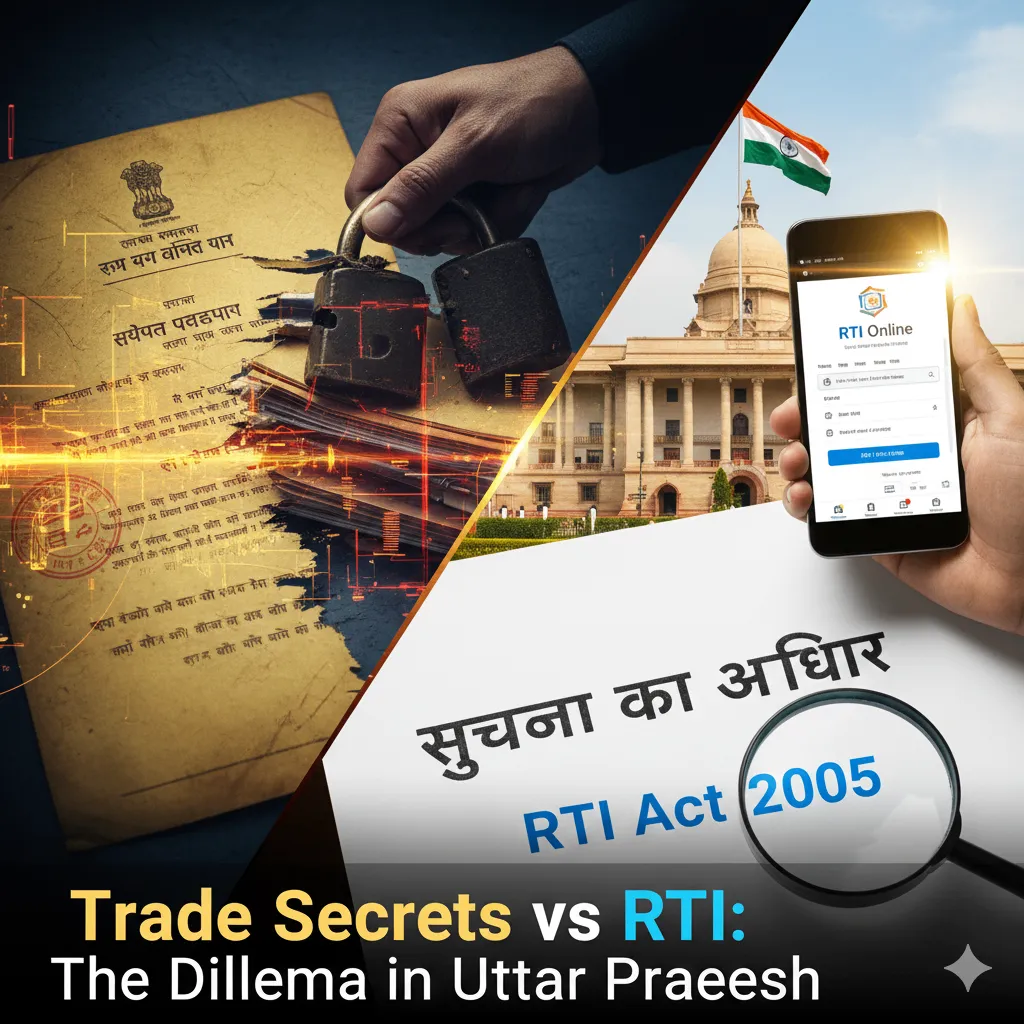
Key Takeaways (Trade Secrets vs RTI)
- A legal battle in Mirzapur questions the application of the RTI Act, particularly concerning trade secrets related to public servant postings.
- The CMO of Mirzapur misuses Section 8(1)(d) of the RTI Act to protect information that should be public, undermining transparency.
- The demand for the appellant’s motive to seek information violates Section 6(2) of the RTI Act, reviving colonial attitudes.
- Corruption risks emerge when posting details remain hidden, revealing potential over-tenure and policy violations.
- The case of Yogi M.P. Singh vs. CMO Mirzapur highlights the necessity for strict penalties under Section 20 to uphold RTI compliance.
Trade Secrets vs RTI: How Public Authorities are Sabotaging the RTI Act in Uttar Pradesh
In the heart of Mirzapur, a legal battle is unfolding that threatens to redefine—or rather, undermine—the very essence of the Right to Information (RTI) Act, 2005. The case raises critical questions about Trade Secrets vs RTI, especially when a government department claims that the transfer and posting details of public servants are “trade secrets. This is not a hypothetical scenario; it is the reality of a case currently before the Uttar Pradesh Information Commission (UPIC).
The appellant, Yogi M.P. Singh, has found himself in a digital and legal standoff with the Chief Medical Officer (CMO) of Mirzapur. At stake is not just a set of names and dates, but the survival of transparency in public health governance.
1. The Anatomy of Obstruction: Section 8(1)(d)
The core of this controversy lies in a startling legal claim by the CMO Mirzapur. In response to an RTI application seeking the posting durations and tenures of various classes of employees, the Public Information Officer (PIO) invoked Section 8(1)(d) of the RTI Act.
This specific section aims to protect “commercial confidence, trade secrets, or intellectual property.” Companies use it to safeguard their proprietary drug formulas or confidential bidding prices.By applying this to the transfer and posting of government doctors, clerks, and staff, the CMO’s office has made a mockery of the law.
Taxpayers pay public servants, and their presence in an office is a matter of public record, not a “trade secret.” This misapplication of the law suggests a desperate attempt to shield administrative irregularities from public scrutiny.
2. The Illegal Demand for “Motive”
The PIO’s written demand for the appellant to provide a “justification” or “public interest” for seeking the information is perhaps even more alarming.
This is a direct violation of Section 6(2) of the RTI Act, which explicitly states:
“An applicant making request for information shall not be required to give any reason for requesting the information…
When a PIO asks “Why do you want this?”, they are not just being curious; they are acting as a gatekeeper, attempting to intimidate citizens and filter out “inconvenient” questions. The current approach revives the colonial “Official Secrets” mindset that the RTI Act aimed to eliminate.
3. Why Posting Details Matter: The Link to Corruption
One might ask: why is the appellant so persistent about getting staff posting details? The answer lies in the State Government’s Transfer Policy.
In Uttar Pradesh, as in many states, officials transfer employees after a set number of years to prevent the formation of “vested interests” or local corruption hubs. When a public authority hides the duration of an employee’s stay, it often points toward:
- Over-tenure postings: Staff staying in lucrative positions for decades through illegal gratification.
- Policy Violations: A complete disregard for the state’s mandates on administrative rotation.
- The appellant refers to a “lucrative source of backdoor income,” where individuals buy postings instead of earning them.
By withholding these details, the CMO’s office isn’t protecting “trade secrets”; it is potentially protecting a system of administrative anarchy.
4. The Failure of the First Appellate Authority (Trade Secrets vs RTI)
The RTI Act provides a three-tier structure: the PIO, the First Appellate Authority (FAA), and the State Information Commission. In this case, the FAA—the higher-ranking officials within the Health Department—failed to rectify the PIO’s errors. This systemic failure forces citizens like Mr. Singh into long, arduous battles at the Commission level in Lucknow, effectively using “exhaustion” as a weapon against transparency.
5. Public Health Funds and Accountability (Trade Secrets vs RTI)
In a parallel appeal (Case No: A-20241102232), the stakes are even higher. The appellant has sought data regarding TB medicines and government diagnostic policies. Here, too, the PIO has used the “Commercial Confidence” shield.
Hiding information about life-saving medicines and public health expenditure isn’t just a violation of the law; it poses a significant risk to public health. Transparency in health funds ensures that the money meant for the low-income people actually reaches them in the form of medicine and diagnostics.
6. A Call for Harsh Penalties: Section 20(1) and 20(2) (Trade Secrets vs RTI)
The authorities render the RTI Act a “toothless tiger” if they do not enforce penalties. The appellant has rightly prayed for the imposition of a ₹25,000 penalty under Section 20(1) and a recommendation for disciplinary action under Section 20(2).
Without the fear of a personal fine, PIOs will continue to give “meritless” and “malicious” responses. The Commission has a duty to send a clear message: The authorities cannot treat the law of the land as a joke.
7. The Digital Leap: Paperless Governance
A notable aspect of this battle is the move toward online hearings. Conducted via the CATS UPSIC portal, these hearings represent a modern step toward paperless governance. However, technology is only a tool. If the officials remain closed to transparency, a digital hearing will be no better than a physical one. The appellant requests that the proceedings take place in a digital, eco-friendly format, aligning with. (Trade Secrets vs RTI)
Conclusion: Democracy Dies in Secrecy
The case of Yogi M.P. Singh vs. CMO Mirzapur is a litmus test for the Uttar Pradesh Information Commission. If a PIO can successfully argue that a government transfer is a “trade secret,” the RTI Act will effectively be dead.
Transparency is the hallmark of a healthy democracy. We must win the confidence of the citizenry by strengthening democratic values and holding wrongdoers accountable. We must curb the “anarchy, lawlessness, and chaos” created by arbitrary denials now, or the mockery of law will become the new norm.
Here is a comprehensive directory of the IDs, contact details, and web links relevant to your ongoing case before the Uttar Pradesh Information Commission.
1. Case Identification & Portal IDs (Trade Secrets vs RTI)
These are the unique identifiers for your appeals currently active in Court Room S-9.
| Application/Appeal Type | Registration Number | File/Diary Number |
| Main Second Appeal | A-20241102153 | S09/A/2279/2024 |
| TB/Medicines Appeal | A-20241102232 | S09/A/2284/2024 |
| Online Diary No. | D-280520250025 | — |
2. Official Contact Information (Trade Secrets vs RTI)
Use these for sending representations, rejoinders, or reminders about the PIO’s non-compliance.
State Information Commission (UPSIC)
- Presiding Officer: Smt. Shakuntala Gautam (State Information Commissioner)
- Court Room: S-9
- Email for Submissions: hearingcourts9.upic@up.gov.in
- Address: 7/7A, RTI Bhawan, Vibhuti Khand, Gomti Nagar, Lucknow – 226010
- Technical Helpline: 0522-7118629 (10 AM to 5 PM)
Respondent (Public Authority – Mirzapur) (Trade Secrets vs RTI)
- PIO (CMO Mirzapur): Dr. Lalji Gautam (or current incumbent)
- Email: cmomzp@gmail.com
- Phone (Office): 05442-252337
- PIO Mobile: 9454455171 / 9454455172
- Administrative Officer: 9151804317
3. Important Web Links
These links allow you to join hearings, track your case, or download previous orders.
- Online Hearing Portal (CATS-UPSIC):https://upsic.up.gov.in/cispu/onlinehearing/7b74a9(Note: For Microsoft Teams joiner, include your name and Case No. eg: Yogi/S09/A/2279/2024)
- Case Status Tracker:https://upsic.up.gov.in/cispu/trackstatus
- Weekly Cause List (To confirm dates):https://upsic.up.gov.in/cispu/view_weekly_cause_list
- Official RTI Portal UP:https://rtionline.up.gov.in/ (Trade Secrets vs RTI)
4. Recommended Action (Trade Secrets vs RTI)
Since today is the day of the hearing (24/12/2025), I suggest you keep your Teams App open and ready. If you are joining from a mobile device, make sure you have the Microsoft Teams app installed from the Play Store/App Store, as the browser link may not support all features on a phone.
To help you win your argument during today’s hearing, here are the specific RTI sections you should quote. These act as your “legal weapons” to dismantle the PIO’s claim that medicine expenditure or staff postings are “trade secrets.”
Key RTI Sections for Your Argument
| Section | What it Says | How to use it against the PIO |
| Section 4(1)(b) | Mandatory Proactive Disclosure. | Argue that the PIO is legally required to publish staff names, tenures, and budget spending (including TB medicines) on their website without anyone even asking for it. |
| Section 6(2) | No reason for request required. | Use this to shut down the PIO’s question: “Why do you want this information?” State that the law forbids them from asking your motive. |
| Section 8(2) | Public Interest supersedes exemptions. | Even if they claim “Commercial Confidence,” argue that the public health interest in knowing how TB funds are spent far outweighs any private interest. |
| Section 19(5) | Burden of Proof is on the PIO. | Tell the Commissioner: “The law says the PIO must prove why information should be hidden; I don’t have to prove why it should be open. |
| Section 20(1) | Mandatory Penalty. | Demand the ₹250 per day fine (up to ₹25,000) because the PIO used a “frivolous and misleading” excuse (Trade Secret) to block the law. |
Specific Rebuttals for Today’s Hearing
If the PIO says: “Medicine costs/tenders are Trade Secrets (Sec 8-1-d)”
Your Answer: “Respected Madam, Government procurement uses public tax money. The Supreme Court has ruled that taxpayers have a right to know how every rupee is spent. Procurement of TB medicines is a public welfare activity, not a private commercial venture. Section 8(1)(d) cannot be used to hide corruption in public health funds.
If the PIO says: “Transfer and Posting details are confidential”
Your Answer: “Madam, a government employee’s posting is an official act. Under Section 4(1)(b)(ix), a directory of officers and employees must be public. Hiding tenures is a violation of the State’s own Transfer Policy. Transparency is the only way to ensure the policy is being followed.”
Hearing Checklist (Trade Secrets vs RTI)
- Time: Be ready at 12:30 PM.
- Link: Click here to join the Online Hearing
- Identity: Keep your Aadhar Card or ID proof ready to show to the camera if asked.
- Recording: If the platform allows, or if you are on a laptop, you may want to take notes of exactly what the PIO says so we can counter it in the next representation.
Abhiraji Nishad: A Voice Against Illegal Alcohol in Naugaon


Facing a similar challenge? Share the details in the box below, and our team of experts will do their best to help.