
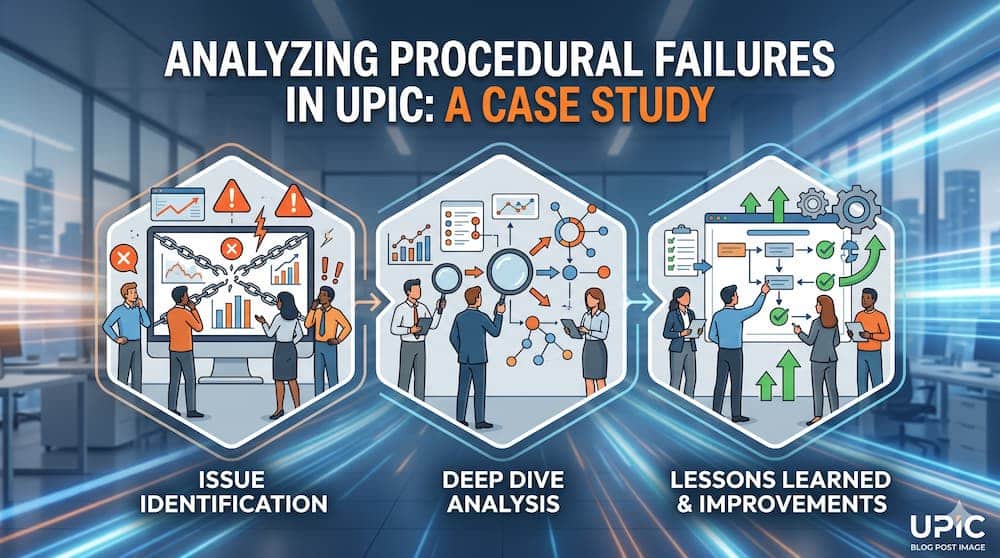
To truly understand operational inefficiencies in UPIC, we must analyse procedural failures. Moreover, analysing procedural failures in UPIC is essential for identifying the root causes of these challenges. Often, team members not only lack adequate training but also miscommunicate or follow outdated protocols. By thoroughly analysing procedural failures in UPIC, organisations can effectively update procedures, improve communication, and enhance training. This proactive approach keeps everyone engaged in finding and resolving problems, ultimately leading to better outcomes and higher-quality performance across UPIC. Furthermore, a culture of continuous improvement encourages active participation in solving deficiencies.
Key Takeaways
- Operational inefficiencies in UPIC stem from procedural failures, inadequate training, and poor communication.
- The RTI Act faces challenges from procedural irregularities that hinder citizen access to information, as illustrated in the Yogi M.P. Singh case.
- Delays in justice, mistaken dates, and ignored submissions reveal significant administrative negligence within UPIC.
- The Commission’s reliance on secondary reports and unnecessary requirements for certified documents creates barriers to accountability and transparency.
- To enhance the effectiveness of the RTI Act, it is crucial to rectify these procedural failures and ensure proper adherence to laws.
Analysing Procedural Failures in UPIC: The Transparency Trap
The Right to Information (RTI) Act of 2005 aimed to empower citizens and hold public authorities accountable through transparency. However, the case of Yogi M.P. Singh vs PIO, District Magistrate Office, Mirzapur (Appeal No. S09/A/1087/2025) reveals a troubling trend: specifically, procedural irregularities, extensive administrative delays, and ongoing jurisdictional confusion repeatedly undermine the Act. Consequently, these failures in UPIC threaten the core of the RTI Act, thereby making it harder for citizens to seek information.
1. The Anatomy of a Delayed Disposal
A major gap exists between official case disposal and actual justice. For example, the CATS portal marked the appeal as disposed of on March 10, 2026, but the appellant received the written order only on March 30, 2026—a 20-day delay. This illustrates a common procedural failure in UPIC.
These delays are not mere clerical oversights; rather, the Commission fails to provide “Speaking Orders” promptly. Consequently, without written orders, appellants lose the right to understand the grounds for disposal or to file recalls or petitions. Thus, prompt delivery is essential for justice.
2. The “30th of February” and Quasi-Judicial Negligence (Analysing Procedural Failures in UPIC)
Perhaps the official order sheet itself provides the most glaring evidence of administrative carelessness. In fact, the document includes a stenographer’s notation dated “30/02/26.” This impossible date clearly signifies how mechanically and perfunctorily high-stakes citizen appeals are being handled. Notably, February never has 30 days. When a quasi-judicial body fails to notice such basic errors in its records, it inevitably undermines public confidence in the entire adjudication process.
3. Non-Consideration of Written Submissions
A cornerstone of natural justice is the right to be heard. The records indicate that the appellant submitted a comprehensive Written Submission (WS) via email at 10:07 AM on the day of the hearing, well before the proceedings began. Despite these submissions, the final order recorded the appellant as “absent” and completely failed to address the legal arguments raised in the WS. (Analysing Procedural Failures in UPIC)
The ignored submission contained critical challenges regarding the competence of the responding authority and the validity of the evidence provided. Consequently, by overlooking these documents, the Commission effectively conducted a one-sided hearing, thereby favouring the Public Information Officer (PIO) over the citizen who was seeking transparency.
4. Jurisdictional Fraud: Agriculture vs Revenue Records
A major point of contention in this case is, indeed, the source of the information provided. Specifically, the RTI (Right to Information) application sought primary records related to the PM-KISAN application process, which, notably, are strictly the domain of the Revenue Department (Tehsil Sadar, the local revenue office for a sub-district). These records particularly include Analysing Procedural Failures in UPIC.
- Tehsil verification logs
- Field inquiry reports (स्थलीय आख्या) of the Area Lekhpal
- Duty rosters of verification officials
Instead of providing these primary records, the Commission accepted a “secondary” report from the Deputy Director of Agriculture (DDA), who is not the statutory custodian of Tehsil-level revenue logs. This report distracts from the actual custodians—the Tehsildar and SDM Sadar—creating a barrier to accountability.
5. The “Certified Khatauni” Contradiction
The department justified rejecting the PM-KISAN application by claiming the uploaded Khatauni (land record) was not “certified. However, the appellant notes that Government Order No. 83/2022/776, cited by the department, does not require a physical certified scan for online self-registration.
This creates an artificial procedural barrier. While the government promotes digital governance, local officials still demand physical certification, harassing farmers and creating loopholes to deny benefits.
6. Administrative Obstruction and the RTI Fee Burden
Even when information is granted, the Commission creates new barriers. For instance, an order dated November 13, 2025, imposes an unreasonably complex process. To obtain a certified copy of an order, applicants, therefore, must submit separate applications. Additionally, they need to pay ₹10 per page for records after inspecting the file. (Analysing Procedural Failures in UPIC)
This “pay-to-play” model for obtaining judicial records contradicts the spirit of the RTI Act. The Act emphasises that authorities must provide information free of cost or, at most, at a nominal rate when they fail in their initial disclosure duties.
7. Seeking Accountability: The Complaint to the SCIC
The State Chief Information Commissioner (SCIC) has received a formal complaint registered under No. UPICM/A/2026/60085. This complaint not only highlights entrenched failures but also demands decisive action. Consequently, we need immediate measures to rectify these violations.
- A Fresh Hearing: Consequently, set aside the flawed order of March 10 to ensure that written submissions receive due consideration. +1
- An Inquiry into Delays: Identify why the order upload was delayed by 20 days despite a mandatory 48–72 hour window.
- Penalty Proceedings: Consequently, initiating Section 20(1) proceedings against the PIO due to the 11-month delay in responding to the original application.
Conclusion (Analysing Procedural Failures in UPIC)
The Yogi M.P. Singh case exemplifies the challenges that RTI applicants face. Specifically, when tasked with upholding transparency, the Uttar Pradesh Information Commission frequently exhibits clerical errors. Moreover, it accepts secondary reports from inappropriate authorities and subsequently delays the publication of orders. Consequently, the “Right to Information” effectively transforms into a “Right to Wait.”
True transparency requires more than just disposing of a file; in fact, it demands rigorous adherence to procedural law and careful consideration of all evidence. Moreover, the swift delivery of primary records is also crucial. Consequently, addressing and analysing procedural failures in UPIC is essential to restoring the RTI Act’s effectiveness. This, in turn, ensures that it remains a powerful tool for citizen empowerment.
Based on the documents and correspondence provided, here are, accordingly, the application identifiers, as well as the contact emails, mobile numbers, and official web links for the authorities involved in your case:
1. Case and Application Identifiers (Analysing Procedural Failures in UPIC)
- Original RTI Registration Number: UPICM/R/2026/60172.
- First Appeal Registration Number: UPICM/A/2026/60085.
- Second Appeal Case Number: A-20250401292.
- Internal File Number: S09/A/1087/2025.
- Diary Number: D-100320260016.
- Original RTI Application (District Level): DMOMR/R/2025/60003.
2. Official Web Links (Analysing Procedural Failures in UPIC)
- Official UP Information Commission Website: upsic.up.gov.in.
- Direct Link for Online Hearing (Bench S-09): upsic.up.gov.in/cispu/onlinehearing/94e322.
- Order Viewing Portal: upsic.up.gov.in/cispu
3. Contact Emails (Analyzing Procedural Failures in UPIC)
| Authority / Office | Email Address |
|---|---|
| State Chief Information Commissioner | hearingcourts1.upic@up.gov.in |
| State Information Commissioner (Bench S-09) | hearingcourts9.upic@up.gov.in |
| Registrar, UP Information Commission | registrar-upic@up.gov.in |
| Secretary, UP Information Commission | sec.sic@gov.in |
| First Appellate Authority (Tejaskar Pandey) | deputysecretary-upic@up.gov.in |
| RTI Online Helpline (UP) | onlinertihelpline.up@gov.in |
| PIO Administrative Section | jansu-section.upic@up.gov.in |
| Deputy Director of Agriculture, Mirzapur | ddamzp2012@gmail.com |
| Commission Webmaster | webmaster-upic@up.gov.in |
Export to Sheets
4. Mobile and Phone Numbers (Analysing Procedural Failures in UPIC)
- Mumtaz Ahmad (PIO/Administrative Officer): 9151804317.
- Tejaskar Pandey (First Appellate Authority): 9415021746.
- UP Information Commission (General): 0522-2724945.
- First Appellate Authority Office (Direct): 0522-2724941.
- Appellant (Yogi M.P. Singh): 7379105911.


Facing a similar challenge? Share the details in the box below, and our team of experts will do their best to help.