
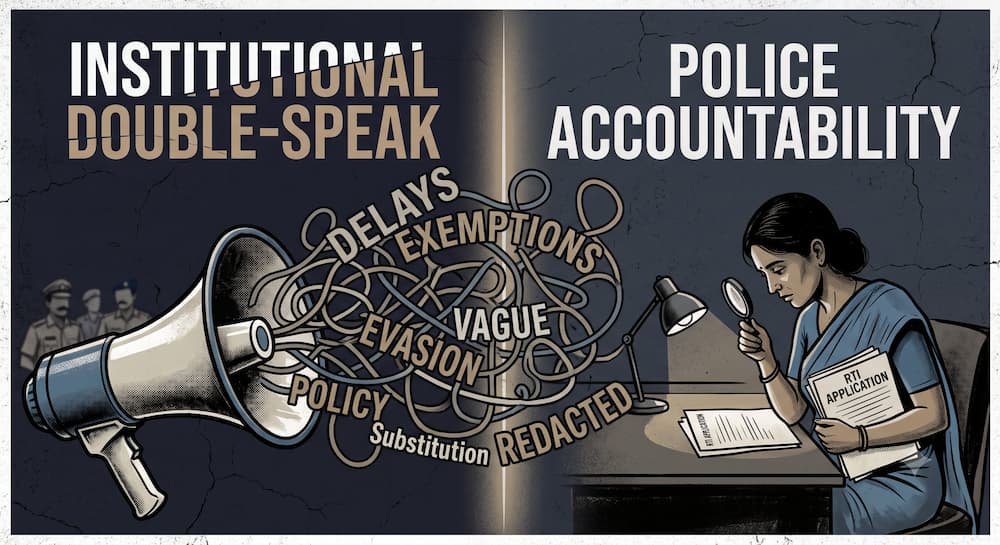
Institutional double-speak within the police force offers a sobering reflection of our society. Notably, the working styles of police personnel in the air differ significantly from their conduct at ground level, thereby leading to a disconnect between policy statements and actual practices. Consequently, this disparity raises critical questions about the accountability of our police personnel. Why, then, do they not adhere to the claims of being an accountable staff? It seems there is a considerable gap between the rhetoric we often hear in official communications and the daily realities faced by officers on the streets. Therefore, addressing this inconsistency is crucial for the integrity of law enforcement agencies. Only by fostering transparency and encouraging true accountability can we genuinely hope to bridge the divide and enhance the public’s trust in the police force.
Key Takeaways
- Institutional double-speak in police poses significant challenges for accountability and public trust.
- RTI appeals expose systemic failures and resistance in police transparency, revealing contradictions in responses.
- Key issues include misleading case metrics, conflicting legal justifications, and lack of judicial mandates.
- Lack of coordination between police divisions undermines information management and reveals operational flaws.
- Accountability advocates must exploit contradictions, demand official certifications, and document unlawful executive actions.
Institutional Double-Speak in Police: First Appeals Uncover Contradictions and Evaded Mandates in Mirzapur
The Right to Information (RTI) Act, 2005 remains a cornerstone of democratic accountability. It replaces bureaucratic opacity with administrative clarity. However, the transparency framework frequently meets structured resistance. This happens when citizens seek critical tracking metrics from law enforcement authorities. Consequently, this resistance manifests as vague, boilerplate summaries. It also appears as the evasion of policy tracking. Furthermore, different arms of the same department apply conflicting legal exemptions. This reveals a clear pattern of institutional double-speak in police operations.
On 4 July 2026, two formal First Appeals were officially registered. Specifically, these were filed against the Superintendent of Police Office, Mirzapur. In particular, filed by appellant Sita Devi, these appeals target the Public Information Officer (PIO) Rajkumar Meena (ASP Operation). Notably, the appeal registration numbers are SPMZR/A/2026/60049 and SPMZR/A/2026/60050. Moreover, these filings follow a highly flawed and defensive disposal of original inquiries. Importantly, those inquiries regarded criminal investigations and emergency responses under Police Station Kotwali Dehat.
An analytical breakdown of these appeals exposes deep-seated systemic patterns. It highlights internal procedural friction. It also exposes questionable executive interventions within the local police administration.
Institutional Double-Speak in Police: Structural Fractures in Police Transparency
An examination of the department’s responses reveals three primary systemic failures. Moreover, these failures highlight the reality of institutional double-speak in police communications:
- The Substitution of General Policy with Case Metrics: First, the police repeatedly omit official guidelines when asked for systemic rules, circulars, or standard timelines. Instead, they substitute them with historical event updates to give the illusion of compliance.
- Inter-Departmental Information Clashes: Furthermore, different wings of the same public authority frequently issue conflicting legal justifications to withhold data. As a result, they directly invalidate each other’s arguments.
- Executive Action Without Judicial Mandate: Finally, local station officials openly admit to taking high-handed actions, such as halting construction work. Yet, they fail to provide any legal or court-ordered backing for those decisions.
Procedural Friction and Information Clashes Between Police Divisions
The most striking revelation from the filed appeals is the complete lack of coordination and transparency. This gap exists between the UP-112 Emergency System Headquarters and the Kotwali Dehat Police Station. Therefore, a public authority compromises the integrity of its information management system when it uses conflicting statutory logic across its sub-divisions. This clearly exemplifies institutional double-speak in police handling of public queries.
Fabricated Safety Exemptions Exposed (Institutional Double-Speak in Police)
The appellant requested the names and designations of emergency responders who attended a property dispute on Plot No. 31, Mauza Nakahara. In response, the UP-112 division aggressively refused to share officer identities. Specifically, the in-charge claimed that disclosing the names would directly threaten public order and personal security. This restriction applied to the personnel on PRV 8588 and PRV 5228.
However, the Kotwali Dehat Police Station report completely contradicted this claim. This report laid bare the institutional double-speak in police exemption policies. In their concurrent report, the local station inspector directly named the responding officers for PRV 5228. These were Head Constable Rajesh Ram and Home Guard Vimlesh Bind. By disclosing these identities, the local station proved that the UP-112 division applied safety exemptions baselessly to hide public records. They did so without any threat to public order. Meanwhile, the identities of the responders on PRV 8588 remain hidden.
Shifting Accountability and Uncertified Logs
In addition, the two divisions engaged in a classic bureaucratic runaround regarding field data ownership. For instance, Kotwali Dehat disclaimed all responsibility for the UP-112 emergency logs. They simply directed the applicant to look elsewhere. (Institutional Double-Speak in Police)
The UP-112 unit did produce internal Computer-Aided Dispatch (CAD) system printouts confirming critical facts. These logs showed that the opposition destroyed a wall and stole construction materials. However, the department failed to legally certify the documents with a signature and seal. Consequently, this omission leaves the documents legally inadmissible. This renders the data practically useless for judicial enforcement.
Evasion of Systemic Timelines and Policy Frameworks
Another layer of institutional double-speak in police administration involves the complete omission of regulatory policy documents. This includes guidelines governing police misconduct and tracking.
Concealing Investigation Rulebooks (Institutional Double-Speak in Police)
For example, the appellant demanded a certified copy of the official circular, standing order, or citizen charter. This document should define the maximum timeframe for an Investigating Officer (IO) to execute a site inspection (Mauka Muayana) and record statements after an FIR registration. However, the department completely evaded the request for systemic statutory rules. Instead, they substituted a brief case history. This text merely stated that Sub-Inspector Umashankar Yadav visited the location within 24 hours of receiving the assignment. Thus, the actual policy tracking rules remain hidden.
The “Free Time” Admission on Public Safety
Even more concerning is the response regarding preventive mandates under Sections 126 and 135 of the Bharatiya Nagarik Suraksha Sanhita (BNSS), 2023. The appellant asked for the standard operating guidelines dictating how quickly the police must act against an active threat to life post-FIR. In response, the local station in-charge recorded a startling admission in writing. (Institutional Double-Speak in Police)
The report stated that preventive actions under Sections 126 and 135 were initiated only after completing other government tasks (“अन्य कार्य सरकार से फुर्सत मिलने पर”). This delay directly compromises citizens‘ life and liberty. Therefore, this text establishes that local law enforcement treats critical preventive safety protocols as conditional upon discretionary availability. They do not treat them as a statutory obligation.
Unauthorized Executive Intervention and Blocked Data Trails (Institutional Double-Speak in Police)
The final issue centers on executive overreach. It also highlights the complete withholding of supervisory tracking sheets.
Halting Construction Without Judicial Mandate
Under Point 5 of application number SPMZR/R/2026/60260, the appellant requested a copy of any civil or revenue court stay order produced by the opposition. This order would allegedly justify halting her construction work. In response, the Kotwali Dehat Inspector acknowledged that a civil lawsuit is pending before the Court of the Junior Division, Mirzapur. However, the report openly admitted that the police halted the construction work independently. They did so under the guise of maintaining law and order. They failed to show any written judicial mandate or injunction.
Total Suppression of Supervisory Logs (Institutional Double-Speak in Police)
Similarly, the department also denied all physical logs regarding administrative oversight. The appellant explicitly requested certified copies of the tracking sheets, instructions, or trails logged by the Circle Officer (CO) or SP. This request targeted the progress tracking of FIR No. 0289/2026. However, the police omitted these documents entirely. Instead, they vaguely stated that senior officers monitor the case from “time to time. They provided no physical evidence of the tracking trail.
Key Takeaways for Accountability Advocates
The First Appeals filed before the Appellate Authority, Aparna Rajat Kaushik, highlight critical lessons for navigating institutional double-speak in police departments:
- Exploit Internal Contradictions: First, when one police division names personnel while another claims an exemption for the same event, it proves the legal exemption is groundless.
- Demand Official Certification: Next, uncertified digital portal printouts do not meet statutory standards. Therefore, advocates must insist on signed and sealed copies.
- Expose Executive Excess: Finally, forcing the police to admit on record that they halted private construction without a formal court stay order provides vital documentation for civil litigation.
The same pattern of institutional double-speak resurfaces whenever an applicant specifically asks for the investigation report and case diary of police. Investigation Report and Case Diary of Police: How Concealment Happens Under RTI breaks down exactly how that concealment works and why it doesn’t hold up legally.
Based on the official records and filings, here is the structured layout of the application tracking IDs, personal contact records, and the administrative digital details for the concerned public authorities:
1. Application & Appeal Tracking Identification (Institutional Double-Speak in Police)
Case A: Investigation Timelines & Regulatory Mandates (Institutional Double-Speak in Police)
- Original RTI Registration Number: SPMZR/R/2026/60272
- First Appeal Registration Number: SPMZR/A/2026/60049
- Associated Police Case Reference: FIR No. 0289/2026 (Police Station Kotwali Dehat, District Mirzapur)
- RTI Filing Date: 11 June 2026
- First Appeal Filing Date: 04 July 2026
Case B: Land Encroachment, Demolition, & Emergency Services (Institutional Double-Speak in Police)
- Original RTI Registration Number: SPMZR/R/2026/60260
- First Appeal Registration Number: SPMZR/A/2026/60050
- Associated Digital Grievance ID: IGRS / Jansunwai Portal Ref No. GOVUP/E/2026/0070938
- Associated Emergency Event IDs (UP-112 System): Event No. P03062600087 and Event No. P03062600169
- RTI Filing Date: 04 June 2026
- First Appeal Filing Date: 04 July 2026
2. Personal Contact Records of the Applicant (Institutional Double-Speak in Police)
- Name: Sita Devi
- Registered Email Address: sitadevimzp1987@gmail.com
- Registered Mobile Number: +91-9984665354
- Residential Address: Village and Post Nakahara, Pincode: 231001, State: Uttar Pradesh
3. Administrative Directory & Contact Details of Public Authorities (Institutional Double-Speak in Police)
The table below catalogs the designations, official communication metrics, and portal addresses for the designated public transparency officers in the Superintendent of Police Office, Mirzapur:
| Authority Tier | Officer Name | Corporate Designation | Official Email Address | Registered Phone Number |
| First Appellate Authority (FAA) | Aparna Rajat Kaushik | Superintendent of Police (SP), Mirzapur | spmzr-up@nic.in | 9473567333 |
| Public Information Officer (PIO) | Rajkumar Meena | Assistant Superintendent of Police (ASP Operation) | aspopmzp@gmail.com | 9473567333 |
| Nodal / Liaison Officer | Rajkumar Meena | Additional Superintendent of Police / Nodal Officer | addlspopmzr@gmail.com | 9473567333 |
4. Public Authority Web Link Systems
To trace, monitor, or execute subsequent rejoinders for these tracking entries, use the following official state portals: (Institutional Double-Speak in Police)
- RTI Online Tracking System (Uttar Pradesh):rtionline.up.gov.in
- Purpose: Used to monitor the disposal trail of original requests (
60272/60260) and check the formal listing status of First Appeals (60049/60050) before the SP Office.
- Purpose: Used to monitor the disposal trail of original requests (
- Integrated Grievance Redressal System (IGRS Jansunwai Portal):jansunwai.up.nic.in
- Purpose: Used to access background action logs, view closure notes, or escalate extensions for the property dispute grievance under ID
GOVUP/E/2026/0070938.
- Purpose: Used to access background action logs, view closure notes, or escalate extensions for the property dispute grievance under ID
- Uttar Pradesh Police Citizen Portal:uppolice.gov.in
- Purpose: Used to download formal copies of FIR No. 0289/2026 registered at Police Station Kotwali Dehat under the Bharatiya Nyaya Sanhita (BNS).


Facing a similar challenge? Share the details in the box below, and our team of experts will do their best to help.