
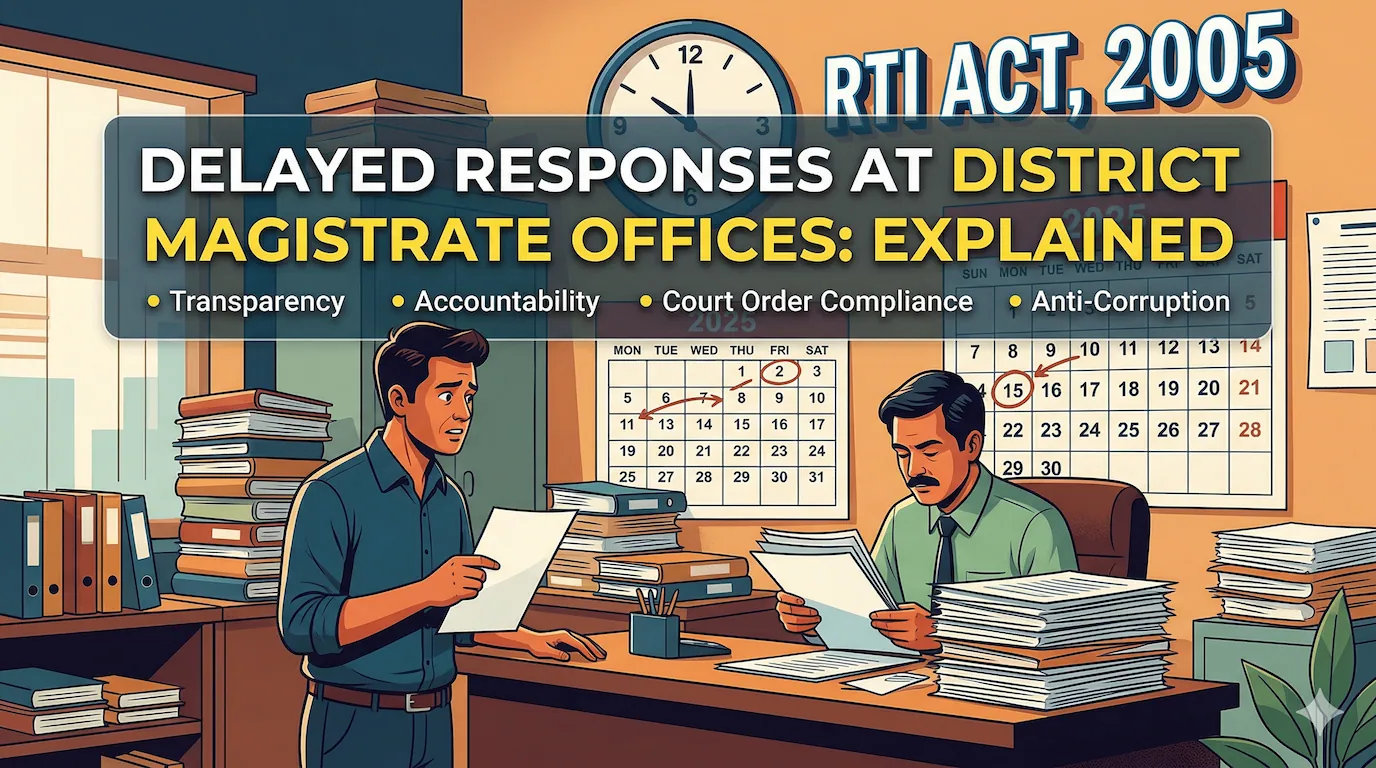
Key Takeaways (Delayed Responses at District Magistrate)
- Transparency in Administrative Processes:
The appellant’s RTI queries highlight the need for clear documentation and disclosure regarding the receipt and compliance of court orders by government officials. These issues often arise in cases involving Delayed Responses at District Magistrate offices. - Accountability for Delays:
Seeking information about the time taken for compliance and mechanisms to address delays underscores the importance of holding public officials accountable for timely execution of judicial directives. - Addressing Corruption:
The request for details about complaint authorities and anti-corruption measures reflects the necessity for robust systems to report and curb corruption within administrative processes. - Service Records for Oversight:
Obtaining posting details of the concerned Lekhpal demonstrates the relevance of maintaining and sharing service records for scrutiny and transparency. - Government Initiatives:
The demand for information on government measures and circulars to prevent corruption points to the expectation that authorities should proactively implement and communicate anti-corruption policies. - Upholding RTI Objectives:
The blog emphasizes that providing the requested information is crucial for upholding the spirit and objectives of the Right to Information Act, thereby fostering public trust and effective governance.
Delayed Responses at District Magistrate: A Reflection on Accountability in Public Administration
Introduction
The government enacted the Right to Information Act, 2005, to promote transparency and accountability in the functioning of public authorities. However, the recent case involving Office, Mirzapur, underscores persistent challenges in the timely provision of information, raising concerns about the effectiveness of the Act in ensuring responsible governance. (Delayed Responses at District Magistrate)
Background of the Case
- Applicant: Yogi M P Singh
- RTI Application Registration Number: DMOMR/R/2025/60023
- Date of Filing: 25th February 2025
- Public Authority: District Magistrate Office, Mirzapur
- Public Information Officer (PIO): Hemant Kumar, Tehsildar
Mr. Singh submitted an RTI application seeking crucial information regarding the compliance of a court order by the Lekhpal of Village Panchayat Babura, among other points related to transparency and anti-corruption measures within the Tehsil Sadar.
Core Issue: Non-Response within Statutory Timeframe (Delayed Responses at District Magistrate)
Despite the statutory obligation under Section 7(1) of the RTI Act, which mandates the PIO to respond within 30 days of receipt of the application, Mr. Singh did not receive any information even after one month and 23 days had passed. This led him to file a first appeal (Registration Number: DMOMR/A/2025/60046) on 19th April 2025, citing “No Response Within the Time Limit” as the ground for appeal.
Legal Framework
Section 7(1) of the RTI Act, 2005, clearly states:
The Central Public Information Officer or State Public Information Officer, as the case may be, on receipt of a request under section 6 shall, as expeditiously as possible, and in any case within thirty days of the receipt of the request, either provide the information on payment of such fee as may be prescribed or reject the request for any of the reasons specified in sections 8 and 99.
Information Sought by the Applicant (Delayed Responses at District Magistrate)
Certainly. Based on the details provided regarding the First Appeal under Section 19(1) of the Right to Information Act, 2005, the following is an appropriate continuation of the blog, maintaining a formal and informative tone:
Next Part of the Blog: Legal Framework and Expected Actions
The appellant’s grievance centres on the non-compliance with the statutory timeline mandated under Section 7(1) of the Right to Information Act, 2005. The Act clearly stipulates that the Public Information Officer (PIO) must respond to an RTI application within 30 days of receipt. In the present case, the applicant submitted the application on 25th February 2025, but as of 19th April 2025, they have received no response. This delay not only contravenes the provisions of the RTI Act but also undermines the principles of transparency and accountability in public administration.
Responsibilities of the Appellate Authority
Upon receipt of the First Appeal, it becomes the duty of the concerned Appellate Authority, in this instance, Mr. Asha Ram Verma, to adjudicate the matter expeditiously. The Appellate Authority is empowered to: (Delayed Responses at District Magistrate)
- Direct the PIO to furnish the requested information without further delay.
- Initiate disciplinary proceedings against the PIO for failure to comply with the statutory timeline.
- Ensure that mechanisms are in place to prevent such lapses in future.
Relief Sought by the Appellant (Delayed Responses at District Magistrate)
The appellant has justifiably requested:
- Immediate disclosure of the information sought under six specific points related to the compliance of a court order by the Lekhpal of Babura, the mechanism to address delays, details regarding complaints of corruption, and measures adopted to curb corruption.
- Disciplinary action against the PIO for violating Section 7(1) of the RTI Act.
Importance of Timely Response under RTI
The essence of the RTI Act lies in its commitment to uphold the citizen’s right to know and to foster a culture of openness in governance. Any delay or denial in providing information not only frustrates the purpose of the Act but also erodes public trust in the system. It is imperative for public authorities to prioritise RTI requests and ensure strict adherence to the prescribed timelines. (Delayed Responses at District Magistrate)
Conclusion (Delayed Responses at District Magistrate)
The present case exemplifies the challenges faced by citizens in seeking information from public authorities. It is the responsibility of the Appellate Authority to uphold the sanctity of the RTI Act by ensuring prompt redressal of grievances and by holding erring officials accountable. Only through strict enforcement and proactive transparency can the objectives of the RTI Act be truly realized.
Analysis of the Information Sought under RTI Application
The appellant has requested information on six distinct points, each pertaining to the compliance of a court order and the functioning of the Tehsil Sadar, Mirzapur. These points reflect the appellant’s concerns regarding administrative transparency, accountability, and the mechanisms in place to address delays and corruption. A detailed analysis of each point is as follows: (Delayed Responses at District Magistrate)
1. Date and Time of Receipt of Court Order by Lekhpal (Delayed Responses at District Magistrate)
The appellant seeks to know the exact date and time at which the concerned Lekhpal received the court order dated 13th September 2024. This information is crucial for establishing the compliance timeline. It also helps in assessing whether any undue delay occurred in the execution of the order.
2. Time Taken by Lekhpal for Compliance
The second point requests details regarding the duration taken by the Lekhpal to comply with the court’s directive. Transparency in this aspect is essential to evaluate the efficiency and promptness of administrative action following judicial intervention. (Delayed Responses at District Magistrate)
3. Mechanism for Action Against Delay (Delayed Responses at District Magistrate)
The appellant highlights that more than five months have passed. During this time, the concerned Lekhpal has not submitted the required report. As a result, information is sought about the specific mechanism available within the Tehsil. This mechanism would address how to take action against officials who cause undue delays in complying with court orders. This includes any applicable rules, procedures, or disciplinary measures.
4. Authority for Complaints of Corruption
The fourth point seeks the name of the staff member(s) in Tehsil Sadar. It also asks for their designation. These members are authorised to receive complaints related to corruption. This is specifically in compliance with court orders. This information is vital for citizens who wish to report malpractice and ensure accountability.
5. Posting Details of Lekhpal Babura (Delayed Responses at District Magistrate)
The appellant requests comprehensive posting details of the Lekhpal of Babura village. This includes the date of joining the Mirzapur district. The appellant also seeks the first posting details. Additionally, they want to know the district where the Lekhpal initially joined service. Such information helps in tracing the service history and may be relevant in cases where administrative conduct is under scrutiny.
6. Government Measures to Curb Corruption
The appellant seeks details of measures adopted by the government to curb corruption. This request is made in compliance with court orders. It includes requests for circulars, office memoranda, government orders, and manuals. These documents are available in Tehsil Sadar and outline the steps taken to address and prevent corruption. (Delayed Responses at District Magistrate)
Significance of the Sought Information
Each point of information sought by the appellant is directly linked to promoting transparency. These points also ensure timely compliance with judicial orders. Additionally, they enhance accountability within the public authority. The failure to provide such information violates the RTI Act. It also raises concerns about the effectiveness of internal mechanisms. These mechanisms are meant to prevent administrative arbitrariness and corruption.
Conclusion (Delayed Responses at District Magistrate)
The appellant’s queries are well-founded and aligned with the objectives of the Right to Information Act, 2005. It is the Public Information Officer’s responsibility to ensure this information is provided promptly. The Appellate Authority also has a responsibility in this matter. Appropriate action must be taken to address the issues raised. Only through such responsiveness can public trust in administrative processes be maintained.
Thank you for providing the details. Below is a formal summary of the contact information for the concerned public authorities related to your RTI appeal:
- Registration Number: DMOMR/A/2025/60046
- Name of Applicant: Yogi M P Singh
- Date of Filing: 19/04/2025
- Status: RTI APPEAL RECEIVED as on 19/04/2025
First Appellate Authority (FAA) Details (Delayed Responses at District Magistrate)
- Name: Asha Ram Verma
- Designation: SDM Sadar
- Phone Number: 9454416810
- Email ID: sdm-sadar.mi@up.gov.in
Nodal Officer Details
- Name: Shiv Pratap Shukla
- Email ID: adm.fr.mi-up@gov.in
If you require further assistance or wish to follow up on your application, you may contact the above-mentioned officials via the provided phone number or email addresses. For additional information, you may also visit the official government portal relevant to your district or department.
Below are the official web links for your reference:
District Administration, Mirzapur, Uttar Pradesh
- Official District Website: https://mirzapur.nic.in/
Contact Information for SDM Sadar (First Appellate Authority):
- You may find further details and contact information on the district website’s Contact Directory.
RTI Portal, Government of Uttar Pradesh: (Delayed Responses at District Magistrate)
- RTI Online Portal: https://rtionline.up.gov.in/
For any official communication or status updates regarding your RTI appeal, you may utilize these web links. If you require direct access to any specific department or officer’s page, please let me know, and I will assist you further.


Facing a similar challenge? Share the details in the box below, and our team of experts will do their best to help.