
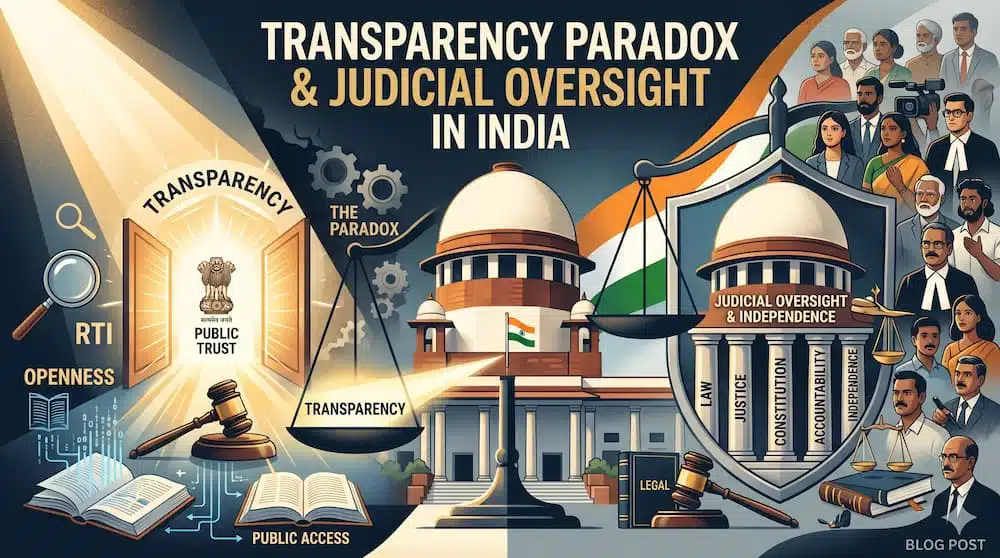
Transparency Paradox and the Complexities of Judicial Oversight in India: An In-Depth Examination of Accountability Mechanisms and Public Access to Justice. This exploration delves into the intricate relationship between transparency in judicial processes and the oversight responsibilities of the judiciary in India. It highlights the challenges faced by citizens in accessing information regarding judicial mandates, particularly in the context of police accountability and the implementation of landmark rulings. The ongoing struggle for transparency calls into question a robust framework that ensures judicial decisions are not only made but also effectively monitored and enforced at all levels of governance.
Key Takeaways
- The article explores the Transparency Paradox & Judicial Oversight in India, focusing on citizens’ difficulties in accessing judicial information.
- The RTI case highlights a ‘transparency gap’ between judicial mandates and their administrative fulfilment, especially regarding police accountability.
- The Supreme Court’s Lalita Kumari ruling requires FIR registration, but implementation often falters due to bureaucratic failures.
- The Central Information Commission now faces a critical decision on defining judicial records versus administrative oversight documents.
- This case underscores the need for transparency to ensure that we effectively monitor and enforce landmark judicial decisions.
Transparency Paradox & Judicial Oversight: RTI, Judicial Oversight, and the Battle for Police Accountability
Transparency Paradox & Judicial Oversight: Few judgements in Indian jurisprudence resonate as profoundly with the common citizen as Lalita Kumari v. Govt of U.P. (2014). This landmark ruling established a crucial mandate: police are required to register an FIR when a complaint reveals a cognisable offence. Nevertheless, a recent RTI confrontation involved a citizen named Sh. Yogi M P Singh and the Supreme Court of India Registry has exposed a significant “transparency gap” between judicial mandates and their actual administrative execution.
This case, pending before the Central Information Commission (CIC) under Diary Number 628506, raises a fundamental question: When the Supreme Court issues a mandate for the public good, is the monitoring of that mandate a judicial secret or an administrative record open to the public?.
1. The Core Conflict: Judicial Record vs. Administrative Oversight
The primary flashpoint in this RTI dispute is the classification of information. When the appellant requested details on “Compliance Reports” filed by the State of Uttar Pradesh regarding FIR registrations, the CPIO of the Supreme Court denied the request.
The Registry’s stance is that any information related to the Lalita Kumari case—even compliance data—is a “Judicial Record.” Under this logic, such documents can only be accessed through the Supreme Court Rules, 2013, which require a formal application for certified copies, often involving a demonstration of “locus standi” (personal interest in the case).
Conversely, the appellant argues that “Compliance Reports” and “Monitoring Mechanisms” are administrative functions. The Registry holds these records to ensure that courts follow the orders nationwide. By labelling these as judicial, the public authority effectively shields systemic data from the RTI Act’s transparency requirements.
2. The Breakdown of the Compliance Chain
This RTI application is necessary because of a startling discovery at the grassroots level. Documents from the Senior Superintendent of Police (SSP), Mirzapur, dated late 2025, revealed a massive administrative failure.
The district police office stated that the mandatory FIR advisory—issued by the Ministry of Home Affairs (MHA) following the Supreme Court’s orders—was never received in District Mirzapur.
- The MHA Advisory (Oct 2015): Was meant to be the bridge between the Court’s ruling and the local police station.
- The Reality in Mirzapur: A decade after the judgement, local authorities claim the instructions are missing from their registers.
This “lost in transit” defence by local police necessitates transparency from the top. If the Supreme Court is the ultimate guardian of fundamental rights, the public has a right to know what administrative mechanisms exist to catch these failures.
3. The BNSS Transition and the “Zero FIR” Dilemma
The timing of this RTI is critical due to India’s transition to the Bharatiya Nagarik Suraksha Sanhita (BNSS), 2023. With the repeal of the old Code of Criminal Procedure (CrPC), there is legitimate public concern regarding whether the Lalita Kumari protections remain intact.
One specific concern is the status of the “Zero FIR.” Previously viewed largely as an administrative advisory, the appellant sought clarification on whether it is now a mandatory judicial requirement under the new legal framework. The CPIO refused to provide this information, citing a lack of jurisdiction to “interpret the law.” While a CPIO cannot provide legal opinions, the refusal to disclose whether the Court has issued new circulars regarding the BNSS transition leaves a vacuum of information during a period of massive legal upheaval.
4. Procedural Hurdles: The RTI “Run-Around”
The trajectory of this case illustrates the procedural fatigue often faced by RTI activists:
- CPIO Rejection (Feb 28, 2026): Information denied on the grounds of “Judicial Records” and “Scope of Duty.”
- FAA Dismissal (March 24, 2026): The First Appellate Authority (FAA) upheld the rejection without addressing the distinction between administrative oversight and judicial adjudication.
- The Missing Hearing: Notably, the FAA noted the appellant’s absence from the video conference hearing. While procedural, this instance highlights the difficulty of navigating high-level appeals from districts like Mirzapur.
The FAA’s reliance on the Central Information Commission decision (2020)—which states that judicial records can only be accessed through Court Rules—effectively creates a barrier where the RTI Act is superseded by internal Court procedures.
5. Why the Second Appeal Matters
The successful filing of the Second Appeal (Diary No. 628506) brings this issue before the CIC. The Commission now has the opportunity to define the boundary between a “Judicial Record” and an “Administrative Oversight Document.”
If the CIC rules in favour of disclosure, it could set a precedent requiring the Supreme Court Registry to be more transparent about how it monitors the enforcement of its landmark judgements. This is not just about one citizen in Mirzapur; it is about ensuring that when the highest court in the land speaks, the administrative machinery cannot hide the “Compliance Reports” behind a veil of judicial secrecy.
Conclusion: Justice Must Not Only Be Done, But Be Tracked
The Lalita Kumari mandate was designed to prevent police high-handedness and ensure that every victim has their day in court. However, as Sh. Yogi M.P. Singh’s RTI demonstrates, a judgement is only as strong as its implementation.
By seeking data on the monitoring mechanisms and the transition to the BNSS, this RTI challenge addresses accountability directly. Transparency is the only way to connect a “landmark judgement” on paper with a registered FIR at a local police station. Transparency advocates are now watching the CIC to see if they will open the way to administrative accountability within the halls of justice.
Based on the documents provided, here are the identification and contact details for the public authorities and individuals involved in this RTI matter:
1. Central Public Information Officer (CPIO) (Transparency Paradox & Judicial Oversight)
- Public Authority: Supreme Court of India. +1
- Name & Designation: S.K. Kamesh Nookala, Additional Registrar & CPIO.
- Address: Supreme Court of India, Tilak Marg, New Delhi-110001.
- Diary Number (Application ID): 4517/RTI/25-26/SCI. +1
2. First Appellate Authority (FAA) (Transparency Paradox & Judicial Oversight)
- Public Authority: Supreme Court of India.
- Name & Designation: Ms Aarti Singh, Registrar-cum-First Appellate Authority. +2
- Address: Tilak Marg, New Delhi-110001. +1
- Appeal Number: 136/2026. +1
3. Senior Court Assistant (Transparency Paradox & Judicial Oversight)
- Name: Manan Arora.
- Designation: Senior Court Assistant, working with the Ld. Registrar/Appellate Authority.
4. Uttar Pradesh State Police (Mirzapur) (Transparency Paradox & Judicial Oversight)
- Public Authority: Office of the Senior Superintendent of Police (SSP), District Mirzapur. +1
- Designation (PIO): Om Prakash Singh, Public Information Officer / Additional Superintendent of Police (Operations). +1
- Appeal Registration Numbers: * S09/A/1630/2025 (Registration No: A-20250700617). +1
- S09/A/1015/2025 (Registration No: A-20250400289). +1
- SPMZR/A/2025/60020. +1
5. State Information Commission
- Authority: Uttar Pradesh State Information Commission.
- Presiding Officer: Shakuntala Gautam, State Information Commissioner (Hearing Room S-9).
6. Weblinks and Portals (Transparency Paradox & Judicial Oversight)
- Supreme Court Official Website: www.sci.gov.in. +1
- Supreme Court RTI Portal: https://registry.sci.gov.in/rti_app. +1
- Supreme Court Video Conferencing (Cisco Webex): https://sci-vc.webex.com/sci-vc/j.php?MTID=m7cf81afc336b61efb0c9b652cab48bd4.
- Central Information Commission (CIC): www.cic.gov.in. +1
7. Appellant Details (As recorded in files) (Transparency Paradox & Judicial Oversight)
- Name: Sh. Yogi M P Singh. +2
- Mobile Number: 7379105911. +2
- Email ID: yogimpsingh@gmail.com


Facing a similar challenge? Share the details in the box below, and our team of experts will do their best to help.