
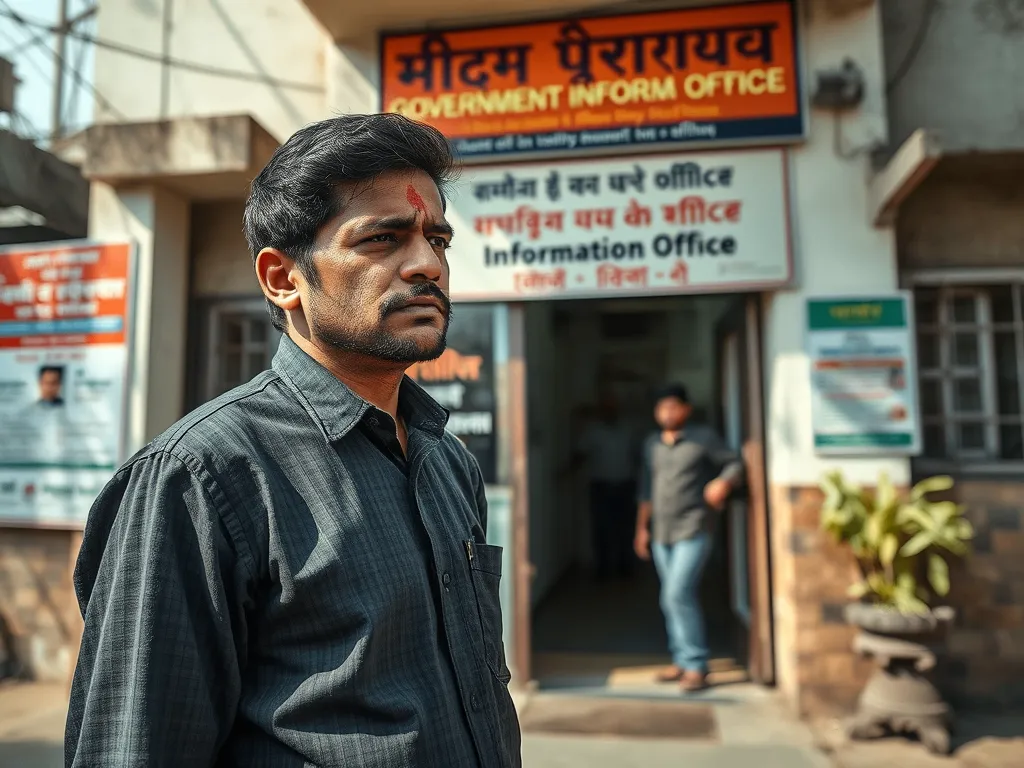
Escaping accountability often leads to a cycle of negligence and poor governance, particularly in areas like Tehsil Sadar. Local leaders may avoid responsibility, resulting in unchecked decisions that affect communities. This creates a significant gap in trust and transparency, undermining efforts to foster development and ensure equitable growth for residents.
Escaping Accountability at Tehsil Sadar Mirzapur: Key Takeaways from the RTI Battle
This blog post exposes officials in Tehsil Sadar, Mirzapur, openly defying transparency laws with impunity.
Moreover, the case highlights three critical issues:
- Evading Legal Mandates: Public Information Officer Hemant Kumar ignores explicit orders of the Uttar Pradesh Information Commission and withholds staff posting and transfer data without justification.
- The refusal to share information clearly violates the New Transfer Policy. Staff remain in key roles beyond permitted terms, creating local power monopolies.
- The case escalated from a simple RTI request to a Second Appeal, with officials repeatedly skipping hearings. This reveals an administrative culture that shields staffing irregularities from public transparency.
This blog post criticises local authorities for refusing to share implementation documentation, rendering state policies powerless in Mirzapur. It highlights how local authorities openly defy the RTI Act.
Accountability in democracy relies on information. In Tehsil Sadar, Mirzapur, officials evade it. The case of Yogi M.P. Singh v. the Public Information Officer highlights disregard for Commission orders and refusal to disclose staff postings.
The Core of the Dispute: A Request for Accountability
The dispute began when Yogi M.P. Singh filed an RTI seeking detailed staff information at Tehsil Sadar, covering four main points:
- Senior Staff Details: Posting history and service commencement dates for Class I and Class II employees.
- Clerical Staff (Class III): Duration of stay in Mirzapur and details of the districts from which they were transferred.
- Support Staff (Class IV): Service timelines and transfer histories.
- Policy Compliance: The request sought proof of the step-by-step implementation of the New Transfer Policy from the Uttar Pradesh government. Hemant Kumar refuses to provide the requested information, escalating the case to a Second Appeal (A-20241100263) before the State Information Commission.
Escaping Accountability at Tehsil Sadar: The “Runaway” Official and Defiance of the Information Commission
On April 30, 2025, Hon’ble State Information Commissioner Shakuntala Gautam led a hearing in Room S-9. The findings were clear. Despite receiving notice by email, the PIO of Tehsil Sadar chose not to attend. Furthermore, the Commission noted a prior notice sent on March 21, 2025, directing the disposal of the application. Consequently, a critical question emerges: why is the Tehsildar escaping accountability by refusing to? When officials at Tehsil Sadar hide posting and transfer dates, they signal a deliberate strategy of escaping accountability. In essence, they fear exposing staff who have stayed in powerful positions for years in breach of transfer rules. Or years in breach of transfer rules.
The New Transfer Policy: A Paper Tiger?
The Uttar Pradesh government often updates its Transfer Policy. The aim is to prevent vested interests and power monopolies in administrative blocks. The policy requires staff rotation every three to five years.
- Transfers out of home districts or specific zones for certain cadres.
- Transparency in “attachments” and temporary postings.
If the Tehsildar’s office at Tehsil Sadar does not explain its implementation of the policy, then the policy is meaningless.
The Role of the SDM in Ending Escaping Accountability at Tehsil Sadar
The Tehsildar is the PIO, but the Sub-Divisional Magistrate (SDM), Asha Ram Verma, is responsible for supervision. The SDM cannot ignore the State Information Commission’s orders while a subordinate office misbehaves.
If the Tehsildar fails, the SDM must intervene; the RTI Act 2005 mandates it. Authorities must not tolerate evasion at any level. Silence from both offices signals a systemic failure in Mirzapur’s administration.
To outsiders, posting and transferring details may seem minor. certificates, and local justice – lack of transparency hurts ordinary citizens. (Escaping Accountability & Tehsil Sadar)
- Preventing Corruption: Long tenures can make staff gatekeepers. may use their positions to demand bribes for routine tasks.
- Checking Nepotism: Transparency shows if authorities favour certain employees. “Prime” postings should not go to favourites, regardless of policy. of Law: Transparency ensures that government orders are followed and not selectively ignored.
- A new hearing is set for July 17, 2025. This is not just about the Tehsildar—it tests whether evading accountability is possible in Uttar Pradesh’s transparency framework.
When authorities treat RTI requests as optional, they undermine the Act’s foundation. The appellant’s plea — “O God help me” — shows the frustration citizens feel when officials ignore them.
The government must ensure that Tehsil Sadar follows the New Transfer Policy and stops officials from hiding behind delays and non-attendance. Transparency, here are the official contact details for the authorities mentioned in your appeal.
1. Uttar Pradesh Information Commission (UPIC) (Escaping Accountability & Tehsil Sadar)
This body hears your second appeal. Send all case correspondence (A-20241100263) here.
- Office Address: 7/7 A, RTI Bhawan, Vibhuti Khand, Gomti Nagar, Lucknow, UP – 226010.
- Website: upic.gov.in
- Email: webmaster.upic@gmail.com / scic.up@up.nic.in
- Helpline Number: 0522-2724930
- Court S-9 Email: hearingcourts9.upic@up.gov.in (As per your documents)
2. Public Information Officer (Tehsildar Sadar, Mirzapur)
Tehsildar Hemant Kumar’s office is the main subject of your grievance.
- Office Address: Tehsildar Office, Tehsil Sadar, District Mirzapur, Pin – 231001.
- Official CUG Mobile: 9454417672 (Standard CUG for Sadar Tehsildars in UP) or 9454417833 (Mirzapur specific).
- Official Email: teh-sadar.mi@up.gov.in / tehsilsadar025@gmail.com
- Office Phone: 05442-220188
3. Sub-Divisional Magistrate (SDM Sadar, Mirzapur) (Escaping Accountability & Tehsil Sadar)
SDM Asha Ram Verma is the supervising and first appellate authority.
- Office Address: SDM Office, Sadar, District Mirzapur, Uttar Pradesh.
- Official CUG Mobile: 9454417573 (Standard CUG for SDM Sadar).
- Official Email: sdm-sadar.mi@up.gov.in
- Administrative Helpline: 05442-252801 (City Magistrate/General Admin).
4. Online RTI Portal (For Filing/Tracking)
File a fresh complaint or report non-compliance with the government transfer policy here.
- Web Link: rtionline.up.gov.in
- Technical Helpline: 0522-7118629
- Technical Email: onlinertihelpline.up@gov.in
When emailing authorities, always CC the District Magistrate (dm-mi@up.gov.in / 9454417567) and the Information Commission. This ensuresyour communication is tracked by higher offices. (Escaping Accountability & Tehsil Sadar)
Given the legal framework and record, the Uttar Pradesh Information Commission faces serious questions about its ability to ensure information provision, particularly in light of complex procedural interactions in the recent case closure. The Commission’s Statutory Obligation. Under the RTI Act 2005, the Information Commission holds the power to ensure compliance through several mechanisms: Directing Disclosure: The Commission can specifically require a public authority to take steps to secure compliance, such as providing access to the requested information.nformation.
- Imposing Penalties: If a PIO fails to provide information without a good reason or denies a request with malice, the Commission imposes a penalty of ₹250 per day, up to a maximum of ₹ 25,000. Litigability of Decisions: Section 19(7) of the Act states that the Information Commission’s decision is binding.g.
2. Analysis of Your Specific Case (You say the PIO did not provide information, but the Commission’s September 2, 2025, order reports a different procedure. This is a different procedure.
- The Commission closed your appeal not because officials gave the information, but because neither party attended the hearings.mit. Conclusion of “Lack of Interest”: Because of this absence, the Commission concluded you were no longer interested in the case. Consequently, it finalised the matter without taking further enforcement action against the Tehsildar.ainst the Tehsildar.
3. Has the Commission “Failed”? (Escaping Accountability & Tehsil Sadar)
From a legal standpoint, the Commission would argue it fulfilled its duty by scheduling hearings and providing a forum for the appeal. Even so, your grievance highlights a deeper systemic gap:
- Non-Compliance by PIO: The records show that Tehsildar Hemant Kumar also failed to appear and actively ignored previous directions to provide. Lack of Proactive Enforcement: Critics often argue that Commissions fail when they close cases due to “appellant absence” instead of proactively penalising PIOs. This is especially problematic when the Commission has already found those PIOs in initial default.itial default.
Your Legal Remedy: (Escaping Accountability & Tehsil Sadar)
If you believe the information was wrongly denied and the Commission should not have closed the case, you can:
- File a Restoration Application: Formally ask the Commission to reopen the case by explaining why you were unable to join the hearings.
- Report Non-Compliance: If a specific order was previously passed directing the Tehsildar to give you info, and he didn’t, you can file a separate complaint for non-compliance under Section 18.
- High Court Writ: If the Commission’s order is perceived as “perverse” or illegal, you can challenge it in the Allahabad High Court under Article 226.
The gravity of this situation cannot be overstated. When a Public Information Officer — a public servant — systematically ignores the summons of a statutory body like the State Information Commission, he directly undermines the rule of law.
Under the RTI Act 2005, the Commission holds the same powers as a Civil Court for summoning and enforcing the attendance of persons. Yet the PIO remained absent from multiple hearings — April 30 and September 2, 2025 — suggesting a profound lack of fear regarding administrative or legal consequences.
Analysis of the Administrative Failure (Escaping Accountability & Tehsil Sadar)
The Commission’s failure to compel the PIO’s presence carries several critical implications:
- Undermining Statutory Authority: By not appearing, the Tehsildar directly challenges the Commission’s authority. In doing so, he treats the hearing as optional rather than mandatory.
- Procedural Imbalance: Various orders and notices dating back to February 2025 directed the PIO to provide the information. Nevertheless, he neither appeared nor submitted a written statement. (Escaping Accountability & Tehsil Sadar)
- Closure Without Enforcement: The final order disposed of the appeal due to the appellant’s “lack of interest.” Notably, the Commission did not penalise the PIO for his documented defiance of previous orders.
- The “Double Default”: In this case, the PIO defaulted on his duty to provide information and then on his duty to answer the court. Despite this double failure, the Commission closed the case without releasing the information.
Powers the Commission Could Have Invoked (Escaping Accountability & Tehsil Sadar)
To ensure the presence of a public servant, the Commission has the power to:
- Issue Summons: Legally mandate the officer’s presence.
- Impose Penalties: Section 20 of the RTI Act provides for a penalty of ₹250 per day, up to a maximum of ₹25,000, for obstructing the flow of information.
- Recommend Disciplinary Action: Against the officer for persistent non-compliance.
- Issue Bailable Warrants: In extreme cases of defiance, though this is rarely used.


Facing a similar challenge? Share the details in the box below, and our team of experts will do their best to help.