
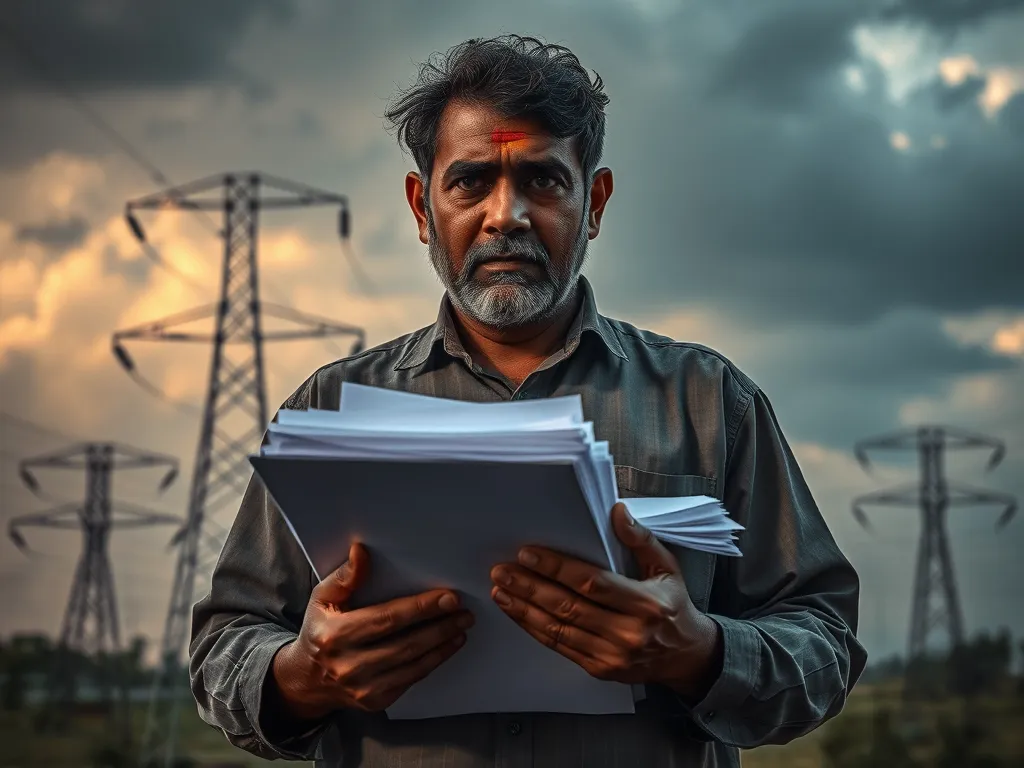
The electricity theft case involving Kamlesh Singh has garnered significant attention due to its implications for energy security and legal accountability. Investigations reveal a network of unauthorised connections that not only result in financial losses for utility companies but also pose safety risks to the community. Legal proceedings are ongoing.
Key Takeaway — Electricity Theft Case & Kamlesh Singh:
Bureaucratic negligence and weak penalties destroy the rule of law. This case reveals three major failures in the Mirzapur Electricity Department:
- Officials ignored orders and RTI mandates, blocking transparency.
- Electricity theft was proven. The department fined ₹2,17,746 under Section 135 but failed to recover the funds, resulting in a direct loss to the state.
- The system failed Kamlesh Singh. He got arbitrary bills for property that the accused occupies, punishing the whistleblower and letting the offender go free.
This post delivers a simple truth: laws matter only when enforced. Without holding officials accountable, corruption and abuse of power will win.
This structured blog post analyses Kamlesh Singh’s ongoing administrative and legal struggle against systemic negligence within the electricity department of Mirzapur, Uttar Pradesh.
Electricity Theft Case & Kamlesh Singh: The Fight for Accountability Against RTI Negligence and Administrative Apathy in Mirzapur
Transparency is the backbone of good public utility governance. The Kamlesh Singh electricity theft case (GOVUP/E/2025/0067294) shows that bureaucratic delays and ignored orders break the rule of law. This case exposes Kamlesh Singh, trapped in proven theft, random billing, and an ignored RTI by Purvanchal Vidyut Vitaran Nigam Limited (PVVNL), Mirzapur.
1. The Core Conflict: Theft vs Arbitrary Billing
The genesis of this electricity theft case & Kamlesh Singh’s grievance lies in a confirmed instance of power theft. Following an enquiry, the Junior Engineer established that Dileep Singh (S/O Raghuvar Dayal Singh) was committing electricity theft. Consequently, the department registered an FIR under Section 135 of the Electricity Act 2003.
A property dispute complicates matters. Kamlesh Singh alleges Dileep Singh has “grabbed” the premises. Despite this, EDD II at Fataha, Mirzapur, continues to send arbitrary bills in Kamlesh Singh’s name, making him liable for a property he does not control, while the perpetrator remains unpunished.
2. The RTI Mockery: Defying Senior Orders
The biggest issue is the Executive Engineer’s open defiance of the law. The Superintending Engineer ordered officials to give Mr Singh information on the theft case. Yet Mr Manish Kumar Shrivastava and his predecessors ignored the RTI application (PUVNL/R/2022/60294).
The RTI Act is crucial in a democracy. When an Executive Engineer ignores senior orders, it is a clear violation and institutional indiscipline that breaks public trust.
3. Understanding Section 135 of the Electricity Act 2003
Section 135 targets electricity thieves who use muscle power.
- Criminal Liability: It prescribes imprisonment for up to three years, a fine, or both.
- Pecuniary Penalty: In this specific case, a penalty of ₹2,17,746.00. Although the department issued a recovery notice, the complainant confirms that officials have made no progress in collecting the dues.o progress in collecting the dues.
4. Kamlesh Singh’s Constitutional. In this case of electricity theft, Kamlesh Singh invokes Article 51A of the Constitution of India, which sets out citizens’ Fundamental Duties. Specifically, by demanding an enquIn this case of electricity theft, Kamlesh Singh invokes Article 51A of the Constitution of India, which sets out citizens’ Fundamental Duties.legal occupations.er” in illegal occupations.
Why has the ₹2.17 lakh penalty gone uncollected since 2021? The department’s failure costs the state and encourages further crimes.
5. Current Status of the Electricity Theft Case & Kamlesh Singh’s Road Ahead
On June 18, 2025, the Joint Secretary at the Chief Minister’s Secretariat, Shri Arvind Mohan, received the case. This escalation underscores the Mirzapur authorities’ failure to resolve it.
Key Demands for Resolution:
- 1. Provide a transparent progress report on the FIR and criminal proceedings against Dileep Singh.
- 2. Supply evidence showing recovery of the ₹2,17,746 penalty as ordered by the department.
- 3. Immediately stop billing Kamlesh Singh for the premises occupied by the accused and correct the billing records accordingly.
- 4. Conduct a formal inquiry into the Executive Engineer EDD II’s non-compliance with direct orders and RTI mandates.
Conclusion: What the Electricity Theft Case & Kamlesh Singh Teach Us
Kamlesh Singh’s long fight puts the Uttar Pradesh electricity department’s “Ease of Living” and “Zero Tolerance” claims to the test. Theft and penalties should be addressed swiftly, not left unresolved at the victim’s expense.
The CM Secretariat is watching EDD II, Mirzapur. For Kamlesh Singh and others trapped in similar cases, the law must win over muscle power and bureaucracy.
Based on your grievance details and the official directory of Purvanchal Vidyut Vitaran Nigam Limited (PuVVNL), here are the contact details for the specific public authorities concerned with your case in Mirzapur and the state headquarters.
1. Mirzapur District Authorities (Directly Concerned)
These officials are responsible for the EDD II (Fataha, Mirzapur) division, where the billing and theft issues originated.
| Chief Engineer (Mirzapur Zone) | Jayanti Prasad Narayan Singh | 9450963509 | ce.mirzapur@puvvnl.in |
| Superintending Engineer (EDC Mirzapur) | Ram Das | 9415304000 | se.mirzapur@puvvnl.in |
| Executive Engineer (EDD II Mirzapur) | Manish Kumar Srivastava | 9450963598 | ee.2mirzapur@puvvnl.in |
| Nodal Officer (RTI – PuVVNL) | Sandeep Kumar Verma | 9453047544 | rtipuvvnl@gmail.com |
2. High-Level Appellate & Administrative Authorities
Since your grievance has been forwarded to the Chief Minister’s Secretariat, these are the higher authoritieswho oversee the accountability of the Mirzapur division:
- Shri Arvind Mohan (Joint Secretary)
- Contact Number: 0522-2226350
- Address: Room No. 321, U.P. Secretariat, Lucknow
- Email: arvind.12574@gov.in
- Managing Director (PuVVNL Varanasi)
- Name: Shambhu Kumar, IAS
- Contact Number: 0542-2318437
- Email: md@puvvnl.in
3. Key Web Links for Follow-up
- Official PuVVNL Directory: puvvnl.in/en/article/mirzapur-map
- UP RTI Online Portal: rtionline.up.gov.in (For tracking/filing appeals if the local office remains unresponsive)
- UP Jan Sunwai (Grievance Tracking): jansunwai.up.nic.in
Critical Summary of Your Identifiers:
- Grievance Reg No: GOVUP/E/2025/0067294
- RTI Reg No: PUVNL/R/2022/60294
- Primary Issue: Non-recovery of ₹2,17,746 penalty and arbitrary billing under Section 135.
The electricity department often delays penalty recovery, even after theft is proven. The problem comes from legal complexity, administrative lapses, and local power dynamics.
Based on the legal framework of Section 135 of the Electricity Act 2003 and the procedural realities in Uttar Pradesh (PuVVNL), here are the primary reasons for such delays:
1. The “Civil vs. Criminal” Bottleneck (Electricity Theft Case & Kamlesh Singh)
Section 135 treats electricity theft as a criminal offence. The ₹2,17,746 amount is the department’s civil liability. The department often waits for the Special Court’s judgment before pursuing recovery. If the criminal case is slow, penalty recovery stalls as well.alls.
- The accused may have filed a stay or appeal in the Special Court or High Court. This legal action prevents the department from taking any property attachment or other steps.
2. Administrative Complicity and “Muscle Power” (Electricity Theft Case & Kamlesh Singh)
Your grievance explicitly mentions “muscle power.” In many cases, local-level procrastination is not accidental:
- Collusion: Lower-level staff (like those in EDD II Mirzapur) may be influenced or intimidated by the accused.
- Wilful Negligence: By failing to recover the penalty, officials actively protect the wrongdoer from financial ruin. Indeed, this is why you correctly noted that ignoring a senior’s direction (the Superintending Engineer) is a form of institutional “indIf the initial paperwork (the “Panchnama” or the Inspection Report) contains even minor technical errors, the department’s legal cell often advises against immediate recovery to avoid a “wrongful loss” lawsuit. The recovery to avoid being sued for “wrongful loss.”
- In your case, billing you for a property that someone else occupies suggests flawed records. Moreover, officials may avoid recovery to prevent acknowledging Dileep Singh’s possession — since doing so would force them to correct your bills, an action they clearly seem reluctant to take.
4. Lack of Enforcement Resources
Recovering such large amounts requires the department to coordinate with the Revenue Department (Tehsil) to issue a “Recovery CertificatThe Electricity Department sends the request to the District Collector/Tehsildar to recover the amount as “Arrears of Land Revenue.” However, this hand-off between two departments often buries files for years unless senior officials apply constant pressure. pressure.
5. RTI Evasion as a Shield (Electricity Theft Case & Kamlesh Singh)
By refusing to provide you with the “Progress Report” via RTI, the officials actively hide whether they have even initiated the recovery process. In other words, if they have not sent the notice to the Tehsildar, disclosing that information would expose their own negligence — hence the “mockery of the law” you described.
Pro-Tip for your Next Move: (Electricity Theft Case & Kamlesh Singh)
Since your grievance is now with the Chief Minister’s Secretariat, you should specifically ask for a “Point-wise Status of the Recovery Certificate (RC).” Furthermore, if you need support, I can draft a specific “Demand for Recovery Status” letter that you can send directly to the Mirzapur District Magistrate, who oversees the Tehsildar’s recovery actions.
Related: Electricity Theft in Mirzapur: Unpaid Penalties Exposed


Facing a similar challenge? Share the details in the box below, and our team of experts will do their best to help.