
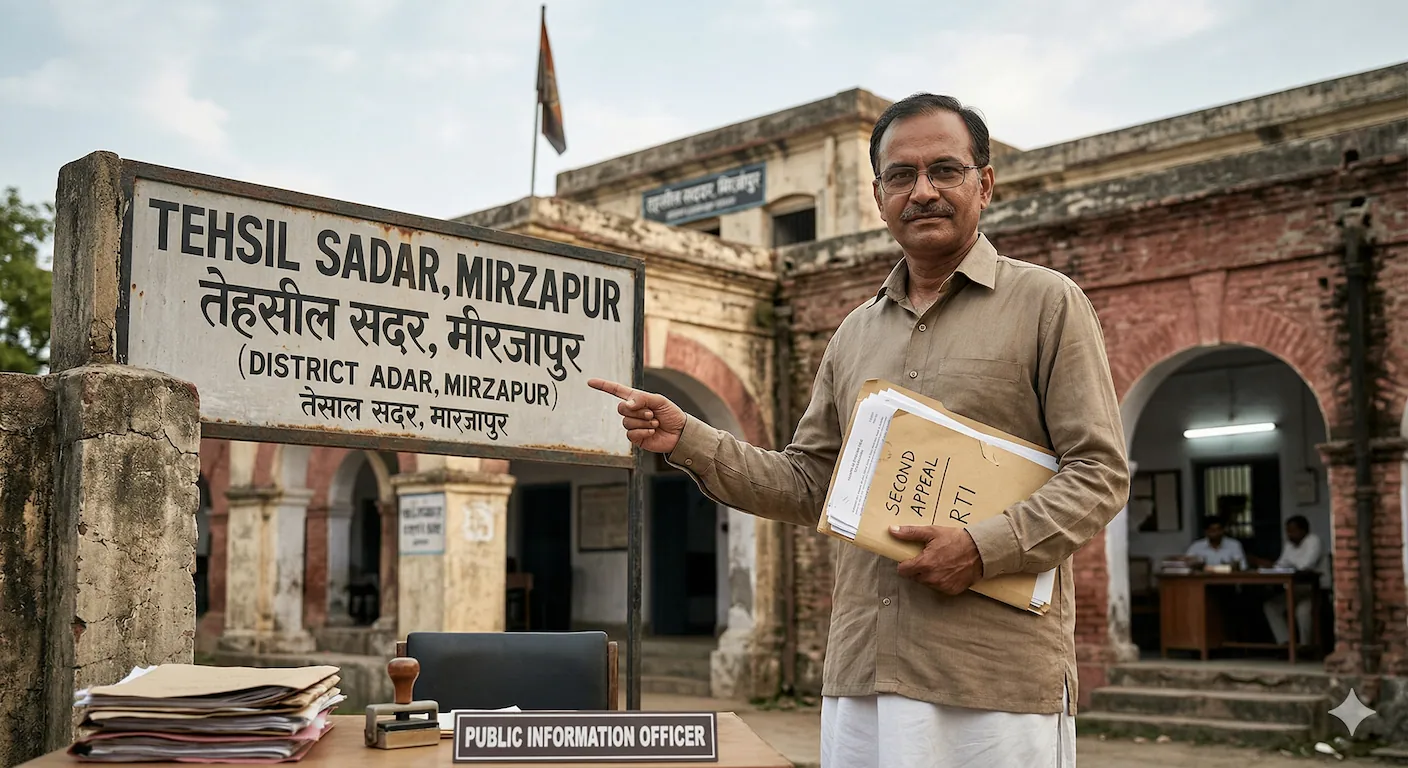
Second Appeal & Tehsil Sadar Corruption: A Citizen’s Fight Against Administrative Corruption in Mirzapur
By Yogi M. P. Singh, Surekapuram Colony, Jabalpur Road, Mirzapur City. This article discusses issues related to Second Appeal & Tehsil Sadar Corruption.
Mobile: 7379105911 | Email: yogimpsingh@gmail.com
Key Takeaways (Second Appeal & Tehsil Sadar Corruption)
- The article discusses a citizen’s fight against administrative corruption in Mirzapur under the Right to Information (RTI) Act.
- It highlights the objectionable conduct of a Lekhpal who allegedly demanded bribes and verbally abused an aggrieved citizen.
- The author filed an appeal with the Uttar Pradesh Information Commission challenging the denial of information by the Tehsildar Sadar.
- Despite evidence of corruption, the local administration’s evasive responses raise legal and ethical concerns.
- The piece urges the Commission to ensure transparency and accountability in public service. It emphasizes the need for justice in the face of corruption.
Introduction: The Struggle for Accountability
In a healthy democracy, the Right to Information (RTI) Act, 2005 serves as the strongest shield. It protects citizens against administrative apathy. I recently moved the Uttar Pradesh Information Commission. My appeal (Appeal No: A-20241102395) challenges the blatant denial of information. This denial was by the Public Information Officer (PIO)/Tehsildar Sadar of Mirzapur. This case, registered under file S09/A/2119/2024, is more than just a personal grievance. It is a fight for the integrity of public service. (Second Appeal & Tehsil Sadar Corruption)
The Core Issue: Misconduct and Alleged Corruption (Second Appeal & Tehsil Sadar Corruption)
The genesis of this appeal lies in the unprofessional and allegedly corrupt behavior of a regional Lekhpal, Divyanshu Srivastava. On August 23, 2024, an aggrieved citizen, Narendra Singh, faced obscene verbal abuse and threats. The Lekhpal threatened him after he refused to provide a “party” (bribe) for land-related work.
Despite having audio recordings of this misconduct, the local administration has remained silent. My RTI application sought five specific points of information:
- Action Taken Reports on representations sent to the SDM Sadar, District Magistrate, and Chief Minister.
- Official Notings regarding these complaints.
- Identification of Staff responsible for processing these grievances.
- Verification of Evidence, specifically whether the submitted audio recordings were ever examined.
Administrative Obstruction and the “Fresh Data” Excuse
The response from the Tehsildar Sadar was a textbook example of administrative evasion. The request was rejected under Rule 4(2)(b)(i), claiming that providing this information would require the “collection of fresh data. (Second Appeal & Tehsil Sadar Corruption)
This reasoning is logically flawed and legally untenable. A representation submitted to a public office is a legal record. To claim that providing a status report is “collecting fresh data” is problematic. Stating official notings on a filed complaint as “collecting fresh data” signals a critical issue. It suggests that the Tehsil office does not maintain records of the grievances it receives. This is a terrifying prospect for governance.
Procedural Lapses: The Speed Post Controversy (Second Appeal & Tehsil Sadar Corruption)
During the Commission hearing on January 23, 2025, a significant procedural error occurred. I presented three speed post receipts as evidence of communication with the SDM, DM, and Chief Minister:
- EU245009345IN (SDM Sadar)
- EU245009230IN (District Magistrate)
- EU245009226IN (Chief Minister)
The presiding officer misinterpreted these receipts. He thought they were addressed to the Superintendent of Police, Mirzapur. This was based solely on a postal counter label. Such errors in documentation undermine the credibility of the judicial process and further delay the delivery of justice.
Legal and Ethical Concerns
The PIO’s blanket denial is a violation of Section 7(1) of the RTI Act. Transparency is not a favor granted by the state; it is a statutory right. The administration refuses to disclose who is handling these files. It is also unclear whether the audio evidence of corruption has been heard. By doing so, the administration is effectively shielding misconduct. (Second Appeal & Tehsil Sadar Corruption)
A Plea for Justice (Second Appeal & Tehsil Sadar Corruption)
I have urged the Uttar Pradesh Information Commission to:
- Correct the Record: Re-examine the dispatch evidence to acknowledge that the representations reached the correct authorities.
- Compel Disclosure: Direct the PIO to provide point-wise information as per the law.
- Enforce Accountability: Initiate disciplinary proceedings against the PIO for the unlawful denial of information.
Conclusion: Restoring Faith in the System (Second Appeal & Tehsil Sadar Corruption)
This fight is not merely about a single Lekhpal or a single RTI application. It is about whether the common man in Mirzapur can expect justice when faced with corruption. We cannot allow “administrative indifference” to become the norm.
Let truth and justice prevail.
To “put light” on this matter means to expose the gap between the legal obligations of public officials. It also reveals the reality of administrative resistance in Mirzapur.
Based on the documentation provided, here is a detailed breakdown of the information sought. It includes the legal grounds for the appeal. It also addresses the specific discrepancies involving the Tehsil Sadar office.
1. The Information “In the Dark”
The core of your RTI (Right to Information) request focuses on accountability for a specific incident of alleged corruption. You are seeking five critical “lights” of transparency:
- The Action Taken Report (ATR): It shows the actions the SDM Sadar took. These actions were in response to the complaint about the Lekhpal’s conduct.
- The “File Notings”: Officials made internal remarks as your complaint moved. It traveled from the Chief Minister’s office and DM’s office down to the Tehsil level.
- The Identity of Processors: The names of the specific staff members currently sitting on these files.
- Evidence Verification: The administration must confirm if they have listened to the audio recording of Lekhpal Divyanshu Srivastava. The recording allegedly contains demands for a “party” and use of abusive language.
2. Deconstructing the PIO’s Rejection (Second Appeal & Tehsil Sadar Corruption)
The Public Information Officer (PIO) rejected your request. The officer cited Rule 4(2)(b)(i). They claimed the information would require “fresh collection of non-available data.”
The Reality:
- A complaint filed with a public authority is a Public Record.
- Under the RTI Act, an ATR or a File Noting is “existing information.”
- Claiming this data is “non-available” suggests one of two things. The office might have lost the records. Alternatively, they could be intentionally suppressing the paper trail to protect the accused staff.
3. The “Postal Receipt” Error at the Commission
A critical point of light must be shed on the hearing held on 23/01/2025. The presiding officer’s misinterpretation of the Speed Post receipts is a significant procedural hurdle.
| Receipt Number | Intended Recipient | Interpretation Error |
| EU245009345IN | SDM Sadar, Mirzapur | Mistakenly attributed to SP Mirzapur |
| EU245009230IN | District Magistrate | Mistakenly attributed to SP Mirzapur |
| EU245009226IN | Chief Minister, UP | Mistakenly attributed to SP Mirzapur |
Note: This error is crucial. It allows the Tehsildar to claim they “never received” the documents. This claim justifies their lack of action.
4. Legal Pillars of Your Fight
Your appeal rests on two fundamental legal principles: (Second Appeal & Tehsil Sadar Corruption)
- Section 7(1) of RTI Act 2005: Requires the PIO to provide information or a valid rejection within 30 days. A “blanket denial” without a logical nexus to the law is a violation.
- Right to Reason: As you noted, the “Right to Reason” is an indispensable part of a sound administrative system. A citizen has the right to know why their evidence (the audio recording) is being ignored.
Summary of the Conflict
The situation highlights a classic case of administrative stonewalling. The office refuses to provide the names of the staff as mentioned in Point 4. It also refuses to acknowledge the audio record in Point 5. These actions maintain a “veil of secrecy” over the Lekhpal’s alleged misconduct. (Second Appeal & Tehsil Sadar Corruption)
To ensure your documentation is complete and easily accessible, I have compiled all the critical Application IDs. I also included contact details for the officials involved and the relevant web links from your records.
1. Case Registration & Application IDs (Second Appeal & Tehsil Sadar Corruption)
These numbers are essential for tracking your status on the UP RTI and Information Commission portals.
| Description | Registration / File Number |
| RTI Application ID | DMOMR/R/2024/60085 |
| First Appeal ID | DMOMR/A/2024/60051 |
| Second Appeal (UPIC) Reg. No. | A-20241102395 |
| UPIC Case File Number | S09/A/2119/2024 |
| Hearing Room | S-9 (Scheduled for 23/01/2025) |
2. Official Contact Directory
These are the mobile numbers and emails for the officers responsible for handling your representations and RTI appeals. (Second Appeal & Tehsil Sadar Corruption)
| Authority / Name | Mobile Number | Official Email Address |
| Tehsildar Sadar (PIO) | 9454416823 | teh-sadar.mi@up.gov.in |
| SDM Sadar (FAA) | 9454416810 | sdm-sadar.mi@up.gov.in |
| Nodal Officer (ADM FR) | 9454417638 | adm.fr.mi-up@gov.in |
| UPIC Registrar | 0522-2724930 | registrar-upic@up.gov.in |
| Hearing Court S-9 | — | hearingcourts9.upic@up.gov.in |
3. Essential Web Links
Use these links to check the current status of your applications or to upload further evidence. (Second Appeal & Tehsil Sadar Corruption)
- UP RTI Online Portal (Status Tracking):rtionline.up.gov.in
- Use this to track DMOMR/R/2024/60085 and the First Appeal status.
- UP Information Commission (UPIC):upsic.up.gov.in
- Use this to view the cause list and orders for your Second Appeal (A-20241102395).
- Mirzapur District Official Directory:mirzapur.nic.in
- For verified contact details of other district-level administrative officers.
4. Summary of Speed Post Evidence (For Correction) (Second Appeal & Tehsil Sadar Corruption)
When you communicate with the Commission regarding the “misinterpreted” receipts, refer to these specific tracking IDs:
- SDM Sadar:
EU245009345IN - District Magistrate:
EU245009230IN - Chief Minister, UP:
EU245009226IN
Would you like me to draft a “Statement of Fact” document for you to email to hearingcourts9.upic@up.gov.in ahead of your next interaction with the Commission?


Facing a similar challenge? Share the details in the box below, and our team of experts will do their best to help.