
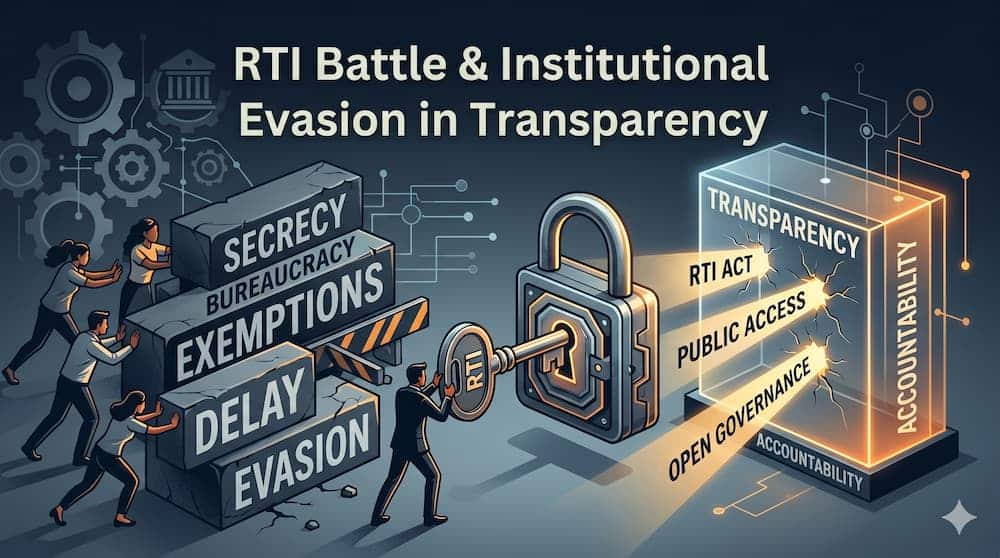
RTI Battle & Institutional Evasion in Transparency are quite frequent in the Mirzapur district. The local government offices often encounter numerous requests for information under the Right to Information (RTI) Act, yet there is a pattern of evasion. Officials may delay responses, provide incomplete information, or even deny requests on dubious grounds, leading to frustration among the citizens. This lack of transparency undermines accountability and breeds distrust in governmental institutions. Activists and residents are continuously striving to navigate this challenging landscape, advocating for their rights and pushing for systemic changes to ensure that access to information is guaranteed and respected in the region.
Key Takeaways
- The RTI Battle & Institutional Evasion are prevalent in Mirzapur, with officials often delaying or denying information requests.
- Citizens face challenges due to administrative hurdles, such as the ongoing case of Yogi M. P. Singh vs the Electricity Department.
- The department’s responses often involve technical obstructions, making it difficult for citizens to obtain necessary information.
- The Uttar Pradesh Information Commission has noted persistent non-compliance by the Public Information Officer, complicating the RTI battle.
- The appellant seeks penalties under Section 20(1) of the RTI Act, emphasising the necessity to confront institutional evasion.
The RTI Battle Against Institutional Evasion: A Case Study in Mirzapur
The Right to Information (RTI) Act was designed to empower citizens, but as seen in the ongoing case of Yogi M. P. Singh vs the Electricity Department, Mirzapur, administrative hurdles often test the limits of transparency. This case is a classic example of how the RTI battle and institutional evasion become intertwined, highlighting how public authorities can use technicalities to obstruct the flow of information. +2
1. The Core Dispute: A Request for Accountability
The grievance stems from a 6(1) application seeking transparency regarding the electrical connections of Mr Tarak Nath Yadav. Within this dispute, issues of institutional evasion and the ongoing RTI battle are clear. The appellant alleges a systemic failure: a second connection was reportedly provided to an individual despite heavy outstanding dues on the premises, which should have legally barred such a connection. +3
The specific information sought includes:
- Connection details and latest bills for the premise. +1
- Documentation regarding the disconnection of previous legitimate lines. +1
- Service records (joining and posting dates) of specific departmental personnel, such as Junior Engineer Kisan Lal Sharma. +1
2. The Department’s Response: Technical Obstruction
On April 9, 2026, the Executive Engineer of the Mirzapur division provided a response that the appellant characterises as a “standard tactic for evasion.” This is yet another stage in the ongoing RTI battle against a pattern of institutional evasion. +1
- The “Connection Number” Barrier: The department claimed that providing details is “impossible” without a specific connection number. This argument ignores the fact that public utility databases are indexed by consumer name and physical address, both of which were provided. +1
- The Personnel Pivot: Regarding the Junior Engineer, the department simply stated he is “not currently working” at that office. This directly bypasses the request for his historical posting dates and joining records. +1
3. Institutional Delay and Commission Intervention
The Uttar Pradesh Information Commission has noted a pattern of non-compliance by the Public Information Officer (PIO). Such persistent institutional evasion is a central concern in the RTI battle. +2
- Repeated Absences: The PIO failed to appear or provide evidence during hearings on January 12 and February 18, 2026. This form of evasion further complicates the RTI battle.
- The Final Warning: Commissioner Shakuntala Gautam issued a final opportunity for the PIO to comply, warning that further delay would lead to “advance orders” and potential penalties.
4. The Appellant’s Stand: Uncovering Ulterior Motives
In a formal representation submitted on May 12, 2026, the appellant argued that the department’s refusal is not a technical limitation but a deliberate cover-up. Such instances underline the need to confront RTI battle scenarios as well as persistent attempts at institutional evasion. +1
If the department is issuing bills for the premises, it possesses the connection details. By denying the information, they shield the fact that a second connection was improperly handled while heavy dues remained.
The appellant is now pushing for the invocation of Section 20(1) of the RTI Act, which allows for the imposition of financial penalties on officers who knowingly provide incomplete or misleading information. This legal provision is critical where the RTI battle and elements of institutional evasion intersect.
5. Current Status: For Further Hearing
As of the latest update, the case remains active under Appeal No: S09/A/1037/2025. While the portal shows a future status of “For further hearing”, it is clear that the struggle involves both RTI battles and institutional evasion and serves as a clear example of the persistence required by citizens to ensure the RTI Act serves its true purpose.
The long-standing delay and the eventual denial of information by the Executive Engineer (PIO) are now central to the proceedings before the State Information Commission. Your assertion that this matter involves the misuse of Section 135 of the Electricity Act 2003 adds a significant layer of legal gravity to your appeal.
Under Section 135, the department has the power to address the “theft of electricity,” but your argument suggests these powers are being used selectively or as a cover for administrative irregularities.
Core Issues & Strategic Arguments
1. The Strategy of Denial through Technicality
- The PIO’s Defense: The Executive Engineer, R.K. Yadav, responded on April 9, 2026, claiming that without a “Connection Number,” they cannot provide details for points 1 through 4.
- The Rebuttal: You contend that since records are possession-based and premise-linked, this is a deliberate denial. If the department is enforcing Section 135 (Theft/Misuse) or issuing bills, they must have a record of the consumer and the premise address.
- The Inference: By refusing to search by name and address, the PIO is effectively blocking evidence that would prove a second connection was improperly granted while heavy dues existed.
2. Misuse of Section 135 (Electricity Act 2003)
- The Accusation: You are highlighting that the department may be manipulating theft-related provisions to bypass the standard rules for new connections or to ignore existing dues.
- The Transparency Gap: Providing the “latest bill” and “connection details” as requested in your 6(1) application would clarify whether the department is legitimately managing the grid or selectively applying Section 135 to favor specific individuals like Mr. Tarak Nath Yadav.
3. Evasive Service Records (RTI Battle & Institutional Evasion)
- Junior Engineer Inquiry: In point 5, you asked for the posting and joining dates of Kisan Lal Sharma.
- The PIO’s Reply: The PIO merely stated he is “not currently working” there.
- The Failure: This does not fulfill the RTI requirement to provide historical service data, further suggesting a desire to protect certain officials involved in the local Mirzapur office at the time of the alleged irregularities.
Status of the Commission’s Action
- Non-Compliance Noted: The Commission’s order from February 18, 2026, already noted that the PIO had not provided information by the earlier deadline of January 12 and was absent from the hearing.
- Penalty Potential: You have formally requested the Commission to invoke Section 20(1) of the RTI Act. Given that the PIO’s eventual response (after a “final opportunity”) was a denial based on a technicality, you have a strong case to argue “malafide intent” to obstruct information.
Summary of the Current Deadlock (RTI Battle & Institutional Evasion)
| Issue | Department’s Stance | Appellant’s Challenge |
| Search Criteria | Connection Number is mandatory. | Records are indexed by Name/Address; denial is a cover-up. |
| Legal Context | Silent on Section 135 misuse. | Alleges misuse of theft provisions to bypass dues. |
| Personnel Data | Official is not currently present. | Joining/Posting history is public record and must be disclosed. |
| Accountability | Delayed response provided April 9, 2026. | We are seeking a penalty for providing misleading and incomplete information. |
The Commission has marked the case “For further hearing” following your representation today. If the PIO continues to deny the information on the next date, the Commission has the authority to issue an order for a search of the physical records at the Mirzapur office.
Based on the uploaded documents, here are the application identifiers, contact details, and web links for the concerned public authorities and the ongoing appeal:
Case & Application Identifiers
- Appeal Number: S09/A/1037/2025 +2
- RTI Registration Number: PUVNL/R/2024/60647
- Diary Number: D-120520260029 (May 12, 2026) +1
- UPIC Registration Number: A-20250301434 +4
- Notice Number: 202605509N300020
Public Information Officer (PIO) Details (RTI Battle & Institutional Evasion)
Primary PIO (Electricity Department):
- Name: Manish Kumar Srivastava +3
- Designation: Executive Engineer & PIO, EDD-2, Fatah, Mirzapur +3
- Mobile: 9450963598
- Email: ee.2mirzapur@puvvnl.in +2
Nodal Officer (PUVVNL): (RTI Battle & Institutional Evasion)
- Name: Sandeep Kumar Verma
- Mobile: 941068XXXX
- Email: rtipuvvnl@gmail.com
Current Executive Engineer (Signatory):
- Name: R. K. Yadav
Uttar Pradesh Information Commission (UPIC) Details
- Address: 7/7A, RTI Bhawan, Vibhuti Khand, Gomti Nagar, Lucknow +3
- Hearing Officer: Shakuntala Gautam, State Information Commissioner +3
- Court/Hearing Room: S-9 +3
- Email (Hearing Submissions): hearingcourts9.upic@up.gov.in +2
Web Links & Portals (RTI Battle & Institutional Evasion)
- Online Hearing Link: https://upsic.up.gov.in/cispu/onlinehearing/7d3a50 +1
- UP Information Commission Portal: https://upsic.up.gov.in +1
- UP RTI Online Status: https://rtionline.up.gov.in/request/allstatus.php


Facing a similar challenge? Share the details in the box below, and our team of experts will do their best to help.