
Key Takeaways (Bridging RTI Gap in India)
- The Right to Information (RTI) Act in India faces challenges with digital governance. This issue is highlighted by the ‘phantom attachment’ syndrome in RTI requests.
- Citizens experience bureaucratic inefficiencies when portals malfunction, leading to delays in accessing vital information.
- The new policy of November 2025 introduces costs for document certification, adding an unfair burden to applicants despite existing rights.
- Administrative accountability remains crucial, as citizens must know who maintains malfunctioning websites that obstruct access to information.
- This case exemplifies a broader issue of ‘paper compliance’, where authorities fulfill legal formalities but fail to deliver substantive information. (Bridging RTI Gap in India)
Bridging RTI Gap in India: The Critical Gap Between Digital Claims and Physical Reality in RTI
In the landscape of Indian democracy, the Right to Information (RTI) Act of 2005 stands as the most potent tool. Specifically, it allows the common citizen to hold the state accountable. However, bridging the RTI gap in India remains a significant challenge. The system transitions toward digital governance. Consequently, a new breed of bureaucratic friction has emerged. Moreover, the recent case of Yogi M P Singh vs. The Uttar Pradesh Information Commission serves as a perfect example of a growing problem. This problem is known as the “phantom attachment” syndrome. It also highlights the failure of technical infrastructure within the institutions designed to uphold transparency.
1. The Core Issue: The “Phantom Attachment” Paradox
The most striking element of this case is, indeed, a contradiction that many RTI activists face today. On December 23, 2025, the Public Information Officer (PIO) issued a formal response. Specifically, the response claimed that the requested information was “attached” to the letter. However, this information was a certified copy of a court order. Yet, surprisingly, the physical and digital envelopes received by the applicant were empty of that specific document, highlighting the pressing need for Bridging RTI Gap in India.
This is not merely a clerical error; rather, it is a procedural failure. Furthermore, an oversight body like the Information Commission sometimes fails to include the documents it claims to be sending. Consequently, this omission creates a “transparency loop.” As a result, the citizen is forced to file a Second Appeal or a First Appeal. This is simply to get what was already supposedly granted. Ultimately, this administrative negligence wastes public resources and effectively delays justice.
2. The Digital Divide: When Portals Become Barriers
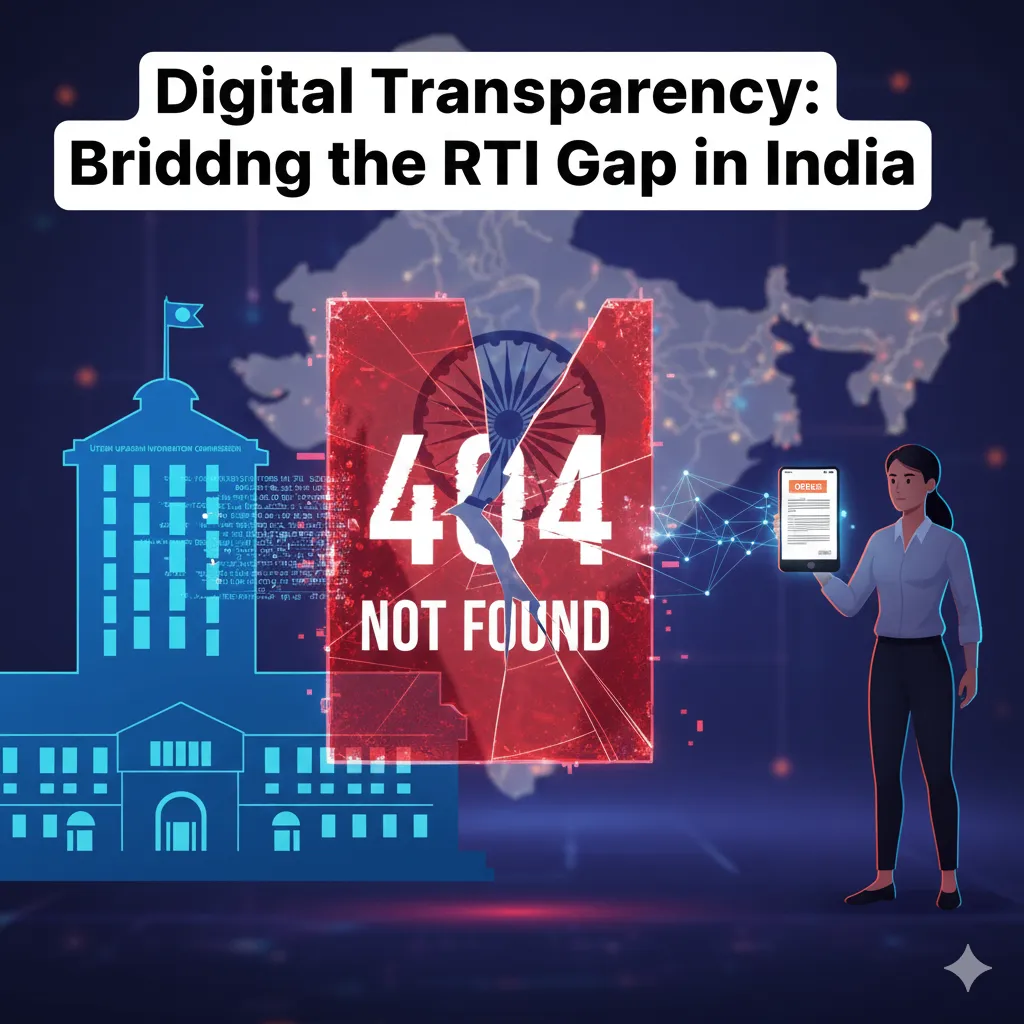
One of the primary requests in this RTI application concerned the malfunction of the official portal. The applicant reported a 404 Error when trying to access specific KOF documents (D-021220250005). The language selection interface failed, defaulting to Hindi despite English being selected.
The response from the Commission was telling. Instead of a direct explanation, the PIO pointed to a “Technical Report” dated December 16, 2025. Predictably, this report was also not provided to the applicant.
When a government portal costs ₹3.78 Crore of taxpayer money, as revealed in the Commission’s own response. Broken links are more than just a technical glitch. They indicate a significant issue. Interface bugs represent issues that extend beyond simple technical difficulties. It signifies a denial of the “Right to Access.” If the digital gateway is broken, the information behind it is effectively sealed, bridging the RTI gap in India.
3. The New Policy of November 2025: A Double-Edged Sword (Bridging RTI Gap in India)
The documents provided in this case also revealed a significant policy shift. This change occurred within the Uttar Pradesh Information Commission. It is dated November 13, 2025. This order aims to streamline the process. Applicants can download orders from the website. They can get them certified by the CRM (Customer Relations Management) section.
While this sounds like progress, it places an unfair burden on the citizen:
- The Cost of Certification: Even though the law mandates providing information, the new policy introduces a fee structure. This includes ₹10 per page for inspection-based copies and ₹3 per page for others. These costs can add up quickly.
- The Reliability Factor: The policy assumes the website is functional. In the current case, the website returns a 404 error. As a result, the “streamlined” process for getting certified copies completely collapses.
4. The Human Element: Administrative Accountability (Bridging RTI Gap in India)
A critical part of the RTI request, therefore, involved a key demand. Specifically, it was to obtain the names and designations of the personnel responsible for website maintenance. Indeed, accountability in the digital age requires that we know who is behind the screen. If a website is malfunctioning, the public has a right to know this. This is especially true if public funds have been spent. Accordingly, they should be informed about which department is responsible for the oversight or which individual is accountable.
By withholding the technical report and the specific names of the maintenance staff, the Commission is protecting its internal hierarchy. This comes at the expense of public accountability.
5. The First Appeal: A Necessary Escalation (Bridging RTI Gap in India)
On January 8, 2026, the applicant filed a First Appeal (Registration No: UPICM/A/2026/60002) before Shri Tejaskar Pandey, the Deputy Secretary. This appeal is a crucial step for three reasons:
- Challenging the PIO: It forces the PIO to explain why they claimed to attach documents that were never sent.
- Demanding the Report: It seeks the hidden Technical Report that explains the 404 errors.
- Invoking Section 7(6): The information was not provided within the 30-day window due to the missing attachments. Therefore, the applicant is now legally entitled to receive all these documents free of cost.
6. The Broader Implications for RTI Activism
This case highlights a disturbing trend where public authorities provide “paper compliance.” They reply within the deadline. Moreover, they use the correct legal terminology. They mention attachments. However, the actual substance of the information is missing. This is “compliance in form, but not in spirit,” bridging the RTI gap in India.
To combat this, citizens must:
- Document Everything: Always save screenshots of 404 errors and broken portal links.
- Audit the Attachments: The moment an RTI response is received, check the list of “enclosures” in the letter. Then, compare the list to what is actually in the envelope.
- Use the Appellate Process: Do not let a “missing attachment” slide. Every failure to provide a document is a ground for appeal.
Conclusion: The Road Ahead
The Uttar Pradesh Information Commission is the custodian of the RTI Act in the state, playing a crucial role in Bridging RTI Gap in India. If the custodian’s own house is in disarray, it sends a message to other public authorities. The areas of concern include its website and its mailing department. This message to other public authorities is one of laxity.
As we wait for the decision on Appeal No. UPICM/A/2026/60002, the core issue remains. Transparency is not just about having a law on the books. It is about the functional, reliable, and honest delivery of information. A ₹3.78 crore website is useless if the “Order” button leads to a 404 page. A PIO’s response is meaningless if the “Attached” order is a ghost.
The fight for information in the digital age is no longer just about getting the government to speak. It is also about getting them to fix the broken links through which they speak.
It is highly ironic and frustrating. The Commission confirms a ₹3.78 crore expenditure on website maintenance. However, the basic functionality required for a citizen to track their case—the KOF (Knowledge of Fact/Key of File) status—remains broken.
Based on the data you provided, you are dealing with a second, separate case file (S09/A/0002/2025) which is currently active. Below is the structured breakdown of this specific case and the technical issues you are facing.
1. Case Details & Upcoming Hearing (Bridging RTI Gap in India)
| Detail | Information |
| Case File Number | S09/A/0002/2025 |
| Diary Number | A-20241200030 |
| Hearing Court/Room | S-9 |
| Next Hearing Date | January 27, 2026 |
| Public Authority | District Panchayat Raj Officer (DPRO), Mirzapur |
| Current Status | Forwarded to Hearing Officer; Pending for Further Hearing |
2. The Technical Failure: “Phantom KOF” (Bridging RTI Gap in India)
You mentioned that the KOF document (D-311220250036) is currently inaccessible. This is a critical failure because:
- The Log Shows Success: The system log states: “KOF submitted by citizen and forwarded to the concern hearing officer.”
- The Reality is a 404/Error: Even though the system “accepts” it, the link is broken. If the Hearing Officer in Court S-9 cannot open your KOF on January 27, they may adjourn the case. They might also claim you haven’t provided the necessary facts.
3. Strategy for the January 27th Hearing (Bridging RTI Gap in India)
The website is failing to display your KOF. You should not rely on the digital system for the upcoming hearing. I recommend the following steps:
- Carry Physical Proof: Print the KOF document you uploaded along with the screenshot showing the 404 Error/Link Failure.
- Submit a Technical Complaint: Before the hearing, send an email to the Webmaster (
webmaster-upic@up.gov.in) and the Registrar of the Commission. State: “In Case S09/A/0002/2025, KOF D-311220250036 is not opening on the portal. This is a denial of digital access.” - Bring up the ₹3.78 Crore Paradox: During the hearing, formally apprise the Information Commissioner of two key points. First, while the Commission claims to spend crores on maintenance, the appellant’s documents are being lost in “broken links.” This loss prejudices your case.
4. Comparison of Your Two Active Files (Bridging RTI Gap in India)
| Case Number | Status | Key Issue |
| S10/A/1318/2024 | Disposed (Dec 3) | PIO failed to attach the final order in the RTI reply. (Appeal filed today). |
| S09/A/0002/2025 | Active (Jan 27) | KOF status not opening; technical glitch prevents tracking. |
5. Consolidated Technical Contact List
If you wish to report this specific KOF error (D-311220250036) immediately:
- UPIC Helpdesk: 0522-2724941
- Nodal Officer (Tejaskar Pandey): 9415021746
- Online Support: rtionline.up.gov.in/contactus.php
1. Application & Appeal IDs
- Original RTI Application No:
UPICM/R/2025/60620(Filed: 05/12/2025) - First Appeal Registration No:
UPICM/A/2026/60002(Filed: 08/01/2026) - Case File Number (Related):
S10/A/1318/2024 - Second Appeal Registration No (Related):
A-20240601728
2. Contact Details (PIO & FAA) (Bridging RTI Gap in India)
| Authority | Name | Designation | Mobile/Phone | Official Email |
| PIO | Mumtaz Ahmad | Administrative Officer | 9151804317 | jansu-section.upic@up.gov.in |
| FAA | Tejaskar Pandey | Deputy Secretary | 9415021746 | deputysecretary-upic@up.gov.in |
| General Office | — | UPIC Office | 0522-2724930 | webmaster-upic@up.gov.in |
Note: For official correspondence, always include your Appeal Registration Number in the subject line.
3. Essential Web Links (Bridging RTI Gap in India)
- RTI Online Portal (UP):rtionline.up.gov.in
- Use this to check the real-time status of your appeal.
- View RTI Status: rtionline.up.gov.in/request/status.php
- UPIC Official Website (CISPU): upsic.up.gov.in/cispu/
- Direct Link to View Orders:upsic.up.gov.in/cispu/seeallorders
- You can search for the order in Case S10/A/1318/2024 here using your registration number.
4. Technical Support (For 404/Website Issues) (Bridging RTI Gap in India)
If you continue to face the 404 Error or the Language Selection Failure mentioned in your appeal, you may send a formal technical complaint to the technical team:
- Webmaster Email:
webmaster-upic@up.gov.in - Technical Consultant: National Informatics Centre (NIC), UP State Unit.
- Reference Document: Mention the “Prabhari Cadre Development Report dated 16/12/2025” (as cited by the PIO).
Would you like me to create a simple tracker for you? You could log the dates and responses as this appeal progresses.


Facing a similar challenge? Share the details in the box below, and our team of experts will do their best to help.