
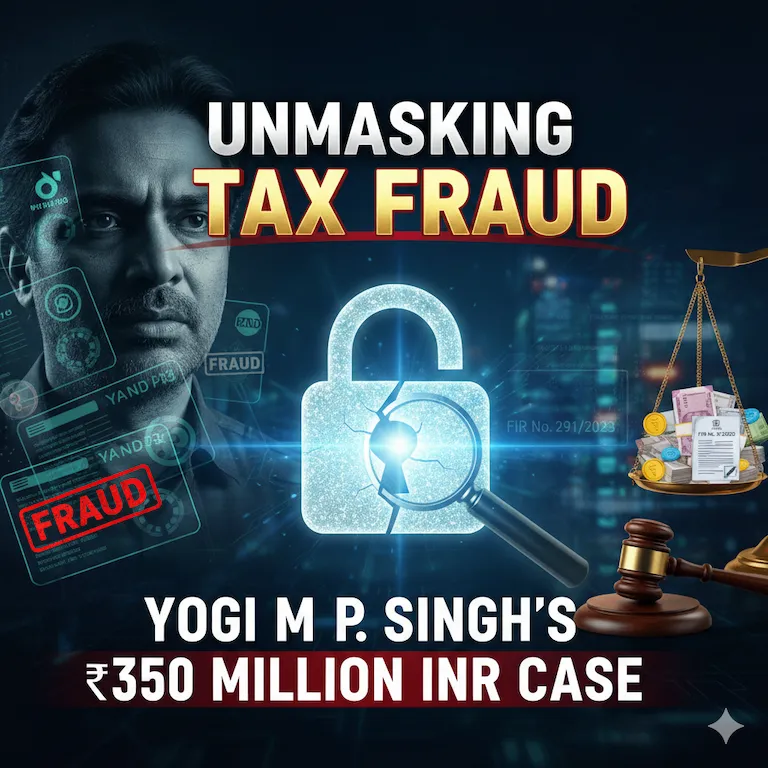
Unmasking Tax Fraud & PAN Misuse involves a thorough investigation into the deceptive practices that individuals or entities employ to evade tax obligations. Tax fraud can manifest in various forms, such as underreporting income, inflating deductions, or misusing the Permanent Account Number (PAN) system to facilitate illegal financial activities. Authorities utilise advanced data analytics and investigative techniques to uncover discrepancies and patterns indicative of fraud. Raising public awareness of the consequences of tax evasion, coupled with stringent regulatory measures, is essential to combating this pervasive issue. Continuous monitoring and cooperation among financial institutions, tax authorities, and the public are crucial for effectively addressing these challenges.
The case of Yogi M P Singh shows a clear “digital vulnerability” in today’s financial systems. Here are the key takeaways.
1. The Scale of Identity Hijacking
The fraud is not a simple case of a stolen credit card; it is systemic identity exploitation.
- Massive Financial Volume: Over ₹35 Crore (₹350 million) in fraudulent transactions were attributed to a single individual.
- Corporate Proliferation: More than 200 distinct companies and firms misused one PAN, suggesting a coordinated “shell company” network rather than isolated incidents.
2. The “Evidence vs Procedure” Gap
A significant bottleneck in the investigation is the friction between digital records and traditional police protocol.
- The TIS as Evidence: The Tax Information Summary (TIS) is the primary evidence, providing a 25-page roadmap of every fraudulent entity involved.
- Authentication Hurdle: The investigation was delayed by procedural demands for “manual signatures” on digitally-generated government documents, highlighting a need for better digital literacy within local law enforcement.
3. High-Level Oversight vs Ground-Level Inertia
Despite the Uttar Pradesh Information Commission (UPIC) monitoring the case, the victim reports no tangible progress.
- FIR Status: FIR No. 291/2023 was filed under Section 420 IPC and Sections 66C/66D of the IT Act, yet the suspects remain “unknown” despite being named as corporate entities in tax records.
- Allegations of Inaction: The appellant has characterised the police progress reports as “bogus,” suggesting that monitoring by a constitutional body has not yet translated into effective investigative action.
4. The Victim’s “Double Jeopardy”
The victim is caught in a pincer movement between criminals and the state.
- Tax Harassment: While the police investigation stalls, the Income Tax Department’s automated systems continue to issue notices and demands to the victim for transactions he did not commit.
- Burden of Proof: The case demonstrates how the burden of “proving innocence” often falls unfairly on the victim of identity theft.
5. Critical Need for Specialised Units
- The Solution: The case underscores the the technical capability to pierce the corporate veil of shell companies.
Unmasking Tax Fraud & PAN Misuse: The ₹35 Crore PAN Identity Theft Exposing India’s Digital Vulnerabilities
In this report on Unmasking Tax Fraud & PAN Misuse, I break down how a single PAN was allegedly used across 200+ entities. As a result, ₹35 crore moved through suspicious transactions. I also explain what the records show, why enforcement stalls, and which reforms can prevent repeat abuse.
The Permanent Account Number (PAN) anchors India’s financial system. It links banking, taxation, and corporate compliance. However, the case of Yogi M P Singh (Mahesh Pratap Singh), now before the Uttar Pradesh Information Commission (UPIC), shows how criminals can weaponise this identity marker against an innocent citizen.
The alleged fraud involves ₹350 million (₹35 Crore) and more than 200 corporate entities. Therefore, this is not only a personal grievance. It also exposes gaps in digital identity controls and the slow pace of cybercrime investigations.
The Genesis: A Nightmare in Numbers (Unmasking Tax Fraud & PAN Misuse Begins)
The ordeal began when the appellant, Yogi M P Singh, discovered that unknown entities used his PAN to route massive transactions. In the Income Tax Department’s records, Mr Singh suddenly appeared as a high-net-worth individual. In reality, criminals had hijacked his identity.
On November 11, 2023, police registered FIR No. 291/2023 at Police Station Kotwali Katra in Mirzapur district. The charges were grave.
- Section 420 IPC: Cheating and dishonestly inducing the delivery of property.
- Section 66C IT Act: Identity theft (using another person’s unique identification feature).
- Section 66D IT Act: Cheating by personation using a computer resource.
However, the victim quickly learned that filing an FIR only starts the process. Next, he faced a long fight with bureaucratic inertia.
The “Smoking Gun”: The Tax Information Summary (TIS)
In any financial fraud investigation, the paper trail matters. For Mr Singh, the trail ran through the Tax Information Summary (TIS), a 25-page document from the Income Tax Department. It offers one of the clearest artifacts for Unmasking Tax Fraud & PAN Misuse when one PAN appears across dozens (or hundreds) of entities.
The TIS aggregates financial information linked to a PAN. In this case, it listed more than 200 companies and firms that reported transactions tied to Mr Singh’s PAN. As a result, the document gave police a ready list of entities and transaction IDs to verify.
The Procedural Stumbling Block
Instead of treating the TIS as a lead, the investigating officer, Mr Jitendra Kumar, raised a procedural objection. He said police could not act unless the appellant “signed” the document to verify its source.
This objection highlights a gap in local law enforcement’s digital literacy. The TIS is a digitally generated government record. Therefore, asking the victim to sign it adds a redundant delay. It also distracts from the real task: investigating the 200 companies listed in the TIS. Mr Singh later complied and submitted a signed 25-page hard copy on June 6, 2025. Even so, the investigation reportedly remained stagnant.
Analysis of the “Unknown” Suspects: How PAN Misuse Scales into Organised Tax Fraud
Police filed the FIR against “unknown” individuals. Yet the TIS names the participating companies. This creates a paradox. If the companies are known, investigators can also identify the directors and authorised signatories behind them.
The misuse of a single PAN by 200 companies suggests a centralised fraud ring. For example, it is unlikely that 200 unrelated firms independently chose the same PAN. Instead, the pattern points to a shell-company ecosystem. In such setups, people sell or lease identities to enable money laundering or tax evasion.
The Role of the Information Commission
Moreover, this case stands out because the Uttar Pradesh Information Commission (UPIC) is involved. The commission’s administrative head is monitoring the investigation’s progress.
Under the Right to Information (RTI) framework, the appellant has asked why police have not made arrests despite the available records. Meanwhile, his frustration keeps growing. He describes the police’s conduct as the “inscrutable face of the Sphinx”—present but silent, watching but not acting.
The Allegation of “Bogus Reports”
Currently, the dispute centres on the progress report dated June 6, 2025. The Public Information Officer (PIO) in the Mirzapur SP office shared a report that, according to the appellant, shows “no action.” As a result, a hard question follows. If a citizen provides a government-sourced list of 200 entities committing fraud, and police still take no action for over 18 months, does this reflect incompetence—or a deeper systemic failure?
The Human Cost: Financial Harassment
Meanwhile, the police investigation stalls. However, the Income Tax Department continues to run automated processes. As a result, Mr Singh faces the following.
- Tax Demand Notices: Being held liable for taxes on ₹35 Crore of income he never earned.
- Potential Asset Freezing: The risk of his legitimate bank accounts being frozen due to “suspicious” high-volume activity.
- Legal Costs: The financial and mental toll of fighting a battle against both criminals and the state’s own investigative machinery.
Conclusion: A Call for Reform (Unmasking Tax Fraud & PAN Misuse)
The Yogi M P Singh case signals a bigger risk for India’s digital future. If criminals can link a citizen to 200 fraudulent companies, the system must respond fast. Otherwise, the “Ease of Doing Business” collapses under the “Ease of Committing Fraud.”
Urgent Recommendations (Unmasking Tax Fraud & PAN Misuse)
- EOW Intervention: The Superintendent of Police, Mirzapur, should immediately transfer the case to the Economic Offences Wing (EOW). In turn, the EOW can apply specialised expertise to multi-firm corporate fraud.
- Inter-Departmental Coordination: Establish a single-window protocol between the Income Tax Department and the Police. This way, officers can verify TIS data without forcing the victim to act as a middleman for “authentication.”
- Accountability for Delay: Finally, the Information Commission should use its powers to turn “monitoring” into time-bound milestones.
Ultimately, this quest for justice in FIR No. 291/2023 goes beyond one man’s PAN. It tests whether India can keep every citizen’s digital identity as a shield, not a target.
Unmasking Tax Fraud & PAN Misuse is not only about documenting wrongdoing. It is also about pushing time-bound investigations, cross-department verification, and safeguards. That way, automated tax systems stop punishing victims while offenders stay unidentified.
In your quest for justice regarding the ₹35 Crore tax fraud case (FIR No. 291/2023), navigating the various public authorities can be complex. Based on the documentation available, here are the essential contact details and application identifiers for the offices currently involved in your investigation and RTI appeals.
Uttar Pradesh Information Commission (UPIC) (Unmasking Tax Fraud & PAN Misuse)
The UPIC is currently monitoring the investigation’s progress through your second appeals.
- Official Website: upsic.up.gov.in
- Case Tracking: CATS (Complaint and Appeal Tracking System)
- Key Contacts:
- State Chief Information Commissioner: scic.up@gov.in
- Hearing Court S-9 (Shakuntala Gautam): hearingcourts9.upic@up.gov.in
- Hearing Court S-5 (Padum Narayan Dwivedi): hearingcourts5.upic@up.gov.in
- Registrar: registrar-upic@up.gov.in
- Office Address: RTI Bhawan, 7/7A, Vibhuti Khand, Gomti Nagar, Lucknow, UP.
- Phone: 0522-2724930
Mirzapur District Police (Unmasking Tax Fraud & PAN Misuse)
The investigation is centred at Police Station Kotwali Katra, Mirzapur.
- Superintendent of Police (SP) Mirzapur:
- Email: spmzr-up@nic.in
- CUG Mobile: +91-9454400299
- Office Phone: 05442-252578
- Additional SP (City):
- Email: asp-city.mi@up.gov.in
- CUG Mobile: +91-9454401104
- Police Station Kotwali Katra:
- Landline: 05442-223541
- Public Information Officer (PIO), SP Office:
- This is the office that provided the June 6, 2025, progress report. You can address follow-ups to the SP Office directly via their CUG numbers.
Income Tax Department (ITD) (Unmasking Tax Fraud & PAN Misuse)
Since you are receiving notices based on the fraudulent TIS data, these channels are critical for reporting identity theft.
- AIS/TIS Helpdesk: 1800 103 4215 (For queries specifically related to the Tax Information Summary).
- e-Filing Grievance:
- Portal: incometax.gov.in (Login -> Services -> Register Grievance).
- Email: efilingwebmanager@incometax.gov.in
- PAN Grievance (Protean/NSDL):
- Email: tininfo@proteantech.in
- Phone: 020-27218080
Key Application Identifiers (Unmasking Tax Fraud & PAN Misuse)
Referencing these specific IDs in your communications will ensure they are linked to your ongoing case:
| Identity | Identifier | Status / Date |
| FIR Number | 291/2023 (Kotwali Katra) | Registered 11.11.2023 |
| UPIC Case No. | S05/A/1286/2025 | Registered 2025 |
| RTI Reg. No. | A-20251102004 | Related to CMO/Police matters |
| Grievance ID | GOVUP/E/2025/0141201 | Supplementary Complaint filed Jan 2026 |
| Electricity RTI | PUVNL/R/2024/60261 | Disposed 03.12.2024 (Appeal Pending) |
Suggested Next Step (Unmasking Tax Fraud & PAN Misuse)
Would you like me to help you draft a formal email to the State Chief Information Commissioner (SCIC) to highlight the investigating officer’s failure to act on the TIS evidence?


Facing a similar challenge? Share the details in the box below, and our team of experts will do their best to help.