
Digital Accountability in UP’s RTI Hearings: When “Absent” Isn’t Verified
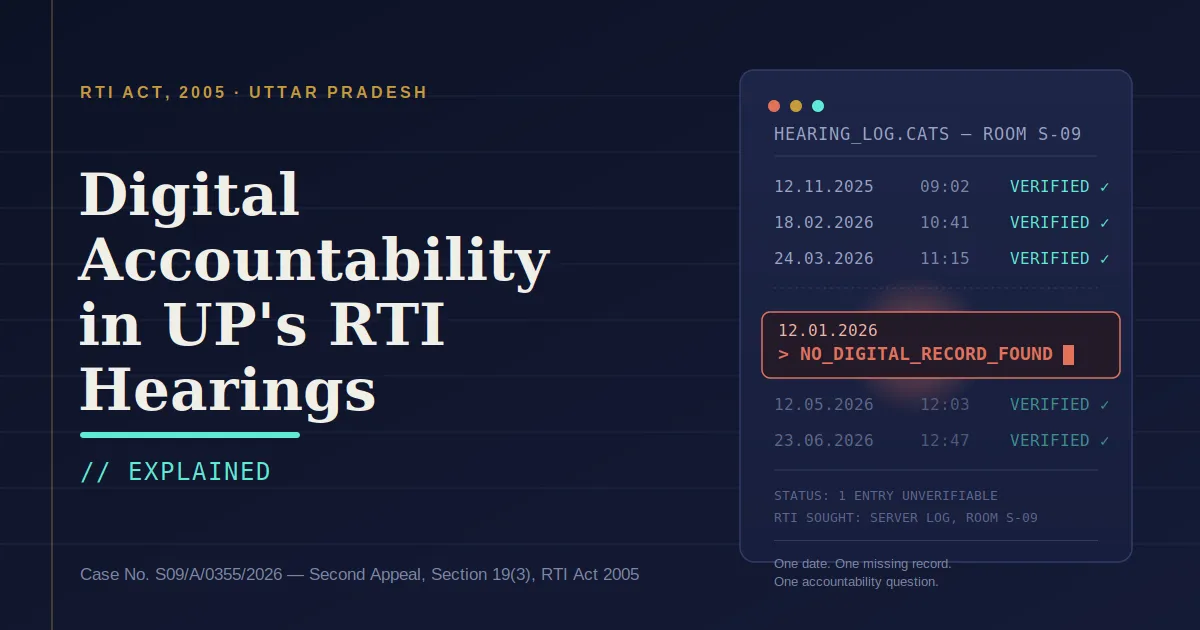
A case study in digital accountability in UP’s RTI hearings — how one citizen’s RTI application, First Appeal, and Second Appeal exposed the absence of verifiable digital records behind an online hearing’s “absent” finding.
This situation, therefore, highlights the significant challenges faced by citizens when navigating bureaucratic procedures.
Moreover, it calls into question the integrity of digital systems purported to offer transparency.
The citizen’s persistence in pursuing the matter through multiple appeals further illustrates the vital role individuals play in holding institutions accountable for their operations.
In addition, the failure to provide accurate digital documentation raises concerns over the effectiveness of current policies.
Consequently, there is a clear need for reforms in the management of public information.
Ultimately, this case serves as a critical reminder of the importance of maintaining robust digital records.
Such measures are essential to ensure accountability and protect citizen rights in an increasingly digitized world.
Key Takeaways
- The case study on Digital Accountability in UP’s RTI hearings reveals issues with the lack of verifiable digital records for online hearings.
- Yogi M. P. Singh’s persistent RTI application and appeals expose the challenges citizens face in ensuring transparency from public institutions.
- The absence of digital attendance logs and participant records calls into question the integrity of the Commission’s findings.
- This case highlights the broader issue of accountability in digital systems and the need for more robust public information management policies.
- Key takeaways for RTI applicants include asking for underlying records, documenting attempts, and properly escalating appeals.
Introduction: A Test Case for Digital Accountability in UP’s RTI Hearings
On 12 January 2026, the Uttar Pradesh State Information Commission held an online hearing in Appeal No. S-09/A/1037/2025. The Commission’s own order for that date records a simple, two-line finding: staff called out the names, and both parties were absent. But for the appellant, Yogi M. P. Singh, that finding didn’t match his experience. He says he tried to join the hearing. So, over the following months, he filed an RTI application, then a First Appeal, and finally a Second Appeal — all to answer one narrow but important question: can the Commission produce a verifiable digital record to support its own finding of “absence”?
That question sits at the heart of what this post calls digital accountability in UP’s RTI hearings. Once a public hearing moves online, the systems recording it should be just as transparent and verifiable as the hearing itself. This post therefore documents the full journey: the applications filed, the responses received, the dates involved, and the core issue underneath it all — along with the official case numbers and contact points, so readers can track the matter or file something similar of their own.
How It Began: A Simple RTI Application
On 18 February 2026, Yogi M. P. Singh filed an RTI application under Section 6(1) of the RTI Act, 2005, before the Uttar Pradesh Information Commission.
- RTI Registration Number: UPICM/R/2026/60101
- Date of filing: 18/02/2026
- Applicant contact: Mobile 7379105911, Email yogimpsingh@gmail.com
The application sought five narrow, factual points about the 12 January 2026 hearing in Appeal No. S-09/A/1037/2025:
- The status or receipt of a written representation filed via the CATS portal (Ref: 45D 110120260011) on 11/01/2026.
- A certified copy of the online hearing attendance log or participant list for the hearing (12:30 PM–1:30 PM).
- Confirmation of whether the Commission’s digital system recorded the appellant’s login for the hearing link provided.
- A certified copy of the daily order sheet or minutes of proceedings recorded by the Bench Clerk for Hearing Room S-09.
- Confirmation of whether the Commissioner saw the appellant’s written submission during the hearing.
None of these are extraordinary requests. They simply ask for the paper trail — or rather, the digital trail — behind a single administrative finding.
The SPIO’s Response: Answers That Don’t Answer
The State Public Information Officer (SPIO), Sri Mumtaz Ahmad, Administrative Officer, responded on 26 February 2026 (letter dated 25.02.2026, Patrank 1404/2025-26). (Digital Accountability in UP’s RTI Hearings)
- SPIO office contact: Room No. 404, RTI Bhawan, Vibhuti Khand, Gomti Nagar, Lucknow – 226001
- Email: jansu-section.upic@up.gov.in
- Mobile: 9151804317
On close reading, though, the reply doesn’t independently address Points 2 through 5. Instead, it answers each of those points with a single line: “as per Point No. 1.” And for Point No. 1, it simply states that a reply from Hearing Room-9, dated 25.02.2026, is attached.
That attachment, however, turned out to be a short covering note from the court clerk (Ahalmad) of Room S-09. The note recounted procedural history: staff emailed a notice on 30.12.2025, sent a hearing link on 15.12.2025, and uploaded an order dated 12.01.2026 online, fixing the next hearing date. In other words, it didn’t contain any certified digital log, server record, or participant list — the very substance of what the appellant had actually requested.
The First Appeal: Closed Without Addressing the Core Issue (Digital Accountability in UP’s RTI Hearings)
Dissatisfied, the appellant filed a First Appeal under Section 19(1) of the RTI Act on 27 February 2026.
- First Appeal Registration Number: UPICM/A/2026/60029
- First Appellate Authority (FAA): Sri Tejaskar Pandey, Deputy Secretary
- FAA office contact: Room No. 410, RTI Bhawan, Vibhuti Khand, Gomti Nagar, Lucknow – 226001; Mobile 9415021746; Email deputysecretary-upic@up.gov.in
On 6 March 2026, the FAA issued an order holding that the information sought had “already been made available,” and closed the appeal as fully resolved. Yet the order never engaged with the appellant’s actual grievance: nobody had produced the digital attendance and login records — the one thing that could turn an unverifiable assertion into a verifiable fact.
The Second Appeal: Taking the Matter to the State Commission
On 19 March 2026, the appellant filed a Second Appeal under Section 19(3) of the RTI Act before the Uttar Pradesh State Information Commission.
- Second Appeal Case Number: S09/A/0355/2026
- Registration Number: A-20260301603
- Respondents: SPIO Mumtaz Ahmad and FAA Tejaskar Pandey
This appeal sought three specific reliefs. First, it asked the Commission to direct production of the certified digital server logs and Teams participant list for the 12 January 2026 hearing. Second, it asked for correction of the official hearing record, if warranted. Third, it asked for an inquiry under Section 20(1) of the RTI Act into the SPIO’s conduct, since the appellant alleges the SPIO furnished misleading and incomplete information.
The Commission listed the matter for hearing on 17 August 2026, in Hearing Room S-1, before Chief Information Commissioner Raj Kumar Vishwakarma (official hearing-room email: hearingcourts1.upic@up.gov.in).
The Missing Order: What “Absent” Really Means Without Digital Accountability in UP’s RTI Hearings
A central factual question in this case concerns the order dated 12 January 2026 itself — the one document that actually records the appellant’s “absence.” On examination, the order simply reads: staff called out the names; both parties are again absent — and lists the matter for the next date. (Digital Accountability in UP’s RTI Hearings)
Crucially, the order never discloses how the Commission reached that determination in an online hearing. It cites no participant list, no login log, no screenshot, and no system-generated record — only the clerk’s notation. This gap forms the crux of the appellant’s Second Appeal. He isn’t simply claiming he was, in fact, present. Instead, he’s raising a broader question: does any verifiable digital record exist to support such findings at all?
A Systemic Gap in Digital Accountability in UP’s RTI Hearings
This is where the case moves from an individual grievance to a matter of public interest. Suppose a citizen can be recorded as “absent” from a virtual government hearing based solely on an internal, undocumented notation. And suppose that even a specific RTI request cannot compel disclosure of any underlying digital record. In that case, the finding becomes, in effect, unfalsifiable — and the affected citizen has no way to test it, challenge it, or correct it. This gap is precisely what discussions of digital accountability in UP’s RTI hearings need to confront.
The RTI Act, 2005 exists to prevent exactly this kind of opacity in how public authorities function. Consider the technology involved: Microsoft Teams, integrated with the Commission’s own Complaint and Appeal Tracking System (CATS), can generate join and leave timestamps and participant records as a standard system function. So the real question is whether the Commission’s own infrastructure retains such records — and if so, why officials never disclosed them. That question sits at the center of this case, and any serious push for digital accountability in UP’s RTI hearings must answer it.
Supporting Evidence and the Broader Pattern
The appellant’s submission also placed an email on record, sent at 12:54 PM on 12 January 2026. That email shows he had logged into a Microsoft Teams lobby since 12:00 PM that day, attempting to join a separate hearing scheduled at the same time in a different Room. Although that email relates to a different case, the appellant offered it as corroborative — not conclusive — evidence. It shows he was actively engaging with the Commission’s virtual hearing systems that day, which supports the plausibility of a similar technical or admission difficulty in the hearing actually under dispute. (Digital Accountability in UP’s RTI Hearings)
Separately, in an unrelated but concurrently pending matter before the same Commission (Appeal No. S-09/A/1037/2025, concerning an electricity billing and disconnection RTI request), the appellant has documented a different pattern: delayed, incomplete, and evasive responses from a different public authority, stretching over more than a year. In the appellant’s view, this underscores a recurring difficulty that citizens face when they try to extract complete, verifiable information from public bodies, even after Commission orders direct compliance.
What This Case Means for RTI Applicants Seeking Digital Accountability
For any RTI applicant navigating a similar situation, this case offers a few practical lessons:
- Ask for the underlying record, not just the outcome. A finding or a covering letter is not the same as the primary evidence behind it.
- Document your own attempts as they happen. Emails, timestamps, and screenshots — even from a different proceeding — can help establish a pattern of good-faith engagement.
- Don’t accept “as per Point No. 1” as a substantive answer. Public authorities must address each point of an RTI request specifically. Cross-referencing without producing the actual record is a common but improper practice.
- Escalate through the proper channels, in writing. File a First Appeal, then a Second Appeal, each with a clear, point-wise written submission. This builds a record that a Commission can act on.
Case Details for Reference
| Particular | Detail |
|---|---|
| Underlying Appeal | S-09/A/1037/2025 (Room S-9) |
| RTI Application | UPICM/R/2026/60101, dated 18/02/2026 |
| First Appeal | UPICM/A/2026/60029, dated 27/02/2026 |
| Second Appeal (Case No.) | S09/A/0355/2026 |
| Second Appeal (Registration No.) | A-20260301603 |
| Hearing Date | 17/08/2026, Room S-1 |
| Presiding Officer | Raj Kumar Vishwakarma, Chief Information Commissioner, UP |
| Track case status | upsic.up.gov.in — search by Registration No. A-20260301603 |
Conclusion: Why Digital Accountability in UP’s RTI Hearings Matters
At its core, this case tests how much of a public authority’s own internal decision-making a citizen can actually see. And an RTI Act built to promote transparency loses much of its force if records that could resolve a factual dispute in minutes stay undisclosed, even under a direct, specific request. So whatever the Commission ultimately decides about the facts of 12 January 2026, one underlying question will remain: how should an online government hearing determine and verify “absence”? That’s a question of digital accountability in UP’s RTI hearings worth asking well beyond this single file.
Related reading: The same pattern — a public authority citing a broad, boilerplate exemption instead of engaging each specific query — shows up in a Mirzapur police case too, where a station leaned on “case diary confidential” to close out queries that were never case-diary material. See Police Case Diary & RTI: A Legal Analysis.
This post is based on publicly filed RTI applications, appeals, and Commission correspondence in Case No. S09/A/0355/2026 before the Uttar Pradesh State Information Commission. Official contact details for the Public Information Officer and Appellate Authority are reproduced as published under Section 4 of the RTI Act, 2005.


Facing a similar challenge? Share the details in the box below, and our team of experts will do their best to help.