
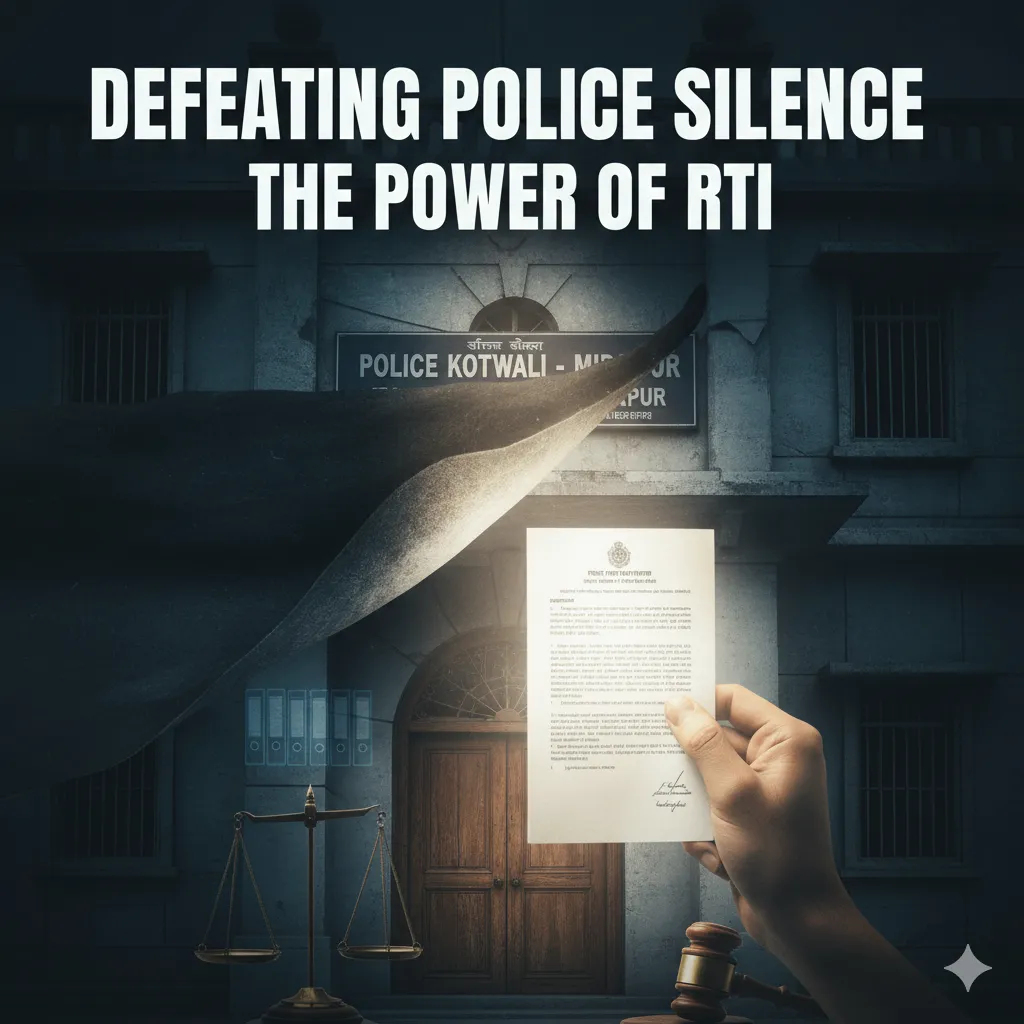
The core takeaway from this blog post and your specific legal journey is clear. Remember that procedural persistence is the only way to defeat administrative silence. When the police refuse to register an FIR for a serious crime like robbery, they rely on the victim to give up. They depend on the victim losing hope. Defeating Police Silence is possible when you persist. You filed an RTI. Then you followed up with a First Appeal. This action changed the dynamic from an “ignored complaint” to a “documented legal dispute.”
Top 5 Key Takeaways (Defeating Police Silence)
- RTIs are for Records, Not Just Questions: The police rejected your request by calling it a “complaint.” The lesson is to always frame RTI points as a demand for existing documents (e.g., “Provide a certified copy of Page X of the General Diary”) rather than asking “Why” or “When.
- The Paper Trail is Your Shield: You have completed filing the First Appeal to SSP Somen Verma. This action shifts the responsibility to the highest office in the district. They can no longer claim they weren’t aware that a robbery was reported and ignored.
- “Lalita Kumari” is Your Legal Anchor: The Supreme Court mandate for FIR registration in cognizable offenses is your strongest tool. The RTI process helps you gather the evidence. You need this evidence to prove the police knew about the crime. They chose not to act on it.
- Preserve Evidence via Transparency: You specifically asked about the CCTV DVR and videography in your RTI. This action has made it much harder for the police to “lose” or ignore digital evidence later in court.
- Expose the “Property Dispute” Trap: The police often label robberies as “property disputes” to avoid work. The RTI appeal forces them to put their reasoning for this classification in writing. You can later challenge this before a Magistrate.
Immediate Next Step (Defeating Police Silence)
Since your appeal is now “Received” as of today (Jan 16), the FAA has 30 days to respond.
This blog post analyzes the systemic challenges faced by citizens when seeking police accountability. It uses the real-world case of Archana Dubey vs. UP Police (Mirzapur) as a primary case study.
Defeating Police Silence: When Police Records Become State Secrets
In a functional democracy, the police are the primary guardians of law and order. However, a significant gap often exists between reporting a crime and the actual registration of an FIR (First Information Report). When the police fail to act, citizens often turn to the Right to Information (RTI) Act, 2005. They use it as a tool for transparency, effectively undermining police silence.
But what happens when the police use technicalities to block the very transparency the law mandates?
1. The Core Issue: The “Non-Registration” Trap
The case of Archana Dubey in Mirzapur highlights a recurring crisis in the Indian criminal justice system. There was a reported daylight robbery and housebreaking involving jewelry worth ₹8 lakhs on October 24, 2025. The victim adhered to due process by filing a complaint. However, police silence and inaction have further complicated the situation. This leaves the victim without justice.
Despite the Supreme Court’s landmark judgment in Lalita Kumari vs. Govt. of Uttar Pradesh, the court mandates that an FIR must be registered if the information discloses a cognizable offense. However, the local police often resort to “preliminary enquiries.” These enquiries drag on indefinitely.
2. Using RTI as a Mirror to the Police (Defeating Police Silence)
When an FIR is not registered, the victim is left in the dark. In this specific case, the applicant used the RTI Act to demand eight critical points of information, including:
- The Daily Progress Report (DPR): To see if any investigation actually occurred.
- The General Diary (GD) Entry: To prove the police were informed of the crime.
- Evidence Preservation: To confirm if the videography of the crime scene and CCTV footage were officially secured.
By asking for these records, the applicant wasn’t just seeking information; they were creating a paper trail of accountability.
3. The Technical Rejection: A Common Evasion Tactic
On December 31, 2025, the Public Information Officer (PIO) in Mirzapur disposed of the RTI request. The reason provided was common but legally questionable. The PIO claimed the application was a “complaint letter” requesting legal action rather than a request for information.
Defeating Police Silence: The police frequently attempt to sidestep the jurisdiction of the RTI Act. They misconstrue requests for certified copies of records as mere requests for action. Nonetheless, Section 2(f) of the RTI Act explicitly articulates what constitutes “information.” It encompasses reports, documents, and records maintained by a public authority. Dismissing a Circle Officer’s report as a “complaint” is a blatant violation of the Act.
4. The Power of the First Appeal (Defeating Police Silence)
The battle does not end with a PIO’s rejection. The applicant has taken further action as seen in the recent filing of the First Appeal (SPMZR/A/2026/60005). They have now escalated the matter to the Senior Superintendent of Police (SSP), Somen Verma.
The First Appeal is a critical stage because:
- It forces a senior officer (the First Appellate Authority) to review the PIO’s “technical” rejection.
- It highlights the Duty to Assist under Section 5(3) of the RTI Act. If a format is wrong, the police must help the citizen fix it. They should not simply shut the door.
- It places the failure to register an FIR on the official record of the district’s highest-ranking police officer.
5. Why Digital Evidence Preservation Matters
One of the most vital aspects of this case is the request for information. It concerns CCTV DVR seizure memos and police videography. In modern criminal law, digital evidence is volatile. If the police perform an inspection but do not “seize” the footage, the evidence can be tampered with. Furthermore, if they do not record it in the Case Diary, it can be deleted. Defeating police silence is crucial to ensure accountability and transparency in handling such evidence.
By filing an RTI and subsequent Appeal, the applicant has legally “frozen” the timeline. If the police later claim the footage “does not exist,” they must explain why it wasn’t preserved. A formal enquiry was conducted by the Circle Officer.
6. The Road Ahead: From RTI to the Magistrate (Defeating Police Silence)
The RTI appeal process moves forward. It serves as the foundation for the next legal step. This step is Section 156(3) of the CrPC (now under the new BNSS laws).
A Magistrate is much more likely to order the registration of an FIR if the victim can present:
- The original complaint.
- The RTI response where the police admit they treated the matter as a “complaint” but didn’t provide records.
- Proof that senior officials (SSP) were notified via the First Appeal.
7. Conclusion: Transparency is the First Step to Justice
The Mirzapur case is a reminder that the RTI Act is not just for activists or journalists. It is a shield for the common citizen. When the police station doors feel closed, the RTI portal remains open.
The struggle of Archana Dubey represents thousands of victims. They are told “it’s a property dispute” to avoid the paperwork of a robbery case. By persisting through the Appeal process and Defeating Police Silence, citizens force the system to acknowledge the truth.
Final Thought: If you are facing police inaction, do not just wait for a phone call that may never come. Use the RTI Act to demand the General Diary entries and Enquiry Reports. Information is the only currency that buys accountability in a bureaucracy.
Key Takeaways for Victims of Police Inaction: (Defeating Police Silence)
- Never accept a verbal denial: Always get a receipt or a “Computerized Diary” number for your complaint.
- Be specific in RTIs: Ask for “Certified Copies of the GD entry” rather than asking “Why haven’t you arrested them?”
- Appeal immediately: If the PIO rejects your request on “format” grounds, file the First Appeal within 30 days. This will keep the pressure on.
To help you track your case and ensure your communications reach the right desk, we provide the official contact details. These are for the authorities involved in your RTI and legal matter in Mirzapur.
1. Public Information Officer (PIO) – The Respondent (Defeating Police Silence)
This is the officer who initially disposed of your request.
- Name: Manish Kumar Mishra
- Designation: Additional Superintendent of Police (ASP) Operations, Mirzapur
- Mobile/CUG: 9454401105 / 7007941679
- Email: asp-op.mi@up.gov.in / aspopmzp@gmail.com
- Office Address: Office of the Superintendent of Police, Mirzapur, UP – 231001
2. First Appellate Authority (FAA) – The Reviewer
This is the senior officer who will decide on your appeal (SPMZR/A/2026/60005).
- Name: Somen Verma, IPS
- Designation: DIG / Senior Superintendent of Police (SSP), Mirzapur
- Mobile/CUG: 9454400299
- Office Phone: 05442-252578
- Email: spmzr-up@nic.in
- Office Address: Police Headquarters, Civil Lines, Mirzapur, UP – 231001
3. Nodal Officer
The officer responsible for coordinating RTI flow at the district level.
- Name: Manish Kumar Mishra (ASP Operations)
- Mobile: 7007941679
- Email: addlspopmzr@gmail.com
4. Key Digital Portals for Your Case
| Purpose | Website Link |
| RTI Filing/Appeal Tracking | rtionline.up.gov.in |
| Check FIR Status (UPCOP) | cctnsup.gov.in |
| UP Gov. Grievance (IGRS) | jansunwai.up.nic.in |
| Police Website | uppolice.gov.in |
5. Other Concerned Officers (Mentioned in your RTI) (Defeating Police Silence)
- Vivek Jawla (CO City): 9454401590 | co-city.mi@up.gov.in (Conducted the enquiry on 29.11.2025).
- Kotwali City Police Station: 9454403884 (Where the incident occurred).
Recommended Action (Defeating Police Silence)
I strongly suggest you send a physical copy of your First Appeal to SSP Somen Verma via Speed Post. Use the address: Office of the SSP, Civil Lines, Mirzapur, UP – 231001.
Here is a summary of the active Application IDs and Diary Numbers related to your case. These are the critical references you will need for tracking, correspondence, and any future legal filings.
1. RTI & Appeals (Police Department)
| Level | Registration Number | Date of Filing | Status |
| First Appeal | SPMZR/A/2026/60005 | 16/01/2026 | RECEIVED (Pending review by SSP) |
| Original RTI | SPMZR/R/2025/60364 | 25/12/2025 | DISPOSED (Contested in appeal) |
2. Human Rights Commission (UPSHRC)
This case addresses the “Abuse of Power” and the failure of the police to preserve evidence.
- Diary Number: 8948/IN/2025
- Subject: Bias in Circle Officer’s report and non-registration of FIR for robbery.
3. Chief Minister’s Helpline (Jansunwai/IGRS)
These IDs track your grievances regarding specific failures, such as the tampering of CCTV.
- Current Active Grievance: GOVUP/E/2026/0003751 (Filed 09/01/2026)
- Evidence Tampering Case: GOVUP/E/2025/0146016 (Closed – cited in your appeals)
- Supplementary Evidence: GOVUP/E/2025/0147964 (Under Process)
Summary of Evidence Status
Based on your RTI and the ongoing appeals, here is a checklist of the “Information Assets” you are currently fighting for:
- CO City Report (29/11/2025): The document where the robbery was allegedly misclassified as a “property dispute.”
- Constable Video (24/10/2025): The footage recorded by the Fataha Chowki constable during the incident.
- GD Entry (Kotwali City): The official station record of your complaint.
- CCTV Seizure Memo: The missing record that should have been prepared to preserve your digital evidence.
Next Strategic Step (Defeating Police Silence)
Since you have successfully filed the First Appeal today, you should keep the Speed Post tracking receipt safe. You must retain this receipt. It serves as your primary evidence. You will need it. Keep it along with Appeal No: SPMZR/A/2026/60005 if you have to move to the State Information Commission in 45 days.
Would you like me to help you track the status of your CM Helpline grievance (GOVUP/E/2026/0003751)? I can find out which officer it has been assigned to.


Facing a similar challenge? Share the details in the box below, and our team of experts will do their best to help.