
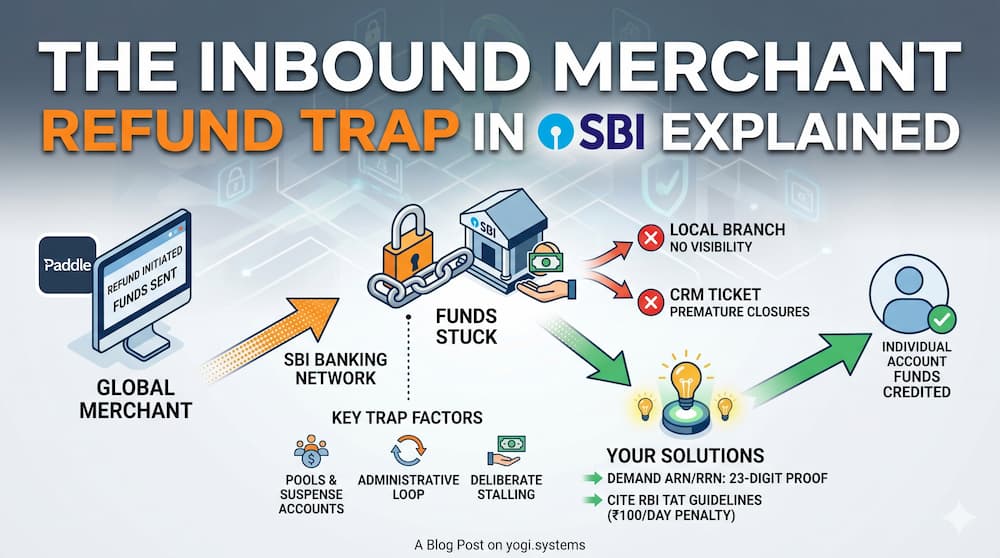
The Inbound Merchant Refund Trap in SBI is obvious from the fact that it takes nearly one month for every refund from the merchant. This prolonged process can cause significant inconvenience to customers who are eagerly waiting for their funds to be returned. According to the established guidelines, it is expected that refunds should be restored to the account within a maximum of 10 days. However, the actual experience often deviates from this expectation, leading to frustration among users. This inefficiency not only reflects poorly on the bank’s operational capabilities but also erodes customer trust. It is imperative for SBI to address this delay urgently to improve its service and enhance customer satisfaction in the refunds process.
Key Takeaways
- The Inbound Merchant Refund Trap in SBI causes delays of nearly one month for refunds, frustrating customers.
- Refunds often get stuck in suspense accounts due to manual reviews and bureaucratic processes, slowing down returns.
- SBI’s delayed refunds violate the RBI TAT Framework, which mandates timely credits and imposes penalties for delays.
- To resolve these issues, escalate complaints through formal channels like CPGRAMS rather than local branches.
- Consumers should use technical details like ARN numbers and RBI guidelines to claim their refunds effectively.
The Inbound Merchant Refund Trap in SBI: Why Your Money Gets Stuck
Every year, millions of digital consumers face a silent financial nightmare when trying to get refunds from international merchants. In fact, global payment systems work seamlessly when you buy something. However, the return journey tells a very different story. This is especially true for international refunds sent to public sector banks like the State Bank of India. Consequently, in this breakdown, we look at the Inbound Merchant Refund Trap in SBI to show exactly where your money vanishes.
Ultimately, this systemic bottleneck is not just a glitch. Furthermore, it violates regulatory frameworks and compromises basic consumer protection standards.
The Anatomy of a Blocked Refund: Merchant vs. Bank
The conflict in refund delays usually stems from a fundamental mismatch. While modern financial technology moves fast, public banking operations move slowly. For example, when you request a refund from a global entity like Paddle, the gateway processes the transaction instantly.
Once approved, the funds leave the merchant’s system immediately. Then, they route directly toward your domestic card network. At this point, the merchant loses all control of the money. Therefore, the transaction enters the international pipeline with a clear audit trail that details:
- The Transaction ID: A unique marker tied to your initial purchase. PDF
- The Credit Note: The official declaration of your returned funds. PDF
- The Exchange Amount: The specific foreign currency converted into Indian Rupees (INR). PDF
However, even though the merchant completes their duty, the funds regularly fail to show up in your account. Instead, the capital becomes stranded at the gateway interface of your receiving bank.
Decoding the ARN: Indisputable Digital Proof
When you confront a bank about a missing credit, front-line staff usually give a standard answer. For instance, they claim they cannot see the transaction. However, an Acquirer Reference Number (ARN) completely dismantles this excuse.
Specifically, an ARN is a unique, 23-digit number. The payment network (like Visa or Mastercard) generates this number as a credit moves through the system. Thus, it acts as a financial passport. When a global gateway issues an ARN, it serves as legal proof. In short, it shows that the money arrived at your bank’s central technical setup.
[Global Merchant] ──> [Paddle Gateway] ──> [Card Network (ARN)] ──> [SBI Central Pool Account]
As a result, once the network creates an ARN, the funds are no longer “in transit”. They have clearly arrived. Therefore, if the money does not reflect in your balance, it is sitting inside the bank’s central clearing vaults or internal suspense accounts.
The Suspense Account Loophole: A Pattern of Stalling
To truly understand the Inbound Merchant Refund Trap in SBI, you must look at how the bank manages internal accounts. When international refunds hit a domestic bank, they rarely route to personal accounts automatically. Instead, they gather in unallocated internal accounts. Bankers typically call these pool or suspense accounts.
Because these inbound transactions require cross-border currency matches, they need manual review. This is exactly where the bureaucracy takes over:
- The Ignorance Filter: Front-line support agents and local branch managers cannot see these central pools. Furthermore, they lack the system access to search global network logs using your ARN. PDF
- The Ticket Trap: When you file an inquiry, the bank generates a Customer Relationship Management (CRM) ticket. Then, staff shift these tickets between departments, which stalls the process.
- Premature Closures: Internal rules force bank workers to close files quickly. As a result, they mark grievances as “resolved” with automated text before anyone actually moves the money.
Consequently, this creates a loop of delay. The bank forces you to prove the purchase happened, even though they already hold your capital.
Violation of the RBI TAT Framework and Penalties
Moreover, this pattern of holding funds violates strict rules set by the country’s central bank. Specifically, the Reserve Bank of India (RBI) Turn Around Time (TAT) Framework protects consumers from delayed electronic transactions.
Under RBI rules, banks must credit your account within a set timeline after a reversal notice. If a bank holds an international remittance past this window, it breaks the law. Furthermore, the framework states that for every day a credit is delayed, the bank must pay a mandatory penalty of ₹100 per day to the customer.
Unfortunately, banks often try to hide these delays. For example, they misclassify merchant refunds as “untracked foreign inflows” to avoid paying the automatic daily penalty.
Strategic Escalation: Bypassing Local Branches
To break through this wall of silence, you must abandon local branch complaints entirely. Instead, launch formal escalations through high-level portals like CPGRAMS or the Ministry of Finance. (Inbound Merchant Refund Trap in SBI)
When you file a formal complaint, keep it simple. Strip out emotion and focus entirely on these core technical details:
| Technical Parameter | Why It Matters |
|---|---|
| Merchant Credentials | Proves the origin and legality of the money. PDF |
| 23-Digit ARN String | Forces the central clearing house to find the transaction. PDF |
| Exact INR Amount | Prevents the bank from claiming a value error. PDF |
| RBI TAT Guidelines | Signals that you intend to go to the Banking Ombudsman. |
By routing your grievance to the Corporate Centre General Manager (Customer Service) level, you strip local branches of their ability to stall. Consequently, the central management team has direct visibility over the pool accounts where these global funds get trapped.
Conclusion: The Path to Accountability
In conclusion, the friction surrounding global merchant refunds shows a clear need for automation. Public sector banks must update their central systems to match incoming ARNs to active customer accounts automatically. Until that happens, the burden of proof falls entirely on you.
Now that you understand the Inbound Merchant Refund Trap in SBI, you can fight back effectively. Use your digital audit trail, invoke the RBI TAT penalty rules, and apply federal grievance channels to force the bank to give back your money.
If, instead of a refund, the YONO SBI app itself keeps showing errors like “Something went wrong,” our step-by-step guide to resolve YONO SBI app errors covers the troubleshooting steps and escalation route to follow.
Here is the structured directory of the contact identifiers, application IDs, and institutional contact details relevant to your current public grievance case.
I. Case File & Application Identifiers (Inbound Merchant Refund Trap in SBI)
- CPGRAMS Grievance Registration Number:
DEABD/E/2026/0097178 - Paddle Transaction ID:
txn_01ktvvq85yxy5y59xjxj0teeb3 - Paddle Credit Note Reference:
CN-4448-90756 - Acquirer Reference Number (ARN):
72700926163004975666721 - SBI Linked Account Number:
34645721675
II. Public Authority & Corporate Contact Directory (Inbound Merchant Refund Trap in SBI)
1. State Bank of India (Corporate Centre) (Inbound Merchant Refund Trap in SBI)
- Concerned Authority: General Manager (Customer Service Deptt.)
- Postal Address: Corporate Centre, State Bank Bhawan, 16th Floor, Madam Cama Road, Mumbai – 400021
- Official Email:
gm.customer@sbi.co.in - Contact Number:
022-22740970
2. State Bank of India (Local Jurisdiction) (Inbound Merchant Refund Trap in SBI)
- Concerned Branch: City Branch Mirzapur, State Bank of India
- Regional Office Coordinate (Varanasi Zone):
CMCOMP7.ZOVAR@sbi.co.in
3. Ministry of Finance (Banking Division) (Inbound Merchant Refund Trap in SBI)
- Nodal Department: Department of Financial Services (DFS)
- Central Grievance Portal Link: CPGRAMS Portal (pgportal.gov.in)
4. Merchant of Record (Global Gateway) (Inbound Merchant Refund Trap in SBI)
- Entity: Paddle Payments (London, UK)
- Support Email:
assist+seller@paddle.com - Billing/Investigation Link: Paddle Support Portal (paddle.net)
III. Digital Media & Case Tracking Link (Inbound Merchant Refund Trap in SBI)
- Public Interest Case Analysis Report: yogi.systems – Great Refund Trap in SBI


Facing a similar challenge? Share the details in the box below, and our team of experts will do their best to help.