
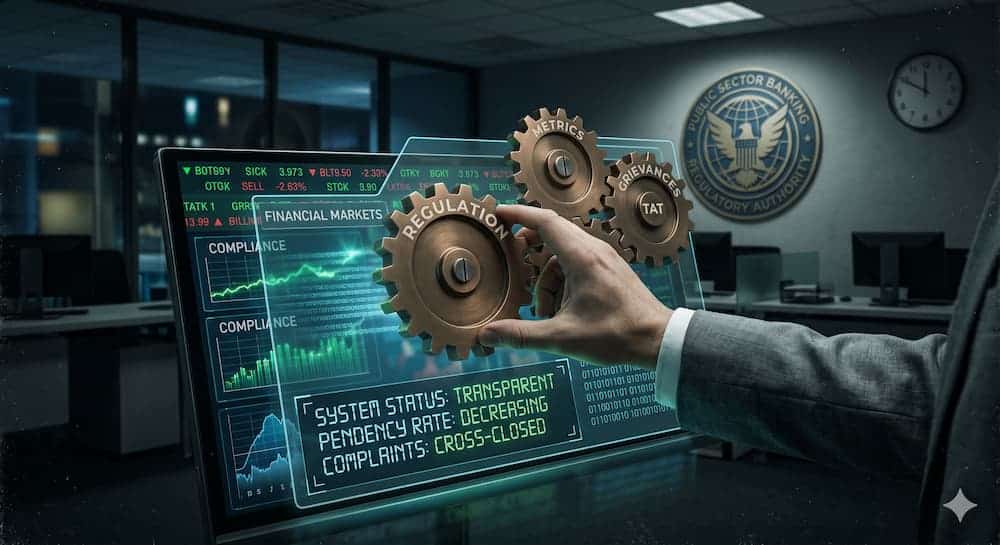
Public Sector Banks and Regulators manipulate the system tools available for the delivery of public services in India. Recently, State Bank of India responded to two separate complaints by closing them with the remark “duplicate complaint.” This raises a critical question: if both complaints are indeed duplicates, whose duplicates are they? It is essential to consider the potential ramifications of such practices on accountability and transparency within the banking sector. The lack of clear communication regarding duplicate complaints can lead to frustration among customers, who may feel that their concerns are not being taken seriously. Moreover, this situation could potentially undermine public trust in financial institutions, making it imperative for banks to adopt more effective complaint resolution mechanisms.
Key Takeaways
- Public Sector Banks and Regulators manipulate complaint systems, leading to frustration and distrust among customers.
- The State Bank of India employs deceptive practices, such as cross-closing complaints to falsify performance metrics.
- The Reserve Bank of India fails to enforce consumer protection, reinforcing the passivity of regulatory oversight.
- Small-value fraud cases often receive inadequate attention from local police, allowing banks to evade accountability.
- Citizens must push for transparency through formal complaints and legal action against negligent banking practices.
The Illusion of Redressal: How Public Sector Banks and Regulators Manipulate Systems
Modern India markets its digital financial systems as highly efficient models of absolute consumer empowerment. For instance, the government presents portals like CPGRAMS and the National Cyber Crime Reporting Portal as ironclad shields. They supposedly protect ordinary citizens from administrative delays and digital fraud. However, a troubling truth emerges when you audit these systems from the ground up. Behind the polished user interfaces lies a deeply entrenched culture of administrative evasion, metric distortion, and systemic non-accountability.
Public sector giants like the State Bank of India (SBI) frequently prioritize bureaucratic metrics over customer justice. At the same time, regulatory bodies like the Reserve Bank of India (RBI) look the other way. Consequently, it becomes glaringly obvious how Public Sector Banks and Regulators Manipulate Systems to shield themselves from public audit.
1. The Anatomy of Deceptive Closure: The Duplicate Ticket Gambit
The most obvious display of bad faith occurs when officials twist public grievance mechanisms to falsify performance metrics. Recently, a highly documented case involving an international merchant refund highlighted this issue. The merchant, Paddle (London, UK), issued a refund for ₹6,783.40. Unfortunately, the bank subjected the complainant to a cynical bureaucratic shell game.
The complainant filed two separate grievances on the CPGRAMS portal. These files carried Registration Numbers DEABD/E/2026/0095920 and DEABD/E/2026/0097178. However, the Office of the Chief General Manager (CGM & CXO) of the State Bank of India cross-closed both files. First, the bank closed Complaint A because Complaint B was “under process.” Next, the bank closed Complaint B the very next day because Complaint A was “under process.
[Grievance 0095920] ---> Closed on 23/06/2026 ---> Reason: "Refer to Grievance 0097178"[Grievance 0097178] ---> Closed on 24/06/2026 ---> Reason: "Refer to Grievance 0095920" | v [BOTH TICKETS MARKED CLOSED]
This is not a technical glitch. Instead, it is a calculated corporate strategy. By cross-closing active files as duplicates, SBI demonstrated exactly how Public Sector Banks and Regulators Manipulate Systems to achieve deceptive goals:
- Metric Falsification: This tactic eliminates active disputes. Therefore, it artificially drives down the bank’s average grievance resolution time so executives can claim high success rates on paper.
- Evasion of Mandatory Penalties: Furthermore, it hides a clear violation of the RBI’s Turn Around Time (TAT) framework. This framework mandates a daily penalty of ₹100 for delayed credits.
- Denial of Appeal Rights: Finally, marking a ticket as a duplicate disables the complainant’s legal right to escalate the matter through the portal’s standard appeal options.
Eventually, the backend technical team at Regional Business Office-7 (Robertsganj) had to manually credit the money under internal CRM No. 1029290219. They did this because the user provided an indisputable Acquirer Reference Number (ARN). Nevertheless, the public portal record remains deliberately distorted.
2. The Post-Office Regulator: RBI’s Flight from Enforcement
The institutional rot deepens because the sector’s highest authority takes a passive stance. Instead of acting as an aggressive watchdog, the Reserve Bank of India operates primarily as a high-priced post office. The RBI issues elaborate master circulars concerning consumer protection and “Zero Liability” for unauthorized electronic transactions. However, its operational arm tells a completely different story.
When citizens forward complex banking disputes or urgent cyber-fraud inputs to the RBI, the Consumer Education and Protection Cell (CEPC) rarely initiates independent punishments. Instead, it merely routes the complaint directly back to the Principal Nodal Officer of the offending bank. Then, it asks that specific bank to submit a report.
This total absence of top-down enforcement proves that Public Sector Banks and Regulators Manipulate Systems to pass the buck. Because the regulator treats rules like the TAT framework as optional suggestions rather than mandatory laws, it actively runs away from accountability. As a result, citizens must file multiple public grievances just to access their own money.
3. The Forensic Blindspot: Small-Value Fraud and Police Evasion
The failure of the administrative machinery reaches its lowest point where local law enforcement meets digital banking. A stark example is the recent handling of FIR No. 226/2023 under Section 420 IPC and 66C/66D IT Act. The complainant filed this case at the Kotwali Katra police station concerning a digital fraud of ₹4,999 from the account of Keshav Pratap Singh (Tantrik K. P. Singh).
The investigating officers closed the case by filing a Final Report that cited a “lack of evidence.” In an era of digital banking, this claim is an admission of absolute professional incompetence or deliberate laziness.
Digital funds leave a permanent, unerasable electronic trail. Yet, when Public Sector Banks and Regulators Manipulate Systems, they leave loopholes that allow local police to ignore ironclad digital leads:
- The KYC Protocol: Every active bank account must follow strict statutory Know Your Customer (KYC) rules. Therefore, Federal Bank legally possesses the physical photos, ID documents, and biometrics of the individual who opened the mule account.
- The Digital Footprint: In addition, the immediate call to the National Cyber Crime Helpline (
1930) locks the unique transaction hash tokens across the network. This action preserves the IP addresses, device signatures, and locations used by the fraudsters.
The local police refused to issue statutory notices to Federal Bank to extract KYC records, device logs, and ATM CCTV footage. Consequently, law enforcement effectively protected corporate banking lapses instead of delivering public justice.
4. Systemic Takeaways: Confronting Institutional Anarchy
The combination of cross-closed public tickets, passive regulation, and superficial police work demonstrates a grim reality. The current grievance machinery aims to manage public anger rather than solve structural problems. When Public Sector Banks and Regulators Manipulate Systems, police systematically ignore small-value frauds. They fail to recognize that thousands of these uninvestigated ₹4,999 thefts collectively fund massive cyber-crime syndicates.
To break this cycle of administrative anarchy, petitioners and civil society defenders must stop relying on standard portals. Instead, they must deploy a more aggressive, multi-pronged strategy:
| Forum | Action Mechanism | Core Objective |
| Judicial Magistrate Court | File a formal Protest Petition under Section 173(8) CrPC against police Final Reports. | Force a judicial review of incomplete investigations and mandate the collection of bank KYC and device logs. |
| RBI Integrated Ombudsman | File a non-cooperation dispute via cms.rbi.org.in against beneficiary banks maintaining unverified mule accounts. | Enforce the “Zero Liability” framework and penalize banks for gross KYC verification negligence. |
| Cabinet Secretariat | Escalate portal data manipulation directly to the Directorate of Public Grievances (DPG). | Expose public sector banks that falsify performance metrics by cross-closing active complaints as duplicates. |
The administration may continue to hide behind automated closure remarks and superficial reports. However, they cannot erase the immutable digital footprints of financial transactions. True transparency will not be delivered voluntarily by the machinery; rather, citizens must extract it through persistent, documented, and legally precise institutional pressure.
Based on the official grievance records, bank notifications, and institutional tracking details discussed, here is the consolidated directory of the application IDs, email addresses, contact numbers, and web portal links for the concerned public authorities.
1. State Bank of India (SBI) Authorities (Public Sector Banks and Regulators Manipulate)
Core Grievance & Application Details (Public Sector Banks and Regulators Manipulate)
- Grievance Registration Number 1:
DEABD/E/2026/0095920(Filed: 20/06/2026) - Grievance Registration Number 2:
DEABD/E/2026/0097178(Filed: 23/06/2026) - Internal Bank CRM Complaint Number:
1029290219(Lodged: 22/06/2026)
Key Contacts & Escalation Points (Public Sector Banks and Regulators Manipulate)
| Authority / Office | Contact Person | Email Address | Contact Number / Address |
| SBI Regional Business Office-7 (Robertsganj – 231216) | Binod Prasad (Chief Manager, Operations) | CMCOMP7.ZOVAR@sbi.co.in | +91-9672148295 |
| SBI Corporate Centre (Customer Service Dept.) | Chief General Manager (CGM & CXO) | cgm.cmcs@sbi.co.in | 022-2274241016th Floor, State Bank Bhawan, Madam Cama Road, Mumbai |
| General SBI Contact Centre | Customer Support | — | 1800 1234 or 1800 2100 (Toll-Free) |
| SBI Unauthorised Transaction Reporting | Fraud Reporting Cell | — | 1800 11 1109 (Toll-Free) |
2. Regulatory & Oversight Bodies (Public Sector Banks and Regulators Manipulate)
Reserve Bank of India (RBI) (Public Sector Banks and Regulators Manipulate)
- Concerned Division: Consumer Education and Protection Cell (CEPC) / Integrated Ombudsman
- Primary Web Link: RBI Complaint Management System (CMS)
- Core Mandate: Enforcing the Zero Liability Framework and the Harmonization of Turn Around Time (TAT) penalties.
Directorate of Public Grievances (DPG) (Public Sector Banks and Regulators Manipulate)
- Concerned Division: Cabinet Secretariat, Government of India
- Primary Web Link: Directorate of Public Grievances Portal
- Central Grievance Portal Link: CPGRAMS Portal
- Core Mandate: Investigating public sector utilities that lock or manipulate citizens out of active grievance processes.
3. Law Enforcement & Cyber Crime Authorities (Public Sector Banks and Regulators Manipulate)
Kotwali Katra Police Station (Mirzapur, UP) (Public Sector Banks and Regulators Manipulate)
- FIR Tracking Number:
No. 226/2023(Under Section 420 IPC & 66C/66D IT Act) - Concerned Investigating Officer: Inspector Arvind Kumar Yadav
- Primary Web Link for UP Police FIR Status: Uttar Pradesh Police CCTNS Portal
National Cyber Crime Reporting Mechanism (Public Sector Banks and Regulators Manipulate)
- National Cyber Crime Helpline:
1930(Immediate Emergency Call Line) - Primary Web Link: National Cyber Crime Reporting Portal
4. Public Interest Platforms (Public Sector Banks and Regulators Manipulate)
- Case Repository & Investigative Blog: yogi.systems (Used for logging the systemic tracking of digital banking lapses and public interest litigation filings).


Facing a similar challenge? Share the details in the box below, and our team of experts will do their best to help.