
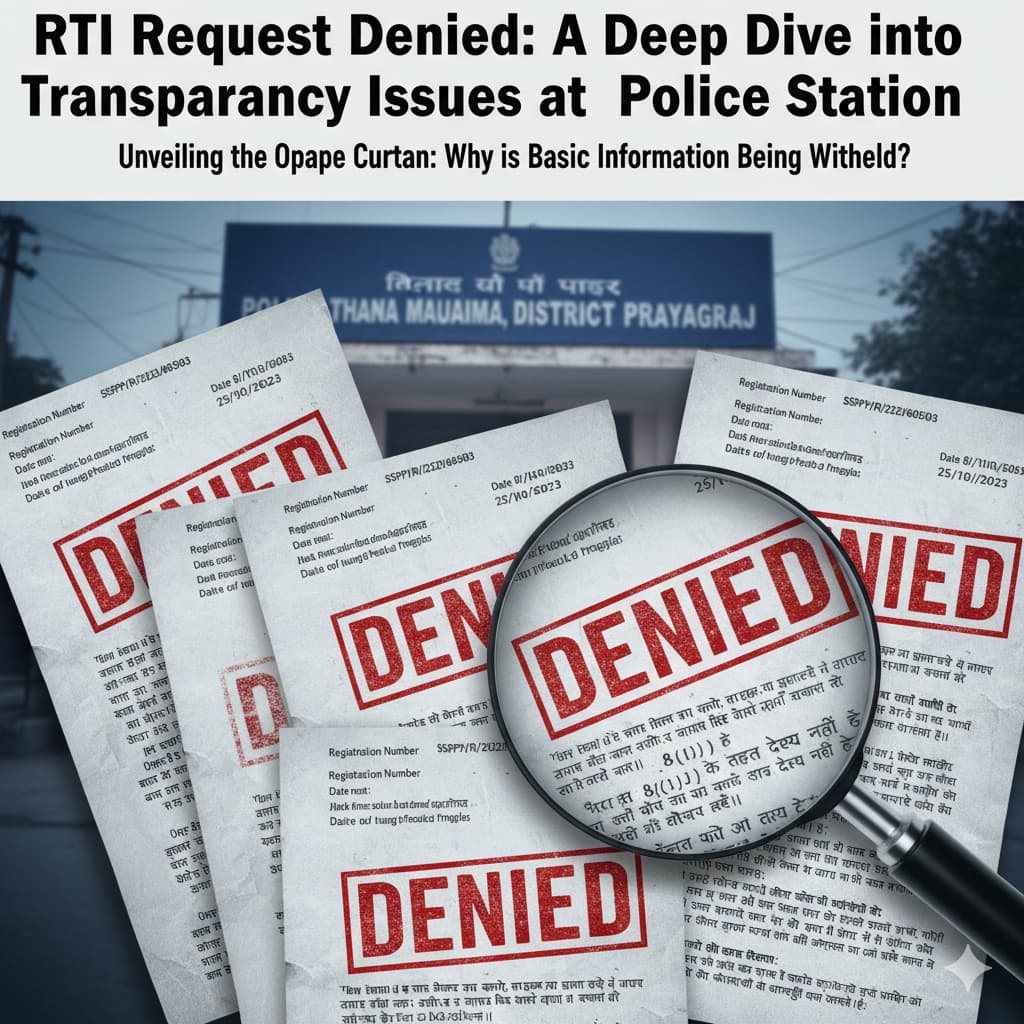
🚨 RTI Denied: Is the Mauaima Police Station Hiding the Truth? 🤫
Key Takeaways
- Yogi M. P. Singh filed an RTI request for information from the Mauaima Police Station, but the response was a near-total rejection.
- The police cited Section 8(1)(J) of the RTI Act, 2005, claiming the information requested violated privacy.
- The refusal to disclose data on expenditures and operational metrics reflects a troubling lack of transparency.
- The case escalated to the State Information Commission, which will review the police’s position on January 2, 2025.
- This situation highlights the broader implications for the Right to Information Act and public accountability.
A Citizen’s Quest for Transparency Hits a Brick Wall in Mauaima Police Prayagraj
On October 25, 2023, a concerned citizen, Yogi M. P. Singh, submitted a comprehensive Right to Information (RTI) request (Reg. No. SSPPY/R/2023/60503) to the Mauaima Police Station in Prayagraj, seeking basic operational and financial data. However, the police station did not provide a clear set of answers and instead issued a near-total rejection based on questionable grounds—raising serious alarms about transparency in public service.
🛑 The Eight Points of Information—And the Eight Denials reflects truth of Mauaima Police.
Mr. Singh’s RTI was precise. He didn’t ask for national security secrets; he asked for core metrics of police function and public expenditure. It’s intriguing how the requests, including those to Mauaima Police, covered these aspects:
- Crime Data: Number of FIRs, NCRs, and preventive actions ($text{u/s } 107/116/151 text{ Cr. P.C.}$) for two financial years.
- Financial Records: Detailed figures for fuel expenses (diesel/petrol) and electricity bills over five years.
- Infrastructure Costs: Funds spent on painting and whitewashing over the last five years.
- Personnel Details: Posting and joining dates for the SHO, all Sub-Inspectors, and all Police Constables.
- Law Enforcement Action: Details on action taken against illegal liquor business and registered cases under the Narcotics Act.
🧐 The PIO’s Blanket Rejection: Citing RTI Section 8(1)(J)
The response from the Assistant Commissioner of Police (ACP) Phoolpur/Assistant Public Information Officer was staggering. For every single one of the eight points, the Mauaima Police Station report cited Section 8(1)(J) of the RTI Act, 2005, which deals with information that:
“relates to personal information the disclosure of which has no relationship to any public activity or interest, or which would cause unwarranted invasion of the privacy of the individual.”
Think about that: Is the total annual fuel bill for a police station “personal information? Are the posting dates of government employees “an unwarranted invasion of privacy”?
The Core Problem:
- Financials (Fuel, Electricity, Painting): These are details of public expenditure. Denying them undermines the very principle of financial accountability.
- Crime & Action Data (FIRs, NCRs, Illegal Liquor): These are operational metrics that directly relate to the police station’s public duty. This is the definition of “public activity.”
- Personnel (Names and Posting Dates): The government discloses the names and posting history of employees performing public duty, and they consider this information public, especially their joining dates in the district.
The indiscriminate use of Section 8(1)(J) for operational and financial data suggests an alarming pattern of stonewalling from Mauaima’s policing system rather than a genuine legal objection.
🏛️ The Next Battle: A Date with the State Information Commission
Fortunately, the story doesn’t end with the initial denial. The matter has now escalated to the State Information Commission (SIC) in Lucknow.
The Commission has directed the ACP’s office to appear on January 02, 2025, and present their written submission (likhit abhikathan). This second appeal will test the legal strength of the applicant’s case and require the police station to formally justify why releasing the total fuel bill would invade someone’s privacy.
📢 Call to Action: Why This Matters to You!
This case isn’t just about one police station; it’s a test of the Right to Information Act itself. If public authorities can use vague exemptions to hide basic operational data, our democracy suffers.
What are your thoughts? Does a public servant have a right to privacy regarding their date of joining a district? Should public funds spent on fuel be kept secret?
Share this post and join the conversation! Follow the news on this case as we wait for the SIC’s ruling on January 2, 2025. The fight for transparency is everyone’s fight, including challenging practices at the Mauaima Police Station!
Yes, I can draft a detailed analysis of the legal grounds under Section 8(1)(j) of the RTI Act, 2005, for a follow-up blog post.
This section is one of the most frequently invoked exemptions, creating a constant tension between the citizen’s right to information and an individual’s right to privacy.
⚖️ Legal Analysis: The Privacy Exemption under RTI Act’s Section 8(1)(j)
Section 8(1)(j) of the Right to Information (RTI) Act, 2005, is the statutory provision that protects an individual’s personal privacy from unwarranted public disclosure. A robust analysis of this section is critical for any PIO or Appellate Authority.
1. The Text of the Exemption (Original Provision)
The original Section 8(1)(j) provides exemption for:
information which relates to personal information the disclosure of which has no relationship to any public activity or interest, or which would cause unwarranted invasion of the privacy of the individual unless the Central Public Information Officer or the State Public 1Information Officer or the appellate author2ity is satisfied that the larger public interest warrants the disclosure of such information.
2. The Two-Part Test for Denial
For a PIO to successfully deny information under this original clause, they must satisfy a two-pronged test:
| Test Part | Criterion |
| Part A (Lack of Public Nexus) | The information must be personal and have no relationship to any public activity or interest. |
| OR | |
| Part B (Unwarranted Invasion) | The disclosure of the information must cause an unwarranted invasion of the privacy of the individual. |
If either of these criteria is met, the information is exempt from disclosure, unless the public interest override applies (see section 3).
3. The Crucial “Public Interest Override”
This is the most critical element of the original provision, designed to maintain the RTI Act’s emphasis on transparency.
- Even if the information meets the criteria for exemption (i.e., it is personal and private), the PIO must still disclose it if the larger public interest in its disclosure outweighs the harm to the protected privacy interest.
- The Supreme Court has clarified that this test requires a case-by-case basis determination by weighing the competing claims of transparency and privacy.
- The burden of proof to demonstrate that the disclosure is warranted by larger public interest traditionally rests with the RTI applicant, especially when dealing with third-party personal information.
4. Judicial Precedents and Interpretation
The interpretation of Section 8(1)(j) has been heavily shaped by landmark judgments:
- Public Officials vs. Private Citizens: The Supreme Court has stated that a public official’s right to privacy cannot be invoked regarding their official duties. Information related to public activity—such as disciplinary action records, asset declarations, and official communications—often fails the privacy defense test because it relates to public activity and interest.
- Examples of Exempted Information: Information considered “personal” and often protected under the original 8(1)(j) (unless public interest is proven) includes:
- Details of a person’s Income Tax Returns (ITRs).
- Medical records and certain service records (e.g., PF nominees, leave details).
- Marks/answer sheets of other candidates in exams, to protect their privacy.
- Proviso Test: The original Section 8(1) had a proviso: “Provided that the information which cannot be denied to the Parliament or a State Legislature shall not be denied to any person. PIOs were advised to use this as an acid test: if the information would have to be shared with the legislature, it should not be denied to the citizen.
5. The Impact of the Digital Personal Data Protection Act (DPDP Act, 2023)
It is crucial to note that the DPDP Act, 2023, has introduced a significant legal change by amending Section 8(1)(j) of the RTI Act:
- The amendment is widely criticized for removing the “larger public interest override” from Section 8(1)(j).
- The Shift: This means that if information can be classified as “personal information” (now read broadly alongside “Personal Data” under the DPDP Act), it can be denied outright, regardless of how compelling the public interest is (e.g., exposing large-scale corruption).
- This legislative change significantly alters the balance, potentially allowing PIOs to deny information by simply classifying it as “personal” and making the default decision one of denial, not disclosure.
I recommend the follow-up blog post focus on the pre-amendment interpretation of the “public interest override” through case law, and then dedicate a section to the significant impact of the DPDP Act on this foundational right.
Would you like to focus the blog post on the judicial precedents of public interest outweighing privacy, or on the critical analysis of the recent amendment?
Public information officer Phoolpur did not provide any information in two and a half months so appeal made against him. PIO in office of commissioner of police, Prayagraj may provide information


Facing a similar challenge? Share the details in the box below, and our team of experts will do their best to help.