
Key Takeaways
- The Ayushman Scheme & Older Citizens aimed to provide universal healthcare, yet a tragic case in Mirzapur highlights systemic failures.
- A complainant alleges that his mother, eligible for treatment, was denied timely care due to bureaucratic negligence.
- This incident reflects a larger issue of corruption and mismanagement within the Ayushman framework, undermining its goals.
- Authorities archived the grievance unhelpfully, ignoring claims of negligence and failing to ensure accountability.
- To restore trust, the government must acknowledge failures, issue refunds, and commit to addressing systemic issues.
A Plea for Justice: How the Ayushman Scheme & Older Citizens Were Failed in Mirzapur
This document addresses grievance GOVUP/E/2025/0060071 on its merits. It focuses on the alleged failure to protect older citizens. Consequently, the system denied a critically ill older patient timely and free treatment. Furthermore, the Ayushman Scheme & older citizens share a bond built on a promise of universal healthcare access. This case, therefore, reveals what happens when authorities break that promise at the ground level.
The Grievance: Bureaucracy vs Life
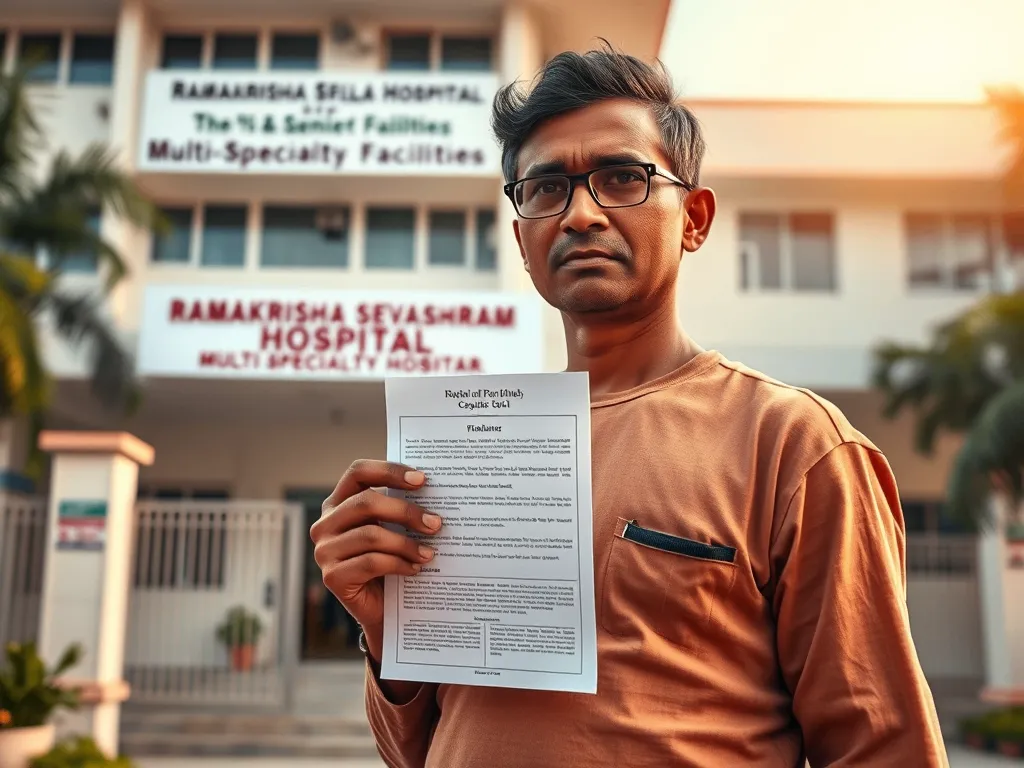
The complainant, Yogi M. P. Singh, raises a core issue: the alleged systemic failure and “doubtful integrity” of the Ayushman office staff at Ramakrishna Sevashram Hospital, Mirzapur. This failure directly links to the tragic death of his 78-year-old mother, Vidya Devi. She was admitted to the Intensive Care Unit (ICU) on June 3, 2025. Moreover, the case sits at the heart of a wider national concern — the gap between the Ayushman Scheme’s stated commitment to older citizens and its real-world implementation.
The complainant provided his mother’s Aadhaar card early in the morning. Nevertheless, the Ayushman staff allegedly failed to complete the biometric process and issue the Ayushman Vay Vandana Card before she passed away. Under the Ayushman Scheme, older citizens aged 70 and above hold entitlement to a separate, dedicated health card. This card provides up to ₹5 lakh in free treatment annually — regardless of income. The Union Cabinet approved this expansion on 11th September 2024, for patients like Vidya Devi. As a result, the delay robbed her of the cashless care she was legally entitled to. To make matters worse, the Chief Medical Officer’s(CMO) office merely suggested downloading the card online. That response was utterly inappropriate and failed to address either the life-and-death urgency or the severe negligence claims.
The Merit of the Claim: The Ayushman Scheme’s Promise to Older Citizens vs. Ground Reality
The complainant grounds his request in two significant facts. First, Vidya Devi was born on 01/01/1950, making her 75 years old at the time of the grievance in June 2025. Second, the Ayushman Scheme’s expansion for older citizens is unambiguous: all Indian citizens aged 70 and above qualify for the Ayushman Vay Vandana Card, with no income threshold applied. Consequently, Vidya Devi was unequivocally eligible for a separate Ayushman Card and the associated medical benefits, including up to ₹5 lakh in free treatment annually. Furthermore, the family had already provided the only document required for enrolment — an Aadhaar card. Therefore, the dedicated hospital staff should have completed the Aadhaar-based e-KYC, the sole procedural step, on the spot.
The government establishes an Ayushman office on the hospital’s premises to facilitate immediate, on-the-spot enrolment and verification. This ensures that critical patients like Vidya Devi receive care without delay. Importantly, the Ayushman Scheme’s commitment to older citizens explicitly includes coverage from the very first day of enrolment, with no waiting period for any disease or treatment. This setup, therefore, is the tangible embodiment of the scheme’s spirit: to remove financial barriers to health access for India’s most vulnerable older population. In this case, nobody questioned the patient’s eligibility. Instead, the staff delayed only the administrative process. Mismanagement led to denial of service. Notably, the dedicated Ayushman office staff failed to complete the biometric verification for a patient lying in the ICU. This failure strongly suggests a grave breach of duty.
- Financial Burden: Because of the delay, the family — described as poor, with three unemployed sons — paid an immediate ₹18,000 to transfer the mother from the emergency ward to the ICU. This situation highlights ongoing challenges faced by Older Citizens under the Ayushman Scheme. This directly contravenes the scheme’s core objective of providing free healthcare to those who need it most.
- Systemic Failure: The complainant argues that this incident exposes a “root cause of the failure of the Ayushman scheme” — corruption is preventing facilities from reaching those who need them, despite the government’s grand claims. In this instance, the hospital office entirely defeated its own purpose: to ensure the Ayushman Scheme reaches older citizens at their most critical moments. At the national level, the scheme has recorded over 116 million hospital admissions and sanctioned treatments worth ₹1.73 lakh crore. Yet the tragedy in Mirzapur illustrates that impressive national figures can mask devastating local failures.
Analysis of the Closure Remarks
The grievance was officially closed on 24/06/2025 with the following unhelpful remark:
“Sir, I would like to inform you that you can download your Ayushman card by yourself through the portal beneficiary.nha.gov.in. Once you receive your card, you can get free treatment at any Ayushman panelled hospital.
This response is severely flawed and compounds thIgnores the Tragic Outcome: The response completely overlooks the complainant’s devastating opening statement: “she is no more.” Advising a grieving family to download a card is not only irrelevant—it is deeply insensitive when Shifts Blame: the response places the responsibility for obtaining the card squarely on the grieving family. In doing so, it ignores the complainant’s claim that the in-house Ayushman office staff failed in their duty to facilitate card issuance at the hospital — precisely the reason the authorities placed them there. Thisis the very reason for their placement there.
- Fails to Address Allegations: The response addresses none of the core allegations — negligence, doubtful integrity, corruption, or mismanagement — against the hospital’s Ayushman staff. Furthermore, it initiates no inquiry into the financial exploitation of a poor family for care that should have been provided. The closure is, therefore, a prime example of administrative non-disposal. In other words, authorities closed the case on paper while failing entirely to address the substantive merits — official misconduct and the denial of a fundamental right to health under a government-sponsored scheme.nsored scheme.
Requested Action: Upholding the Ayushman Scheme’s Duty to Older Citizens
The complainant requests medical help and an inquiry under Article 51A of the Constitution of India. He also pleads to “direct the concerned hospital to provide the free facility,” underscoring the gravity of the situation. Although the patient has passed, the grievance retains full merit. Specifically, it now transitions from a request for medical aid to a firm demand for accountability and justice for the denial of entitled services.
The comments of the Chief Medical Officer, Mirzapur, must reflect the following:
- Acknowledgement of the Death: A formal acknowledgement of the unfortunate demise of Vidya Devi.
- Verification of Eligibility: Confirmation that Vidya Devi was, in fact, eligible for the AB PM-JAY scheme as an older citizen aged 70+.
- Inquiry into Staff Conduct: The CMO must immediately launch a detailed, time-bound inquiry into the conduct of the Ayushman office staff at Ramakrishna Sevashram Hospital. Specifically, the inquiry must determine:
- Why the biometric process failed or was delayed for a critically ill patient.
- Whether the staff were derelict in their duty.
- Whether the hospital knowingly charged the family for services that should have been covered by the scheme.
- Refund/Compensation: A directive to the hospital to immediately refund the ₹18,000 incurred by the family on June 3rd, 2025, as this expense was necessitated by the scheme’s failed implementation.
- Systemic Correction: A plan to re-train or replace Ayushman Mitras/staff to ensure that such critical administrative delays do not lead to the denial of care and potential financial hardship for any other patient. The Ayushman Scheme’s protection of older citizens — a cohort now numbering crores across 4.5 crore families — is only as strong as the frontline staff tasked with delivering it. Structural reform at the hospital level is non-negotiable.


Facing a similar challenge? Share the details in the box below, and our team of experts will do their best to help.