
Key Takeaways
- The case Yogi MP Singh vs ACP Phoolpur showcases the conflict between public accountability and the investigation exemption. This occurs under the RTI Act.
- The Appellant seeks vital information regarding police accountability and crime management, not sensitive case details.
- The PIO denies the request, citing Section 8(1)(h) of the RTI Act, claiming disclosure could impede investigations.
- The Appellant challenges this exemption, arguing it misapplies the law and focuses on administrative rather than case-specific data.
- The appeal stresses the importance of transparency in public office to ensure accountability in law enforcement.
🚨 RTI Battle in UP: Accountability vs. Investigation Exemption
The case of Yogi MP Singh vs ACP Phoolpur (Appeal No. S10/A/0516/2024) is before the Uttar Pradesh Information Commission (UPIC). It highlights a crucial conflict in the Right to Information (RTI) Act, 2005, specifically involving Section 8(1)(h) of RTI Act. This conflict centres on the public’s right to know about police accountability. It also involves the police’s reliance on the ‘investigation exemption’ to deny information.
The core issue revolves around the repeated denial of information. This denial comes from the Public Information Officer (PIO) for the Assistant Commissioner of Police (ACP), Phoolpur, Prayagraj. It concerns motorcycle thefts and police administrative action.
1. The Appellant’s Core Demand
The Appellant, Shri Yogi MP Singh, originally sought information about the functioning and accountability of the Mauaima Police Station. This was in response to a steep rise in motorcycle thefts. His six key queries aimed at transparency. They did not seek sensitive details of ongoing cases.
| Query Type | Key Information Sought |
| Administrative Policy | Circulars/Office Memos exchanged with the Commissioner of Police regarding curbing criminal activities. |
| Accountability | Punitive action taken by the Commissioner of Police against personnel for the rise in thefts. |
| Case Status | Reasons for procrastination in registering FIRs and details of cases worked out (solved) in the last 6 months. |
2. The PIO’s Defense: Section 8(1)(h) of RTI Act
In the written statement dated 11/10/2025, the PIO/ACP Phoolpur relied on the report from the Mauaima Police Station Inspector. They denied most of the information. This denial was based on invoking Section 8(1)(h) of the RTI Act.
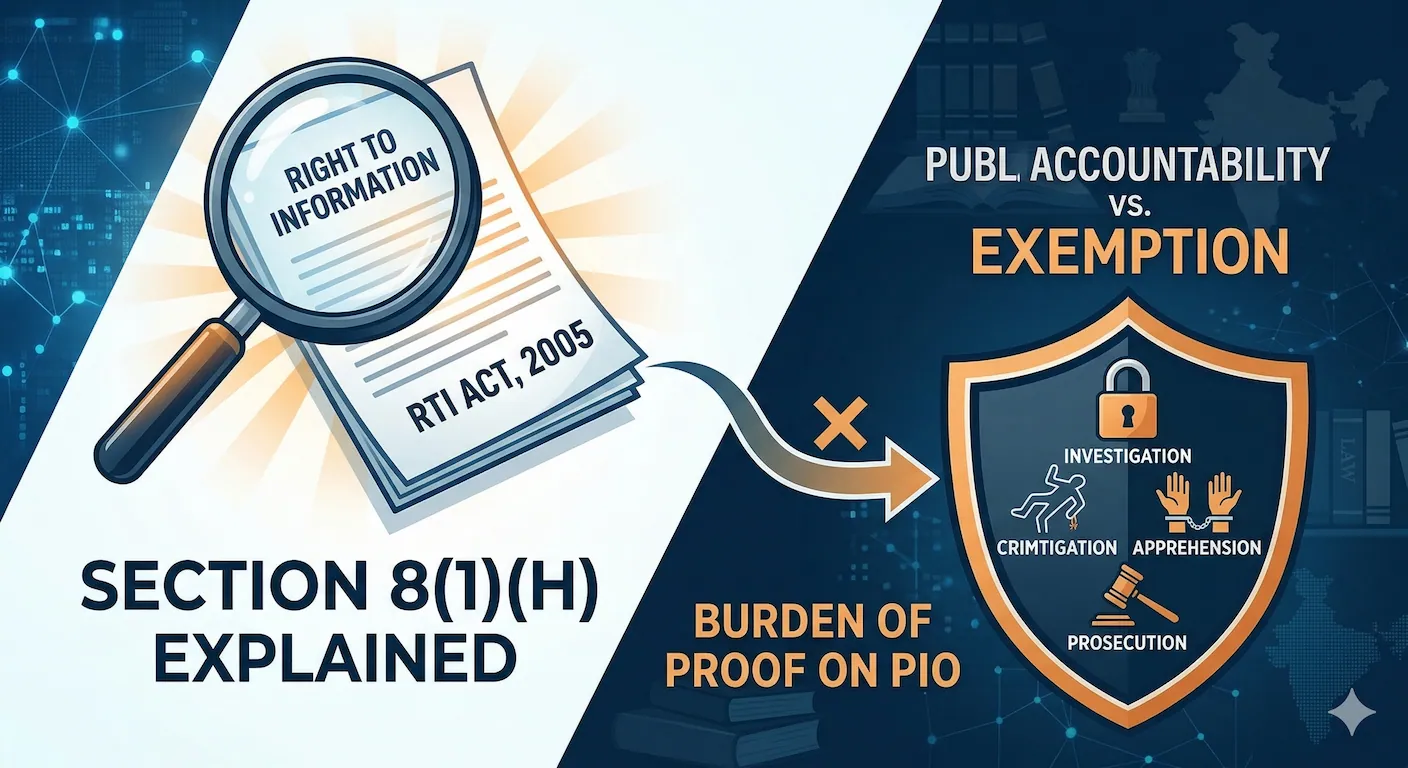
This section permits withholding information if its disclosure would “impede the process of investigation, apprehension or prosecution of offenders.”
- PIO’s Stance: Disclosing instructions on crime prevention or surveillance can hamper the investigation process. Additionally, sharing details about the recovery of the remaining stolen motorcycles may hinder the prosecution process.
3. The Appellant’s Objection: Misuse of Exemption
In his written statement dated 30/11/2025, the Appellant raises sharp objections. He filed this statement before the hearing on 02/12/2025. He argues that the PIO is misapplying and misusing the exemption.
A. The Flawed Investigation Claim (Section 8(1)(h) of RTI Act)
The Appellant argues that the claim of impending investigation is a “flimsy ground” because:
- Time Elapsed: I filed the initial RTI application on 01/01/2024, and I submitted the second appeal on 22/04/2024. The PIO’s reply acknowledges that they registered 21 cases in 2024 and 2025.
- CrPC Time Limits: Given that the time has expired. This period applies to Charge Sheets and ranges from 60 to 90 days if the accused is in custody. The time extends up to 6 months or 1 year in other cases.
- Lack of Proof: The PIO did not provide material evidence. They failed to show how revealing administrative memos would demonstrably impede an investigation at this stage.
B. Seeking Administrative, Not Case-Specific Data
The most forceful argument is that the RTI queries primarily seek systemic and administrative information related to police management. These queries also focus on accountability. They are generally not covered by the 8(1)(h) exemption.
- Information on punitive action taken against staff or internal circulars on crime control strategy falls under general administration.
- Denying this systemic data appears to be an attempt to “escape from accountability” and deny transparency in public office.
C. Incomplete and Vague Information
The PIO’s reply that a “total of 21 cases” were registered in “2024 and 2025” is criticized as vague. The Appellant seeks a clearer breakdown of cases registered in each year to properly assess the police response.
4. The Prayer for Justice (Section 8(1)(h) of RTI Act)
The Appellant’s representation concludes with a strong appeal to the UP Information Commission: (Section 8(1)(h) of RTI Act)
- Reject the blanket application of Section 8(1)(h).
- Direct the ACP Phoolpur to provide the complete administrative and systemic information requested on all six points.
- Initiate penalty proceedings under Section 20(1) of the RTI Act against the PIO for persistent denial without reasonable cause.
This case highlights the critical role of the State Information Commission. It acts as the final arbiter. This ensures that the police and other public authorities do not use RTI exemptions as a shield. They are held accountable to public scrutiny.
That’s a great idea! Knowing the exact text of the exemption helps in understanding the Appellant’s argument about its misuse.
Here is the full text of Section 8(1)(h) of the Right to Information Act, 2005, which forms the central legal point of contention in this case:
⚖️ Section 8(1)(h) of the RTI Act, 2005
Section 8 of the RTI Act lists exemptions, specifying the information that public authorities need not provide.
The police/PIO is invoking the specific clause in the appeal.
Section 8(1)(h) of RTI Act: Information that would impede the process of investigation, apprehension or prosecution of offenders.
| Component | Description | Relevance to the Case |
| “Information…” | Refers to any data, circular, memo, report, or correspondence requested under the Act. | The requested information includes administrative circulars, action taken reports, and case details. |
| “…that would impede…” | This is the crucial threshold. The public authority must demonstrate that disclosure would have a detrimental effect or obstruct the process. A mere possibility is generally not sufficient. | The Appellant argues the PIO made a blanket claim. The claim was made without demonstrating how revealing administrative memos would impede an inquiry. The inquiry is already well underway. |
| “…the process of investigation, apprehension or prosecution of offenders.” | These are the three legal processes protected by the exemption. | The PIO is using this to withhold details regarding crime prevention instructions and the status of stolen property recovery. |
🔑 Key Interpretation Point
The burden of proof in invoking this exemption lies with the Public Information Officer (PIO). The PIO must justify that the stage of the criminal matter genuinely impedes the process. It must not merely cause inconvenience or reveal administrative shortcomings.
🗓️ Sequence of Events in Appeal No. S10/A/0516/2024
The table below outlines the key actions taken by the Appellant, the PIO, and the UPIC. Shri Yogi MP Singh, the Appellant, is involved. The PIO, ACP Phoolpur, is also involved. The UPIC, short for Uttar Pradesh Information Commission, is also involved in this second appeal. (Section 8(1)(h) of RTI Act)
| Date | Event/Action | Authority/Party | Document Reference |
| 01/01/2024 | Original RTI Application Filed (Registration No. DGPOF/R/2024/60004). | Appellant | Submitted in Appellant’s representation. |
| 13/02/2025 | PIO issued communication denying information using Section 8(1)(h). | PIO/ACP Phoolpur | Referenced in Appellant’s email dated 15/04/2025. |
| 22/04/2024 | Second Appeal Filed before the UPIC (Registration No. A-20240401718). | Appellant | Notice/Representation documents. |
| 25/10/2024 | Initial Hearing Date fixed by the Commission. | UPIC | Case Status section of the latest diary entry. |
| 13/10/2025 | Commission’s Order passed (Appellant absent, PIO present). The PIO was directed to send the written statement to the Appellant. The Appellant had an opportunity to file objections. | UPIC (Hon’ble State Information Commissioner) | Order section.(Section 8(1)(h) of RTI Act) |
| 11/10/2025 | PIO submitted a Written Statement/Report to the Commission. They sent a letter with the point-wise denial of information (based on 8(1)(h)) to the Appellant. | PIO/ACP Phoolpur | PIO’s letter and report. |
| 11/11/2025 | The Commission issued a Notice (No. 202511S10N200298) for the next hearing. The Notice includes the order from 13/10/2025. It directs the PIO to submit an action-taken report two days before the next date. | UPIC | Notice document. |
| 30/11/2025 | Appellant drafted a Written Statement/Objection against the PIO’s response, citing the misapplication of Section 8(1)(h). | Appellant | Appellant’s email attachment/representation. |
| 01/12/2025 | Appellant emailed the Written Statement/Objection to the Commission. | Appellant | Email time stamp. |
| 02/12/2025 | Date Fixed for Next Hearing. | UPIC | Notice and Representation documents. |
📞 Key Contact and Website Details (Section 8(1)(h) of RTI Act)
| Party/Office | Contact Person/Reference | Mobile Number | Email Address(es) | Address/Website |
| Appellant | Shri Yogi MP Singh | 7379105911 | yogimpsingh@gmail.com | Surekapuram Colony, Jabalpur Road, Mirzapur City, District Mirzapur (Pincode: 231001) |
| Commission | Hon’ble State Information Commissioner (S-10) | N/A | hearingcourts10.upic@up.gov.in | 7/7/A, RTI Bhawan, Vibhuti Khand, Gomti Nagar, Lucknow |
| Commission Portal | Departmental Portal | N/A | N/A | https://upsic.up.gov.in/ |
| Opponent (PIO) | Public Information Officer, ACP Phoolpur | 9454401281 | co-phoolpur.ah@nic.in (or co-phoolpur.ah@nic.in) | ACP Phoolpur, POLICE COMMISSIONERATE PRAYAGRAJ |
| PIO (Cc) | Umesh Sharma (Possible Nodal/Supporting Officer) | N/A | UMESH SHARMA co-phoolpur.ah@nic.in | N/A |
✅ Rectification and Clarification of Available Information (Section 8(1)(h) of RTI Act)
Based on the appeal documents, here is the status of the key information points:
1. UP Information Commission Details
| Information Point | Status in Document | Rectification/Clarification |
| Appeal Number | Available | S10/A/0516/2024 |
| Registered Number | Available | A-20240401718 |
| Next Hearing Date | Available | 02/12/2025 |
| PIO Action Date | Available | The PIO was to submit a written statement two days before 02/12/2025 (i.e., by 30/11/2025). |
| Hon’ble State Information Commissioner’s Name | Partially Available | The order mentions Shri Rakesh Kumar, Hon’ble State Information Commissioner, but the signatory for the notice is Sonu Kumar Sen. |
Related reading: ACP Manoj Kumar Singh: Service Details Revealed


Facing a similar challenge? Share the details in the box below, and our team of experts will do their best to help.