
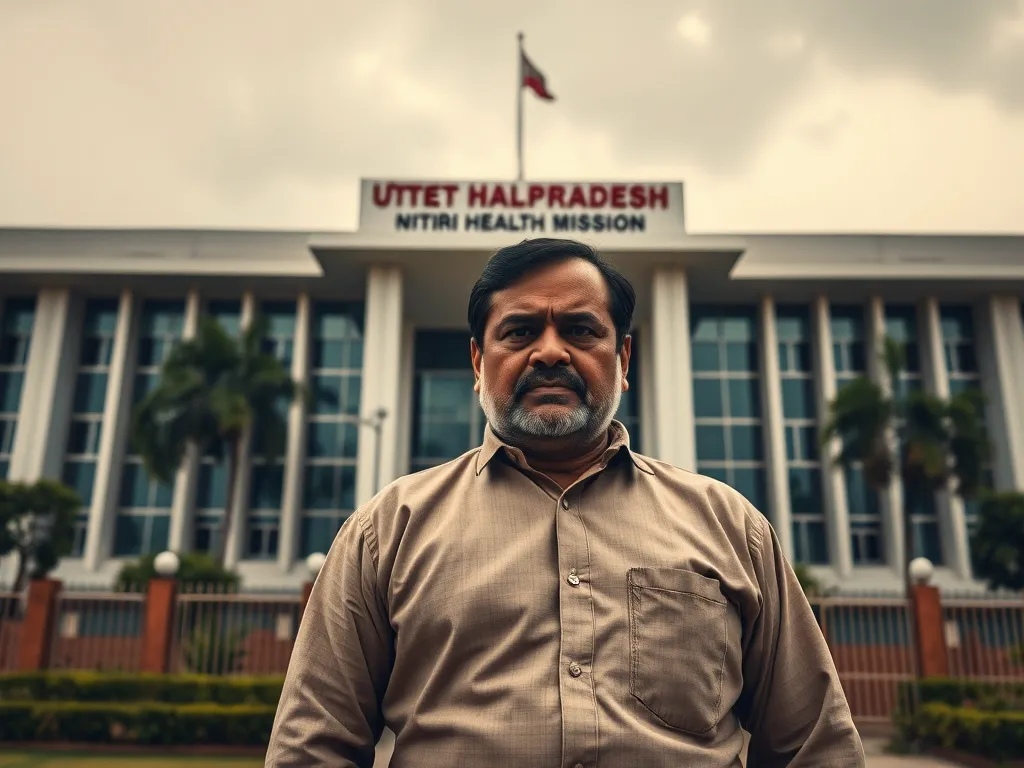
A contentious question now faces the director of the Uttar Pradesh government: did he act lawfully when he chose to ignore a High Court order? The order concerns the recruitment of over 17,000 contract staff in the Department of Medical and Health. In fact, this decision could significantly affect public health services across the state.
Officials must weigh two competing pressures. On one side sits the legal risk of defying a court mandate. Meanwhile, an urgent staffing need weighs on the other side, and ongoing health crises have made it worse. As a result, their choice will affect more than the administration — it will shape the lives of countless citizens who depend on these essential services.
Grievance Status for registration number DHLTH/E/2025/0000615 covers a complaint that Yogi M. P. Singh submitted on 09/01/2025. The Ministry of Health & Family Welfare received it. Notably, the complaint carries Hindi registration number 60000250006402, filed by the same applicant, Yogi M. P. Singh.
Key Takeaways
- The Uttar Pradesh government faces criticism for ignoring a High Court Order regarding the recruitment of 17,000 contract staff in the health sector.
- Yogi M. P. Singh filed a grievance alleging the director’s failure to comply with the court’s directive, impacting public health services.
- Singh’s grievance reflects widespread issues of accountability and transparency in the government’s response to citizen complaints.
- Citizens can escalate unresolved grievances to higher authorities, including filing contempt petitions with the High Court.
- The outcome of this case may reveal the government’s commitment to upholding the High Court Order and addressing public concerns.
High Court Order Ignored by UP: Navigating the Bureaucracy and a Grievance Unveiled
Every democracy depends on a constantly shifting relationship between citizens and their government. In fact, this dynamic interaction shapes politics and society alike.
When citizens believe officials have violated their rights, they hold a powerful tool: they can seek justice and accountability. For instance, if a public official fails in their duty, citizens can file a formal grievance, a vital mechanism for redress and reform.
Yogi M. P. Singh’s case with a recent public grievance fits this pattern. He noticed discrepancies in government services and documented them in detail. His complaint tells more than a complaint. Instead, it narrates a citizen’s struggle against alleged bureaucratic inaction — a challenge many people face when they navigate governance.
Through this grievance, Singh seeks more than personal vindication. Moreover, he highlights systemic issues that may affect countless others, sparking a broader conversation about accountability and transparency in public service.
The Health & Family Welfare Ministry formally registered the grievance. It spotlights a troubling issue: the alleged non-compliance of a public official with a clear, specific order from the High Court. This case impacts the individuals directly involved. Beyond that, it raises profound questions about the rule of law and the accountability of government officials in Uttar Pradesh.
The High Court’s Directive: A Clear Command
The entire grievance stems from a specific order: the High Court of Judicature at Allahabad issued it on October 21, 2024. Specifically, the case, titled Kanhaiya Lal And 6 Others vs. State of U.P. and Another, centered on a writ petition. Petitioners sought a resolution from “respondent No. 2” — the director of the National Health Mission (NHM) in Uttar Pradesh. (High Court Order Ignored by UP)
Petitioners filed the case because of ongoing concerns about the transparency and ethics of the recruitment process associated with the NHM. Critics have accused this process of irregularities and weak adherence to protocol. As a result, they approached the High Court, hoping judicial intervention would shed light on these pressing issues and ensure due process. Specifically, Kanhaiya Lal and six other appellants argued that NHM’s actions — or inactions — threatened their interests, so they asked the court to examine the matter closely.
The court gave a clear instruction: the director had to decide on the petitioners’ representation within two months. That window would start once petitioners submitted a certified copy of the court order.
Petitioners submitted their representation to the director on October 28, 2024, starting the two-month countdown. Consequently, this gave the NHM director a clear legal obligation to act by the end of December 2024.
The Allegation: A Grievance Against Inaction (High Court Order Ignored by UP)
Singh’s grievance, filed January 9, 2025, lays out the timeline in detail. He states that the two-month deadline passed with no action from the concerned official. However, this happened despite the High Court’s clear timeline. The grievance expresses dismay, stating that “respondent number 2 did not take a logistic approach” — a failure to follow the order the high court passed. In other words, this goes beyond a delayed decision: it directly accuses a government official of violating the high court’s order explicitly.
This case reflects a larger pattern. A High Court order forms a pillar of the legal system. However, when public staff allegedly fail to take it “seriously in letter and spirit,” disillusionment spreads. Ultimately, the complainant directly questions the state of “law order condition” in Uttar Pradesh and challenges the notion of “good governance” that its leaders promote.
What Comes Next: Possible Paths for Escalation
Citizens facing unresolved grievances against public officials in India generally have several avenues open to them. First, they can file a contempt petition directly with the High Court that issued the original order, asking the court to examine why its directive went unheeded. Second, they can pursue further RTI applications to gather documentary evidence of delay or inaction, building a stronger paper trail. Third, they can escalate the matter through higher administrative channels, such as the Chief Secretary’s office or the state’s Lokayukta, which handles complaints of corruption and maladministration. (High Court Order Ignored by UP)
Each path carries its own timeline and its own burden of proof. Nevertheless, together they form the toolkit available to ordinary citizens who believe the machinery of government has stalled. In this case, Singh’s grievance already represents one such step. Should the Ministry’s response fail to satisfy him, the natural next move would be a formal contempt petition before the Allahabad High Court itself.
For the more than 17,000 candidates awaiting clarity on their recruitment status, the stakes go well beyond procedure. Indeed, every month of delay narrows the window before candidates age out of eligibility, turning a bureaucratic dispute into a race against time.
Broader Implications and a Call for Accountability (High Court Order Ignored by UP)
Singh’s grievance is a powerful legal document and a sharp critique of public administration. In his view, a systemic failure within the governance framework undermines democracy and accountability.
He says government offices, including the Chief Minister’s Office, routinely fail to respond to grievances, leaving citizens feeling unheard and marginalized. In addition, these offices also withhold information under the Right to Information Act, 2005, a law meant to empower citizens and promote transparency.
The core question is whether the government of Uttar Pradesh operates with true transparency. Democracy depends on trust between government and citizens. However, the current landscape suggests an alarming disconnect.
A second question follows: does the government hold officials accountable for their actions? Public officials must answer to the electorate. Without accountability, governance loses its foundation, trust erodes, and public discontent grows. Therefore, citizens deserve a responsive government that actively addresses their concerns, ensuring their voices are heard, respected, and acted upon.
The grievance’s current status reads “Under process.” Officials forwarded it to the Director-General of Medical and Health, with a resolution expected by January 24, 2025. This case tests the system: will authorities respond to a citizen’s plea, respect judicial authority, and hold public officials accountable? Ultimately, the outcome will reveal much about the state of governance, and it will show how much value Uttar Pradesh places on a citizen’s voice in Uttar Pradesh.
Lack of transparency and accountability in selection process of recruitment
Related reading: ACP Manoj Kumar Singh: Service Details Revealed


Facing a similar challenge? Share the details in the box below, and our team of experts will do their best to help.