
Key Takeaways (Processing of Petitions Before UPHRC)
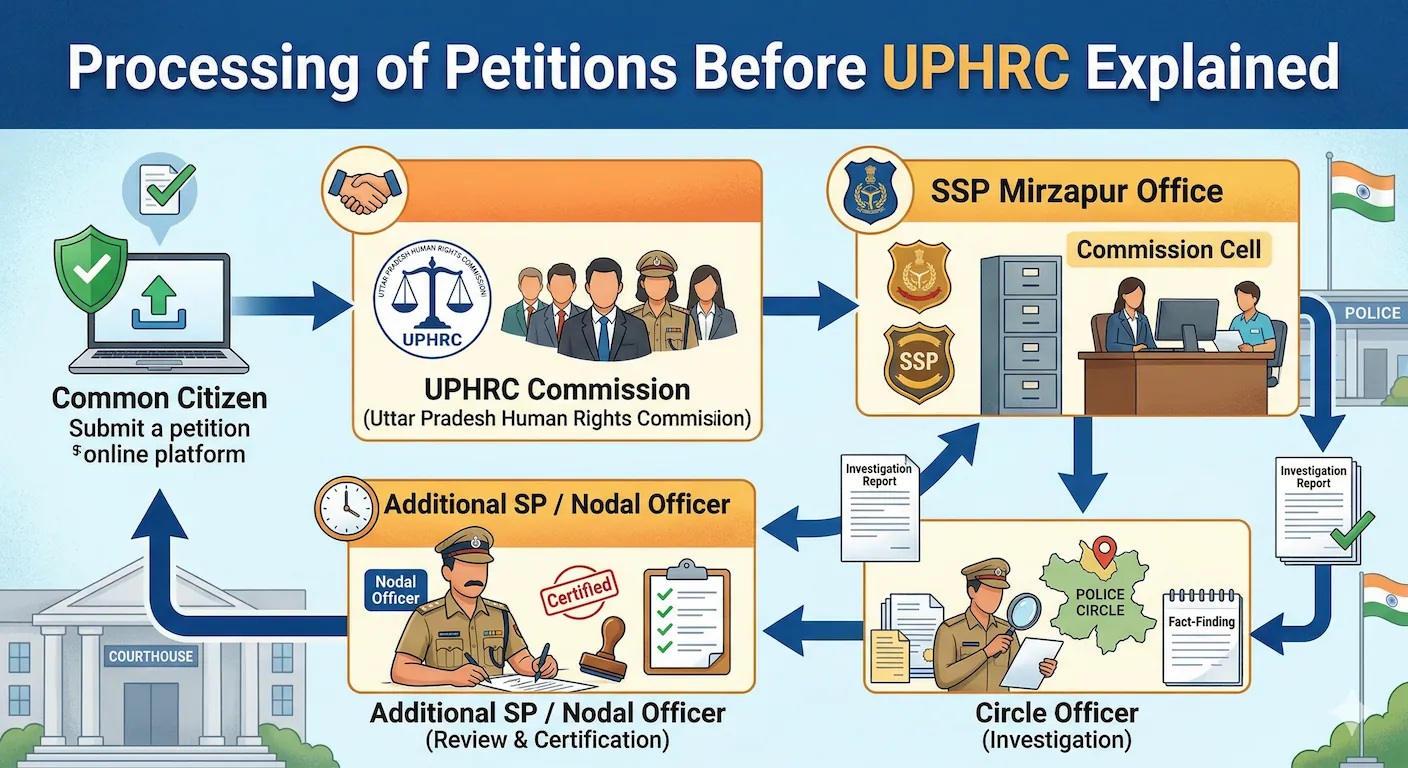
- The Uttar Pradesh Human Rights Commission (UPHRC) directs police actions on submitted applications, starting a multi-step process.
- Initially, the application is received by the Senior Superintendent of Police (SSP) and routed to the Commission Cell for management.
- The Circle Officer investigates the complaint. They submit a report. The Nodal Officer reviews the report before forwarding it to the UPHRC.
- The Additional Superintendent of Police (ASP) ensures compliance with the investigation report. The ASP certifies the findings before final submission to the UPHRC.
- The entire process ensures accountability, with clear roles for officers involved in handling and reporting on human rights applications.
🚨Processing of Petitions Before UPHRC & the Police in Mirzapur
The Uttar Pradesh Human Rights Commission (UPHRC) plays a critical role in addressing human rights violations. The Processing of petitions before the UPHRC is central. It dictates how a common citizen submits an application. It also defines how the Commission responds. When a common citizen submits an application to the UPHRC, the Commission takes note of it. If the Commission decides to take action, it directs the police accordingly. This triggers a specific process. The process is multi-step in nature.
The official response from the Circle Officer in Lalganj, Mirzapur, clarifies how staff handle these applications. We can break it down into several points. This response provides important insights. It helps us understand the process involved in managing these applications. The Police Department manages these applications. Here’s a point-by-point summary.
1. Initial Receipt and Assignment at the Senior Superintendent of Police (SSP) Office
When the UPHRC directs the police to act on an application:
A. Application Reception (Processing of Petitions Before UPHRC)
- The Commission typically receives the citizen’s application online. Then, it forwards the application to the Senior Superintendent of Police (SSP) in Mirzapur.
B. The Commission Cell
- After the SSP’s order, the application is routed to the Commission Cell within the SSP’s office.
- This cell is responsible for the administrative maintenance and dispatch of all applications received from the UPHRC.1
- Designated Staff: The specific employees maintain the applications in the Commission Cell. For example, Ms Laxmi Devi and Ct. Yogesh Kumar include in the document. These employees also handle dispatching the applications.
2. Transfer to the Jurisdictional Officer for Investigation (Processing of Petitions Before UPHRC)
Once recorded in the Commission Cell, the case is assigned to the relevant field officer for action.
- The Area Officer transfers the application. The Circle Officer (CO) of the relevant police circle also receives the transfer. For example, this could be Circle Officer Lalganj. The purpose of this transfer is for investigation.
3. Investigation and Report Submission (Processing of Petitions Before UPHRC)
The Circle Officer’s primary responsibility is to investigate the facts of the complaint.
- Investigation Conducted: The Area Officer/Circle Officer personally investigates the matter detailed in the application.
- Investigation Report: After completing the investigation, the CO prepares a formal report. This report includes their findings. For example, there is a report dated 28.02.2025 mentioned in the document.
- Report Dispatch: The CO returns the investigation report. This is done to the Commission Cell Office. The office belongs to the Senior Superintendent of Police, Mirzapur.
- Office Record Keeping: Ct. Ashish Kumar is responsible for dispatching them. He oversees the process of sending them out.For example, Ct. Ashish Kumar is responsible for dispatching them.
4. Final Review and Forwarding to the UPHRC
The investigation report is reviewed at a higher level before being sent back to the Commission. (Processing of Petitions Before UPHRC)
- Higher Authority Sign-off: The Senior Officer usually signs the investigation report. This officer could be the Additional Superintendent of Police, City Mirzapur, or the Nodal Officer. This certifies the report’s findings and official status.
- The SSP’s office prepares the final certified report. It then forwards the report to the UPHRC. This process closes the loop on the action directed by the Commission.
Key Takeaway (Processing of Petitions Before UPHRC)
The process ensures a clear chain of command. It guarantees accountability. The SSP’s Commission Cell acts as the central hub for receiving and tracking UPHRC applications. The Circle Officer is the designated field investigator. The Nodal Officer/Additional SP reviews the police findings. They certify these findings before the team communicates them back to the Human Rights Commission.
Here is an elaboration on the role of the Nodal Officer in this context:
👮♂️ Role of the Additional SP / Nodal Officer (Processing of Petitions Before UPHRC)
Uttar Pradesh transfers the application to the senior superintendent of Police, Mirzapur. The additional superintendent of police processes these applications with the help of his subordinates. The ASP is responsible for overseeing these applications. Their involvement is essential for ensuring a proper response and action. This position serves as an important checkpoint. The ASP serves as the certifying authority before the police finalise the response. Once they approve it, the response returns to the UPHRC.
1. Quality Control and Review
- Final Scrutiny: The Nodal Officer reviews the investigation report. The Circle Officer (CO) prepared and submitted the report after conducting the ground-level inquiry.
- Ensuring Compliance: This officer reviews the report. They ensure it addresses all points raised by the UPHRC and the original applicant. The officer verifies that the investigators conducted the investigation in accordance with the prescribed rules and procedures. (Processing of Petitions Before UPHRC)
2. Certification and Official Status
- Sign-off Authority: The Additional Superintendent of Police, City Mirzapur / Nodal Officer, signs the investigation report sent by the CO, as explicitly stated in the document.
- Authentication: The senior police official endorses this signature, officially certifying that the report represents the formal response of the Mirzapur Police Department to the Human Rights Commission. Without this sign-off, the report would only be a preliminary finding from the Circle Officer.
3. Liaison (Nodal Function) (Processing of Petitions Before UPHRC)
- Connecting Link: As the “Nodal Officer,” they likely serve as the main point of liaison. They connect the SSP’s Commission Cell with the Higher Authorities, including the SSP and potentially the UPHRC itself.
- Streamlining Communication: This role centralises the official communication channel. A designated senior officer efficiently handles all human rights-related matters.
In short, the Nodal Officer’s role is to officially validate and certify the police investigation. The Officer receives the Circle Officer’s field report. They then transform it into a formal response. This response is reviewed and authorized for the Uttar Pradesh Human Rights Commission.
📜 Role of the Senior Superintendent of Police (SSP) (Processing of Petitions Before UPHRC)
The SSP (or SP, depending on the district) holds the highest authority in the district police. This position acts on the direction of the Human Rights Commission.
1. Direction and Delegation
- Receiving Authority: The SSP is the first police authority to receive the application. They officially receive the direction from the Uttar Pradesh Human Rights Commission (UPHRC). The UPHRC’s order is often a direction to the SSP “to take action at his level.”
- Issuing Orders:The SSP gives the orders that officially register the case and route it to the Commission Cell. The Commission Cell then processes the application. It forwards the application to the jurisdictional officer, like the Circle Officer Lalganj. The jurisdictional officer conducts the field investigation. (Processing of Petitions Before UPHRC)
2. Administrative Control and Reporting
- Oversight: The SSP’s office (via the Commission Cell and the Nodal Officer/ASP) maintains oversight of the entire investigation process.
- Final Accountability: The SSP is ultimately responsible for the investigation’s outcome and the official report sent back to the Commission.
📬 To Whom is the Communication Addressed? (Processing of Petitions Before UPHRC)
The investigation process involves communication at three main stages:
1. To Whom the Police Communicate During Investigation (Internal): (Processing of Petitions Before UPHRC)
The key internal communication flow is:
- The Circle Officer (CO) Lalganj investigates the case.
- The CO addresses the investigation report to the Commission Cell Office of the Senior Superintendent of Police, Mirzapur.
- The Additional Superintendent of Police City / Nodal Officer reviews and signs the report.
2. To Whom the SSP Communicates the Final Outcome (External):
After completing the investigation, the ASP/Nodal Officer reviews and certifies it by signing. Then, they address the final communication back to the directing authority. (Processing of Petitions Before UPHRC)
- The Senior Superintendent of Police, Mirzapur operates via their office/Commission Cell. They send the final action taken report or investigation report to the Uttar Pradesh Human Rights Commission (UPHRC).
The process starts with a direction from the UPHRC to the SSP. It concludes with a final, certified report from the SSP’s office back to the UPHRC.


Facing a similar challenge? Share the details in the box below, and our team of experts will do their best to help.