
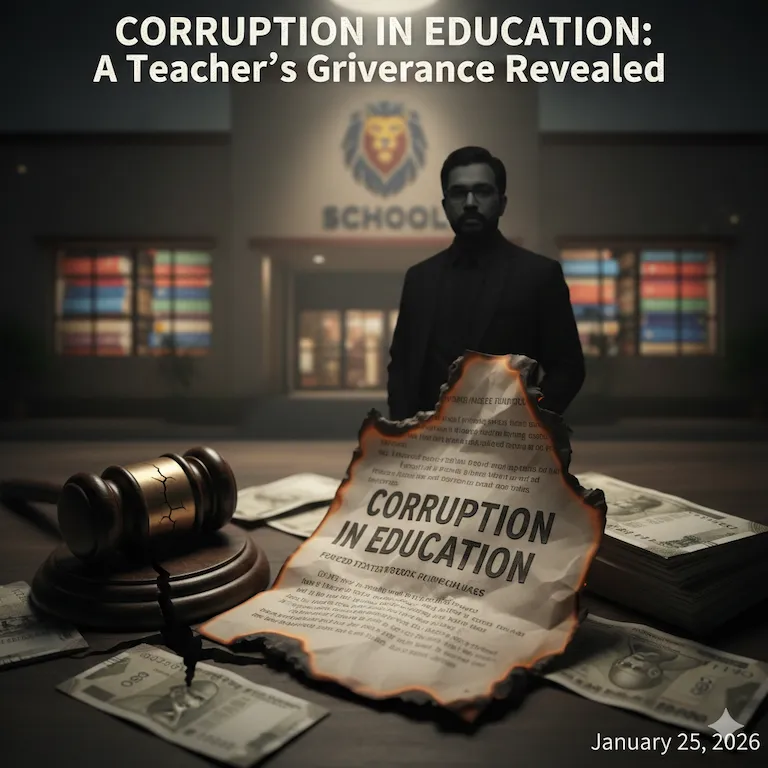
Corruption in education in Uttar Pradesh has become a significant barrier to academic progress and development. This issue manifests in various forms, including bribery for admission, the diversion of funds meant for infrastructure, and the manipulation of examination results. As a result, deserving students often find themselves at a disadvantage, while unworthy candidates gain access to educational resources. Additionally, the lack of transparency and accountability among educational administrators exacerbates the problem, further eroding public trust in the system. To combat this corruption, it is crucial to implement strict regulatory measures and promote ethical practices within educational institutions, ensuring fair opportunities for all.
Key takeaways from the blog post
The key takeaway from this situation is a systemic failure of regulatory oversight, where commercial interests have successfully bypassed educational mandates through bureaucratic inertia.
Here are the critical pillars of the issue:
- The “Textbook Mafia” Mechanism: The school allegedly uses its authority to coerce parents into buying expensive private textbooks, disparaging the NCERT curriculum to justify a high-profit commission model.
- Whistle-blower Exposure: A teacher has provided specific evidence of financial corruption—specifically an alleged ₹16,00,000 “bungling” from book sales at just one branch—suggesting that the academic curriculum is being dictated by “black money” potential.
- The Bureaucratic Loop: The grievance process has become a game of “pass the parcel.” The Central Government (DOSEL) closed the matter by forwarding it to the State, and the State (UP Government) has yet to provide a transparent “Action Taken Report,” leaving the complainant in a loop of administrative silence.
- Erosion of Trust: There is a profound lack of faith in local educational authorities (DIOS and BSA), with allegations that political and bureaucratic influence is shielding the school management from the consequences of violating CBSE guidelines.
The Textbook Mafia: A Teacher’s Crusade Against Commercialization in Mirzapur Schools
Many families in Mirzapur, Uttar Pradesh, face profound financial and psychological distress because of education, which people often herald as the “great equaliser.” A series of grievances filed by Shivam Varma, a teacher at Lions School, has pulled back the curtain on a systemic issue: the forced purchase of expensive, non-NCERT textbooks.
The following report dissects the ongoing legal and ethical battle between concerned educators and a school management system that appears to prioritize profit over pedagogy.
The Core Conflict: NCERT vs. Private Publishers
The heart of the grievance lies in a common but predatory practice in private education. Despite clear guidelines from the Central Board of Secondary Education (CBSE) favoring NCERT (National Council of Educational Research and Training) books, Lions School (both the Bhujwa ki Chowki and Laldiggi branches) reportedly mandates the use of private publications.
The Complainant’s Allegations:
- Physical and Mental Torture: Students and parents are allegedly pressured to purchase books that are significantly more expensive than government-mandated texts.
- False Narratives: Teachers at these institutions are reportedly instructed to criticise NCERT books as “low level,” claiming they are insufficient for board exam success—a claim that contradicts CBSE’s own standards.
- Monopolistic Sales: While the school previously sold books on-campus, they have transitioned to “prescribed shops,” ensuring a controlled environment where parents have no choice but to pay premium prices.
A Trail of Financial Misconduct
According to the grievance registration DOSEL/E/2025/0003990, the scale of this “Textbook Mafia” is staggering. Mr Varma reveals that the school’s governing body previously removed a key member for allegedly misappropriating ₹16,00,000.
The book sales at the Bhujwa ki Chowki branch alone reportedly generated this sum, serving approximately 1,000 students. When extrapolated to the Laldiggi branch, which boasts nearly 4,000 students, the potential “black money” generated through these forced sales reaches into the tens of millions.
The Bureaucratic “Pass-the-Parcel”
One of the most frustrating aspects of this case is the administrative handling of the complaints. Mr. Varma has engaged with both central and state portals, only to find himself caught in a loop of “forwarded” remarks.
1. The Central Grievance (DOSEL/E/2025/0003990)
Initially filed with the Ministry of Education (School Education and Literacy), the grievance was “closed” on May 19, 2025. However, the closure was not a resolution. The department simply forwarded the matter to the State Government of Uttar Pradesh (Letter No. 6-3/2025-IS-15).
2. The State Grievance (GOVUP/E/2025/0061625)
The case moved to the Uttar Pradesh Chief Minister’s Secretariat under the supervision of Shri Arvind Mohan (Joint Secretary). As of June 7, 2025, the status remains “Received,” with the complainant demanding transparency under Article 51A of the Constitution of India, which emphasizes the fundamental duty of citizens to strive toward excellence and safeguard public property.
| Registration Number | Status | Action Taken |
| DOSEL/E/2025/0003990 | Closed | Forwarded to UP State Government |
| GOVUP/E/2025/0061625 | Received | Pending action by Principal Secretary (Basic Education) |
| DOSEL/C/A/25/0000616 | Appeal Closed | Directed user to previous reply |
The Allegation of Deep-Rooted Corruption
A recurring theme in Mr. Varma’s appeals is the lack of faith in local officials. He explicitly states a lack of confidence in the District Inspector of Schools (DIOS) and the Basic Shiksha Adhikari (BSA), labeling their previous dealings as “cryptic and mysterious.
The complainant alleges that the management of Lions School enjoys significant influence within bureaucratic and political circles, allowing them to bypass CBSE affiliation guidelines with impunity. The demand is clear: Cancel the affiliation of Lions School.
Why This Matters: The Public Interest
This is not merely a dispute between a teacher and his employer; it is a matter of substantial public interest.
- Economic Burden: For poor and middle-class families, the difference between a ₹200 NCERT book and a ₹1,200 private book is the difference between debt and stability.
- Educational Integrity: When schools disparage official curriculum (NCERT) to sell private wares, they undermine the national education framework.
- Governance: If a school can openly flout central guidelines, it signals a breakdown in the regulatory power of the state.
Conclusion: The Road Ahead
Mr. Shivam Varma’s inquiry poses a vital question to the Uttar Pradesh administration: Will the Principal Secretary (Basic Education) disclose the actual action taken, or will this remain another “paper-only” transfer of responsibility?
As the grievance sits in Room No. 321 of the U.P. Secretariat, the parents of Mirzapur wait to see if the government will prioritise the welfare of students over the profits of a private committee.
To help you pursue this matter effectively, I have compiled the contact information for the public authorities mentioned in your grievance. These details are essential for sending follow-up letters, RTI applications, or formal appeals.
1. Uttar Pradesh State Authorities (Lucknow) (Corruption in Education in Uttar Pradesh)
The appropriate person has forwarded the grievance here for “necessary action.” These are the primary decision-makers for Mirzapur schools.
- Shri Arvind Mohan (Joint Secretary)
- Department: Chief Minister Secretariat, Uttar Pradesh
- Address: Room No. 321, U.P. Secretariat, Lucknow, Uttar Pradesh – 226001
- Phone: 0522-2226350
- Email: arvind.12574[at]gov[dot]in
- Principal Secretary (Basic Education)
- Phone: 0522-2780391 / 0522-4024440
- Email: upgovbasic@gmail.com / bsdminister@gmail.com
- Chief Secretary of Uttar Pradesh (Shri Shashi Prakash Goyal)
- Address: Secretariat, Lucknow
- Email: cmup@nic.in (CM Office General)
2. Central Government Authorities (New Delhi) (Corruption in Education in Uttar Pradesh)
Since we handled your appeal here, you can contact them to ask for the status of the transfer letter (Letter No. 6-3/2025-IS-15).
- Divya Thalwal (Assistant Director)
- Department: IS-15 Section, Dept. of School Education and Literacy (MoE)
- Address: Shastri Bhawan, New Delhi – 110001
- Phone: 011-23388254
- Email: divya.thalwal@gov.in / is15section[at]gmail[dot]com
- Central Board of Secondary Education (CBSE) – Affiliation Unit
- Address: CBSE Integrated Office Complex, Sector-23, Dwarka, New Delhi – 110077
- Phone: 011-24050302 (Director Affiliation)
- Email: cbse.aff@nic.in
3. Local Mirzapur Education Authorities (Corruption in Education in Uttar Pradesh)
If the Secretariat orders an enquiry, it will likely be conducted by these local officers.
- Joint Director of Education (Mirzapur Division)
- Phone: 05442-266144
- CUG Mobile: 9454457525
- Divisional Assistant Education Director (Basic)
- Email: admzrmdm@gmail.com
Important Web Links (Corruption in Education in Uttar Pradesh)
- UP IGRS (Jansunwai) Portal: jansunwai.up.nic.in
- Central Grievance Portal (CPGRAMS): pgportal.gov.in
- CBSE SARAS (Affiliation Portal): saras.cbse.gov.in
Would you like me to draft a formal “Request for Action Taken Report” (ATR) that you can email to the Joint Secretary (Shri Arvind Mohan) to ensure your file isn’t ignored?


Facing a similar challenge? Share the details in the box below, and our team of experts will do their best to help.