
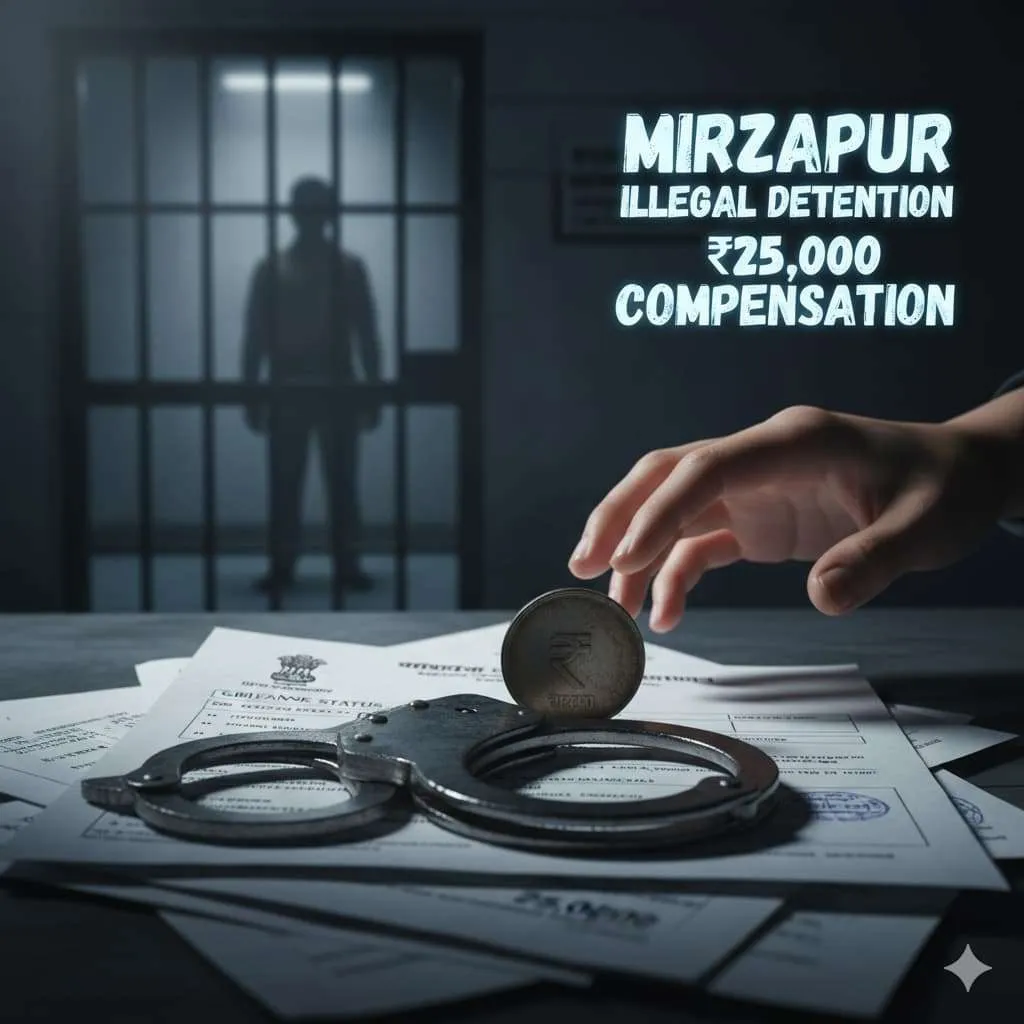
Compensation Request for Illegal Detention in Mirzapur is an important issue and a good example for everyday people. There is clear proof of illegal detention, yet the police are ignoring the whole matter without reason. This lack of action not only weakens the rule of law but also raises doubts about the responsibility of law enforcement agencies. To change the highlighted portion into the active voice, please replace the sentence with the following:
Authorities have treated many people unfairly, causing them not just physical confinement, but also emotional pain and damage to their reputation.
.Victims of such detentions do not have the means to fight against these wrongs. This leads to a cycle of oppression that further weakens public trust in the justice system. The need for a clear compensation system is therefore very important to fix these wrongs. It is essential to ensure that individuals get the recognition and support they deserve for their unfair treatment by those meant to protect them.
Key Takeaways
- Compensation Request for Illegal Detention highlights significant police misconduct and the lack of accountability in Mirzapur.
- Mahima Maurya’s grievances illustrate the misuse of preventive detention provisions against her husband, Pramod Kumar Kushwaha.
- The article calls for immediate inquiries, compensation, and reforms to enhance police accountability within the grievance redress system.
- Legal and constitutional rights protect citizens against arbitrary detention, demanding legal adherence from law enforcement agencies.
- The need for bureaucratic reform is essential to ensure impartial investigation and restore public trust in the justice system.
⚖️ Compensation Request for Illegal Detention: When Legal Detentions Become “Illegal” and the Fight for Compensation in Uttar Pradesh
The principle of the Rule of Law founds the pillars of a democratic state: the police, the judiciary, and the executive.
When these pillars crack, they cause the machinery designed to protect citizens to operate outside its legal mandate.
This results in a chilling erosion of public trust.
The recent complaints filed by Mahima Maurya against the Mirzapur Police in Uttar Pradesh—GOVUP/E/2025/0031932, GOVUP/E/2025/0023181, and GOVUP/E/2025/0031937—highlight a serious problem within the state’s law enforcement system: the claimed illegal detention of a citizen.
The following bureaucratic blocking in the quest for required compensation is also concerning. These complaints are not just separate requests for ₹25,000; they represent a strong accusation of claimed police wrongdoing. They are a call for responsibility and a sign of the ongoing problems affecting the grievance complaint process.
🚔Compensation Request for Illegal Detention: Misuse of Preventive Detention
The central focus of the grievance is the alleged illegal detention of the complainant’s husband, Pramod Kumar Kushwaha, by the Mirzapur Police. Crucially, the police linked the detention to the repealed Section 151 of the Criminal Procedure Code (CrPC), 1973.”Legislators have now replaced this section with Section 170 of the Bhartiya Nagarik Suraksha Sanhita (BNSS), 2023
Understanding Section 151 CrPC (or Section 170 BNSS) (Compensation Request for Illegal Detention)
Section 151 (Prevention of cognizable offences) grants police officers the extraordinary power to arrest a person without a warrant or a magisterial order if they know of a design to commit a cognizable offence. They must believe that the commission of the offence cannot be prevented otherwise. This provision is designed to be a preventive measure. It serves as a surgical tool for immediate de-escalation, not a routine mechanism for detention or intimidation.
The grievance specifically states that Pramod Kumar Kushwaha’s detention was an “illegal detention under section 151 of criminal procedure code.” Furthermore, it alleges the detention took place at the “place of Mithilesh Maurya...” District Prayagraj describes the action as “sheer illegal and mockery of the law of land.” It reflects “anarchy in the working of the police.” (Compensation Request for Illegal Detention)
This highlights a recurring, dangerous trend across police jurisdictions: the routine misuse of preventive detention provisions.
When police use Section 151/170 to settle civil scores, they detain individuals without proper basis. They also hold them beyond the permissible legal window. In doing so, they fundamentally violate the constitutional rights of the individual.
📜 The Constitutional and Legal Mandate
The basis for challenging this detention rests firmly in the fundamental rights enshrined in the Indian Constitution, which form the bedrock of India’s criminal justice system: (Compensation Request for Illegal Detention)
- Article 21 (Right to Life and Personal Liberty): This guarantees that “no person shall be deprived of his life or personal liberty except according to procedure established by law.” Any detention that deviates from the prescribed legal procedure is a direct violation of this article. This includes improper use of Section 151. Additionally, failure to produce the person before a magistrate also constitutes a violation.
- Article 22 (Protection against arbitrary arrest and detention): This mandates that an arrested person must be informed of the grounds for arrest. Critically, the person must be produced before the nearest magistrate within 24 hours (excluding travel time). This requirement is specified in Section 57 of the CrPC (or its equivalent in BNSS).
The complainant’s reference to Custodial Violence—”torture, abuse, and deaths in custody”—also underscores the grave risks associated with illegal detention. The moment a person is unlawfully confined, they become vulnerable to the ‘misuse of power by law enforcement.’ This vulnerability highlights the urgency of the situation. Accountability must be pursued rigorously. It is not just about liberty; it is also about life and dignity.
💰 The Demand for Compensation: A Landmark Directive
Perhaps the most significant aspect of this grievance is the explicit demand for ₹25,000 compensation. A specific state government circular backs this demand.
The grievance explicitly cites a directive issued by the Information and Public Relations Department, Uttar Pradesh, on September 9, 2021, in Lucknow. This directive followed the directions of the **Allahabad High Court. According to this directive: (Compensation Request for Illegal Detention)
A person found to be illegally detained under Sections 107/116/151 will receive compensation of Rs. 25,000. Disciplinary action will be taken against the responsible officer for illegal detention.
This is a powerful, yet often ignored, mechanism for police accountability. It acknowledges the state’s responsibility to compensate a citizen for the breach of their personal liberty. For Mahima Maurya, the demand is not just a personal matter. It is a direct challenge to the Mirzapur Police to comply with a binding governmental instruction. The very existence of this circular is an implicit admission by the state. It acknowledges that the misuse of preventive detention sections is a persistent issue. This situation warrants both punitive (disciplinary action) and compensatory measures. The failure to honor this compensation in a clear-cut case of alleged illegal detention renders the government’s own directive meaningless.
🤯 Bureaucracy and the Breakdown of Grievance Redressal (Compensation Request for Illegal Detention)
Beyond the police’s alleged initial misconduct, the second layer of the grievance exposes a profound disillusionment with the state’s bureaucratic response. (Compensation Request for Illegal Detention)
The complainant uses searing language.
They criticize the official handling.
- Critique of the Police Report: The concerned Additional S.P. Mirzapur submitted a report labelled “arbitrary and inconsistent,” which makes it “illegal and tantamount to anarchy in the working of the police.” This suggests that the police did not conduct a fair, legally rigorous, or honest inquiry into the detention.
- Critique of the Executive Office: The most serious complaint targets the Chief Minister’s office and Secretariat. The complainant questions whether any “competent officer” exists in the office. This officer should “take the perusal of the submissions.” They need to determine whether any point of the grievance touches the police report. The officers allegedly “put[ting] the signature on the papers prepared by the subordinates while keeping their eyes and ears closed.” The fundamental question posed is: “Can such insensitive public staff provide good governance to the citizens in the state?”
This criticism highlights the inherent flaw in the current grievance system: the accused investigates the accused. When someone forwards a complaint of police misconduct to the same police department for a report, they minimize the likelihood of receiving an impartial, self-incriminating report. The complainant effectively demands an objective, high-level review of the police’s internal report by the Chief Minister’s Secretariat. This review allegedly receives approval from “insensitive public staff.” In the complainant’s view, the entire process represents a failure of supervision and mocks the administrative justice system.
🗣️ A Call for True Accountability and Governance
The grievances filed by Mahima Maurya encapsulate the larger narrative of the ongoing battle between the power of the State and the liberty of the Citizen. (Compensation Request for Illegal Detention)
The core conflict is not merely about an alleged illegal detention.
It highlights the failure of accountability when law enforcement commits a legal wrong.
The case demands:
- Immediate & Impartial Inquiry: A directive from the highest level of the state government requires the conduct of an independent, time-bound inquiry into the allegations of illegal detention. This inquiry specifically focuses on the compliance with the Allahabad High Court directives. It also examines the September 9, 2021, circular. (Compensation Request for Illegal Detention)
- Compensation Compliance: If authorities declare the detention illegal, they must immediately disburse ₹25,000 in compensation to Pramod Kumar Kushwaha. This disbursement is not a favor; it is a legal right mandated by the government’s own rules.
- Action Against Erring Officials: Initiate disciplinary action against the police officials responsible for both the alleged illegal detention and those officials (including the Additional S.P. Mirzapur) who submitted an allegedly “arbitrary and inconsistent” report, as per the 2021 circular.
- Reform in Grievance Redressal: A systemic overhaul of the grievance redressal mechanism is necessary to ensure that an independent body handles complaints against police and high-level bureaucracy, instead of routing them back to the same organizations for self-reporting.
Good Governance & Rule of Law (Compensation Request for Illegal Detention)
The phrase “good governance” depends on a responsive administration and a disciplined police force. When the police behave as if they are above the law, and bureaucratic oversight becomes incompetent or indifferent, the principles of the Rule of Law and the spirit of the Constitution suffer severe compromise. It is crucial for the Uttar Pradesh government, through the Chief Minister’s office, to recognize the seriousness of this complaint and take decisive action to demonstrate that the state machinery serves justice, not anarchy. The citizens now scrutinize the responsiveness of officials like Shri Arvind Mohan (Joint Secretary) and the Chief Minister Secretariat to see if the “procedure established by law” applies equally to the protectors of the law as it does to the protected citizen.


Facing a similar challenge? Share the details in the box below, and our team of experts will do their best to help.