
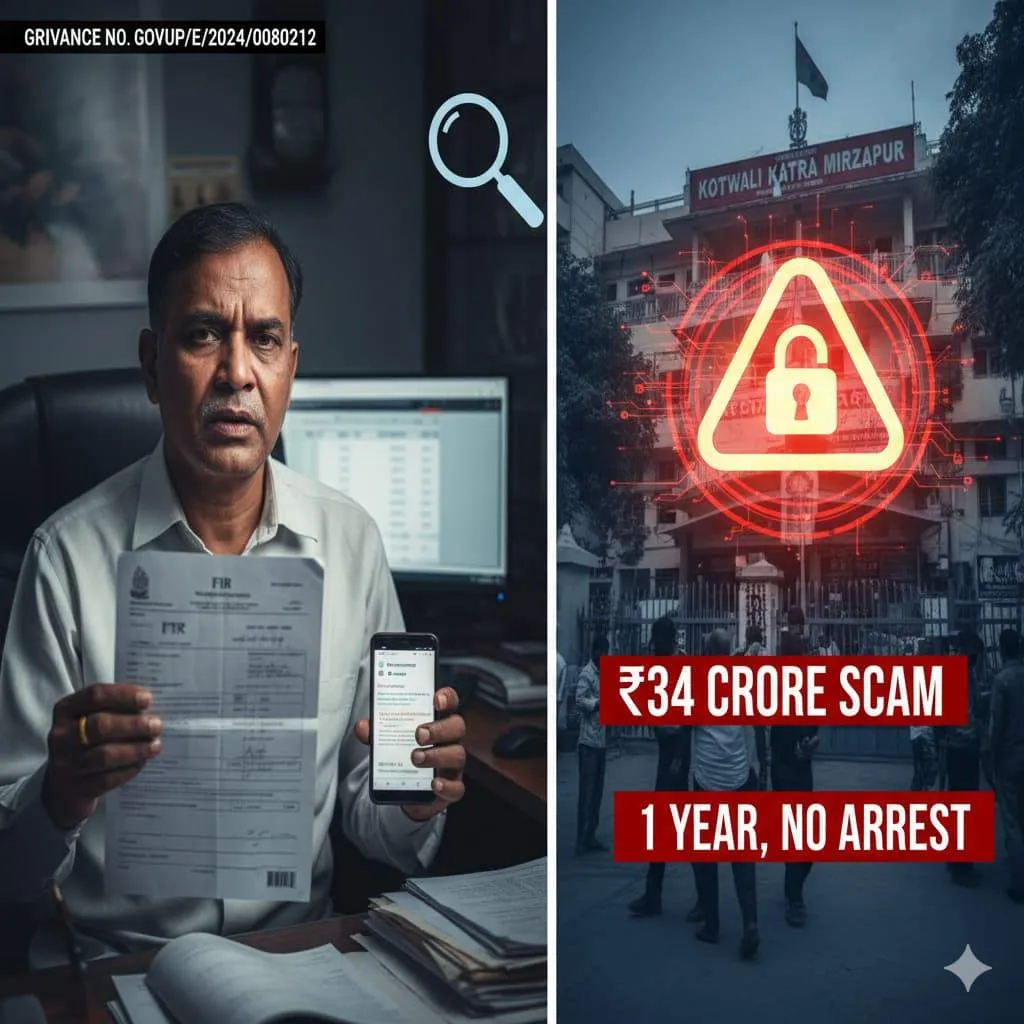
Investigating Cyber Fraud: The Unaddressed Cyber Fraud Crisis in Mirzapur
The digital world has become a new frontier for crime, evolving at an alarming pace that outstrips the capacity of law enforcement and regulatory bodies.
An ongoing case in Mirzapur, Uttar Pradesh, highlights a deeply concerning lapse in the system’s ability to protect its citizens from increasingly sophisticated online threats.
As technology advances, investigating cyber fraud has become crucial in addressing these issues and ensuring that justice prevails.
This is the story of Yogi M. P. Singh, a complainant whose grievance, filed against persistent and massive cyber fraud, has been met with what appears to be a systemic, lackadaisical response from both the local police and central financial authorities.
Singh’s ordeal not only raises questions about the efficacy of current policing strategies but also brings to light the urgent need for a comprehensive overhaul in the way digital crimes are handled.
Many citizens remain vulnerable, and as this case unfolds, it serves as a stark reminder of the challenges that lie ahead in the fight against cybercrime, which impacts not just individual lives but society as a whole.
A Year of Inaction: The Police Investigation
The core of the issue lies in the police’s handling of a cyber fraud case registered under FIR No. 291/23 on November 11, 2023, at Kotwali Katra Police Station, Mirzapur, under Section 420 IPC and Sections 66C/66D of the IT Act against unknown persons. Despite claims that they are investigating cyber fraud thoroughly, there has been little progress.
Despite a formal First Information Report (FIR) and the passage of more than a year, the complainant alleges that the police investigation has failed to make any progress. The grievance explicitly questions this delay, labeling it a reflection of the police’s “incompetence” in handling cyber fraud cases—a critical concern given the “steep hike” of such crimes in the district.
Inspector Arvind Kumar Yadav is currently conducting the investigation into the grievance, which the official response has marked as “Closed.” The complainant rated this non-substantive update as “Poor,” emphasizing that the Chief Information Commissioner of Uttar Pradesh had already ordered a prompt resolution of the case.
The Alarming Scale of Financial Misuse
What elevates this from a routine fraud complaint to a crisis of governance is the staggering financial damage. Moreover, the misuse of vital identity documents became apparent as officials committed to investigating such cyber fraud.
The fraudulent activities involve the extensive misuse of Mr. Singh’s Permanent Account Number (PAN) linked to his Aadhaar to carry out illicit transactions. The known scale of the fraud has alarmingly doubled in a year:
- Last Year’s Fraudulent Transactions: Rs. 16,12,06,667
- Current Total Fraudulent Transactions: Rs. 34,38,77,662 (Over 34 Crores!)
Fraudulent business activities reported in the Annual Information Statement (AIS) tie this immense sum.
- Business receipts: Rs. 4,65,76,920
- GST purchases: Rs. 12,20,99,234
- GST turnover: Rs. 16,32,92,127
- Rent received: Rs. 1,19,09,381
Fraudsters opened the accounts using a different Mobile Number (7024188072) and Email Address (dngoldraipur18@gmail.com). Yet, they allegedly streamed tax notices to the complainant’s personal email and mobile number.
Questioning the System’s Integrity: Income Tax and Banking
The complainant forcefully argues that such massive, unchecked fraudulent transactions using his PAN reflect a severe breakdown in the accountability of the entire financial ecosystem. Therefore, they urge for a focused approach in investigating cyber fraud to expose critical deficiencies in these systems.
- Banking Sector Failure: The sheer volume of transactions suggests a catastrophic failure in the Know Your Customer (KYC) and fraud prevention mechanisms of the banking institutions.
- Income Tax Department (ITD) Negligence: The fact that the ITD is logging business receipts and GST transactions of over Rs. 34 Crore against the wrong person, despite being provided with the fraudulent contact details, suggests a lack of diligence. The complainant even suggests a “tacit understanding between the tax evaders and the personnel of Department of income tax.” The ITD has reportedly taken a third “tax evasion petition” but failed to act against the identified tax evaders.
The Real Law and Order Question because of dilly dally approach in Investigating Cyber Fraud
This case transcends individual victimisation. It also serves as a stark critique of governance. By steadfastly investigating cyber fraud, the systemic failures in law enforcement become apparent. The complainant questions whether this systemic failure—the inability of the police to work out a documented fraud and the IT department’s apparent inability to stem financial identity theft—reflects “good governance” or the “forest rule” in the largest democracy in the world.
The core message is a demand for stern action against both the criminals and the accountable public staff. Their “lackadaisical approach” is seen as promoting crime and leading to a “lowering dignity of the department.”
The growing public resentment against the police due to escalating cyber criminal activities is a dangerous sign. For the sake of maintaining public faith and ensuring the safety of citizens and their property, the case of Yogi M. P. Singh demands urgent attention from the highest levels of the Government of Uttar Pradesh, including the Chief Minister Secretariat. Authorities should urgently start the process of investigating cyber fraud. Urgency is essential to resolve this high-stakes case and restore public trust.
What steps do you think authorities should take immediately to resolve this high-stakes case and restore public trust?
Our chief minister claims to control crime even when cyber-crimes at its zenith
Matter of cyber-criminal activities are closed arbitrarily by government staff


Facing a similar challenge? Share the details in the box below, and our team of experts will do their best to help.