
🐄 A Deeper Dive into the Mirzapur Gau-Shala Crisis: A Call for Humane Governance and Accountability
The recent revelation of alleged gross mismanagement and animal suffering at the government-run cow shelter in Nibi Gaharwar Gram Panchayat, Mirzapur, Uttar Pradesh, has sent shockwaves through the community and raised profound questions about the execution of animal welfare policies in the state. The tragedy at the Gau Shala, brought to light by a formal grievance filed by concerned citizen Yogi M. P. Singh, transcends a simple administrative lapse; it presents a moral and ethical crisis that challenges the very notion of ‘Gau-Sanrakshan’ (cow protection) for which the Uttar Pradesh government allocates significant public resources. This situation demands an extended and detailed examination of the issues at stake, the community’s expectations, and the necessary, immediate governmental response.
The Anatomy of a Tragedy: Allegations and Evidence
The grievance, filed on October 26, 2025 (Registration Number: GOVUP/E/2025/0123247), paints a damning and visually supported picture of the conditions inside the Nibi Gaharwar Gau-Shala. The core of the complaint is the stark contrast between the facility’s official purpose—to provide a safe haven for stray and abandoned cattle—and the alleged reality of a neglectful, life-threatening environment.
Key Evidential Claims:
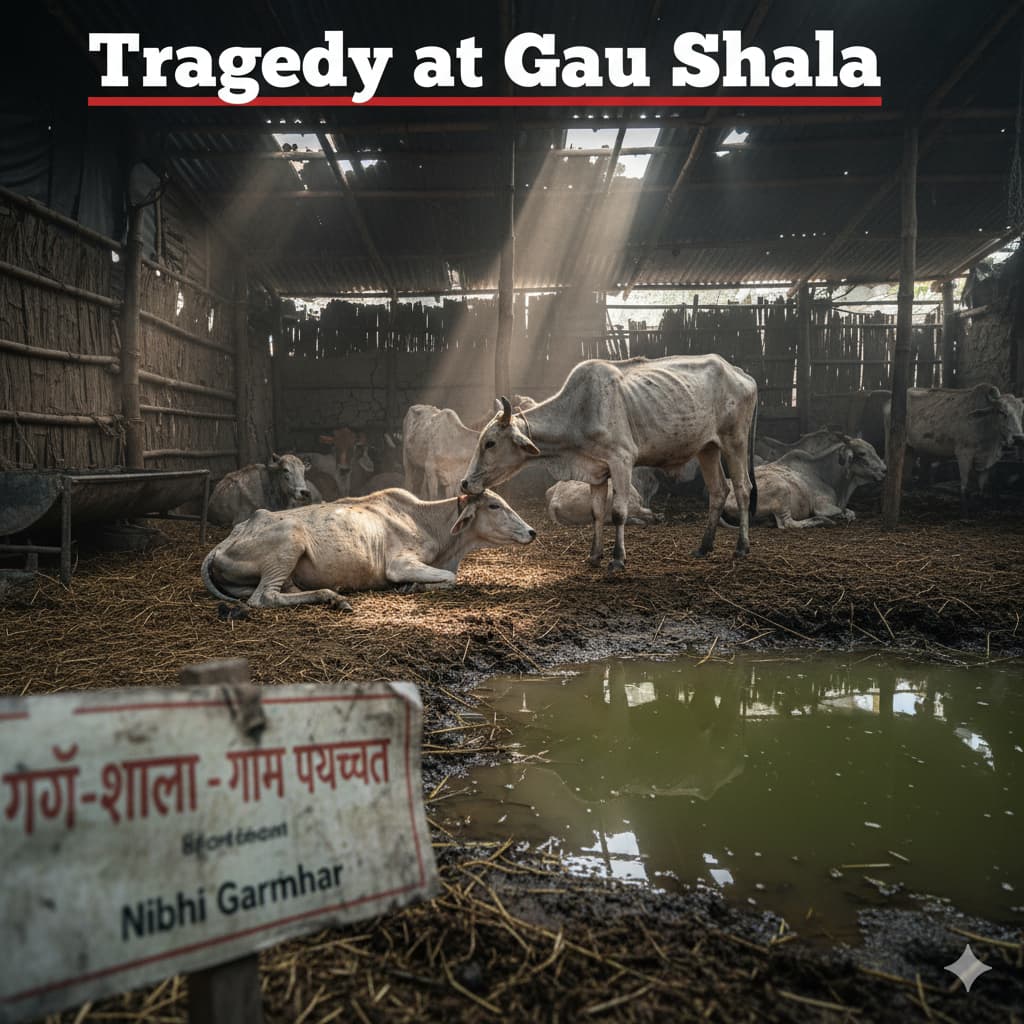
- Preventable Deaths: The most alarming claim is the existence of a viral video and fourteen accompanying photographs that allegedly show at least four cows either recently deceased or in an acute state of dying, having been denied basic and primary medical treatment. This is not a natural disaster; it is alleged to be a direct consequence of systemic neglect, marking the tragic state at the Gau Shala.
- Deplorable Sanitation: The visual evidence reportedly showcases a near-total absence of proper sanitation protocols. Overcrowding, combined with a failure to clean the premises, transforms the shelter from a sanctuary into a breeding ground for disease and suffering. A hygienic environment is fundamental to animal health, and its purported absence highlights a catastrophic failure of facility management.
- Extreme Neglect and Starvation: Beyond the lack of medical care, the complaint emphasizes a severe shortage of fundamental necessities: potable water and adequate fodder. The animals are allegedly suffering from starvation and dehydration, conditions that directly lead to weakness, susceptibility to disease, and ultimately, death. This is a profound violation of the most basic standards of animal care.
The combination of these allegations suggests a scenario where public funds meant for the animals’ welfare are either being mismanaged or outright diverted, leading to a humanitarian (or rather, bovine) crisis. The sheer volume of evidence—a video and fourteen pictures—is intended to leave no doubt as to the severity and veracity of the claims, placing a heavy burden of proof on the local authorities.
The Moral and Political Weight of Gau-Sanrakshan
In Uttar Pradesh, and indeed across much of India, the cow holds a sacred place, often revered as ‘Gau Mata’ (Mother Cow). The state government has repeatedly underscored its commitment to cow protection, establishing dedicated departments and allocating significant budgets for the maintenance and expansion of Gau-Shalas.
A Crisis of Public Trust:
- Violation of Core Policy: The tragedy at the Gau Shala directly undermines the state’s stated policy of cow protection. When a government-run facility—established with the express purpose of saving these animals—becomes a place where they reportedly die from neglect, the credibility of the entire Gau-Sanrakshan movement comes into question.
- Financial Accountability: The use of substantial public funds for these shelters necessitates stringent financial transparency. The complaint hints at potential financial mismanagement, arguing that the preventable nature of the cows’ deaths suggests that the allocated money is not reaching the animals in the form of food, water, or medical care. This perceived dereliction of duty is a profound violation of public trust, especially in a community that holds cows in such high reverence.
- Indifference of Local Officials: The alleged indifference of local executive staff and authorities, who have reportedly been aware of the deteriorating conditions but failed to take decisive action, is a significant part of the grievance. This inaction suggests either incompetence or a lack of sincerity regarding animal welfare, fueling the community’s demand for accountability and transparency.
The community’s frustration, as detailed in the grievance, stems from witnessing this suffering juxtaposed against the state’s very public commitment. They are now rallying to advocate for the animals’ welfare, making their demands for change increasingly vocal and focused on immediate, tangible intervention.
The Urgent Call for Multi-Pronged Intervention
The core of Mr. Singh’s grievance is a clear, actionable plan to transition from bureaucratic acknowledgment to on-the-ground rescue. The suggested steps are designed to be immediate, comprehensive, and focused on both life-saving intervention and long-term systemic reform.
The Threefold Action Plan:
- Immediate Inquiry and On-Site Inspection: The first priority is to confirm the conditions documented in the evidence. The complaint calls for an unannounced, on-the-spot inspection of the Nibi Gaharwar Gau-Shala. This element of surprise is crucial to ensure that the inspection team witnesses the facility in its true, alleged state, rather than a hastily cleaned or prepared version.
- Emergency Care and Resource Deployment: The second step is a humanitarian response: the immediate deployment of a full veterinary staff, complete with all necessary medical supplies, to treat the sick and dying cattle. Concurrently, an emergency provision of adequate fodder, feed, and potable water must be secured to halt the current decline in the animals’ health and avert further tragedy at Gau Shala. This is a time-critical step to save the remaining lives.
- Fixing Accountability: The final step, crucial for restoring public trust, involves a swift and impartial investigation to identify the public staff responsible for the gross dereliction of duty, negligence, and potential financial mismanagement. Holding these individuals accountable sends a clear message that such failures in the execution of public welfare mandates will not be tolerated.
The Status of the Official Response: Procedure vs. Action
The swift procedural response from the state government is a positive initial sign. The grievance was officially acknowledged and promptly forwarded to the highest level of state administration—the Chief Minister’s Secretariat—on the very day it was filed.
Key Administrative Details:
- Forwarded To: Shri Arvind Mohan (Joint Secretary)
- Organization: Chief Minister Secretariat, Uttar Pradesh.
This immediate elevation of the complaint signals that officials are treating the matter with the seriousness it deserves, recognizing the potential political and moral implications of the crisis. The involvement of the Chief Minister’s office suggests a top-down mandate for resolution.
However, the critical question remains: Will the swift procedural response translate into effective, life-saving intervention on the ground?
The animals currently suffering at the Nibi Gaharwar Gau-Shala do not have the luxury of waiting for the bureaucratic process to slowly unfold. Their survival depends on the rapid deployment of emergency resources. The focus now shifts entirely to the local administration—the Block Development Officer of Chhanbey and the corresponding district veterinary and executive teams—to execute the immediate life-saving actions called for in the grievance. Failure to act now will not only result in more tragic deaths but will also confirm the community’s deepest fears about the lack of sincerity in the state’s commitment to animal welfare. The ultimate measure of the government’s response will be the health and survival of the cows in the coming days, ensuring that the tragedy at the Gau Shala is not repeated.
Concluding Thoughts and Next Steps
The crisis in Mirzapur serves as a stark microcosm of the challenges facing animal shelters across the region: the gap between policy intent and on-the-ground execution. This is a moment for the Uttar Pradesh government to demonstrate not only procedural efficiency but genuine compassion and administrative backbone. The prompt and transparent execution of the three suggested steps—Inquiry, Emergency Care, and Accountability—is the only way to save the remaining cattle, restore the community’s public trust, and truly uphold the spirit of ‘Gau-Sanrakshan.’
Would you like me to search for any follow-up reports or official statements from the Mirzapur District Administration regarding the status of the on-site inspection and emergency care deployment?
Municipality Mirzapur city is running away from complaints about stray animals on the roads by taking recourse of P.W.D.


Facing a similar challenge? Share the details in the box below, and our team of experts will do their best to help.