
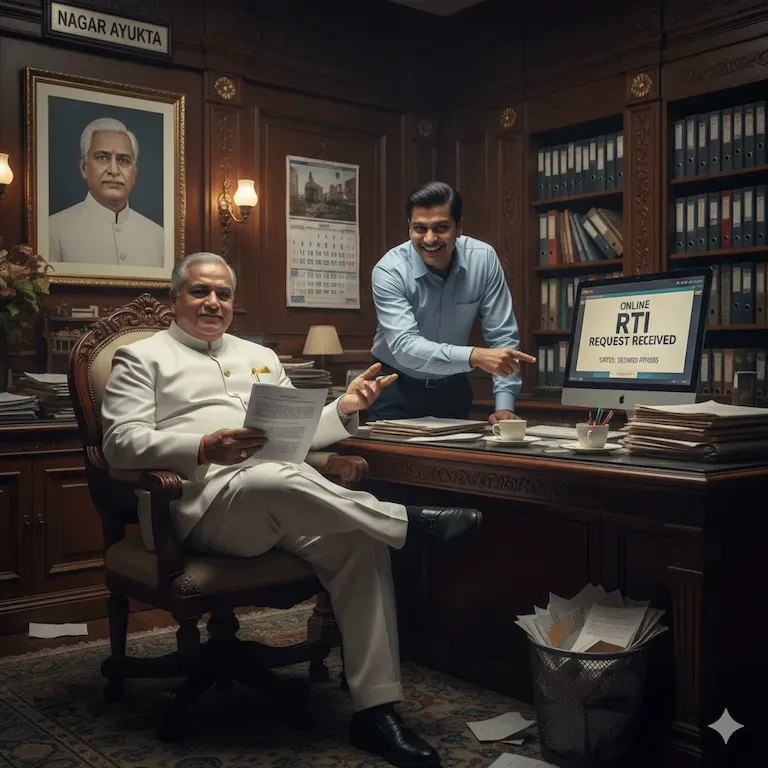
The key takeaway from this blog post is that administrative silence is a violation of the law. The RTI Act provides citizens with the power to transform that silence into accountability. This is done through financial penalties and legal escalation. In Prayagraj, matters concerning administrative silence often involve the PIO Nagar Ayukta Prayagraj. Administrative silence is a violation of the law. The RTI Act empowers citizens to enforce accountability through financial penalties and legal escalation. Administrative silence violates the law. The RTI Act provides citizens with the power to transform that silence into accountability. This is achieved through financial penalties and legal escalation. Administrative silence violates the law. The RTI Act empowers citizens to enforce accountability through financial penalties and legal escalation.
Here is the breakdown of the core message: (PIO Nagar Ayukta Prayagraj)
- The key takeaways from this case regarding the Right to Information (RTI) Act are:
- 1. Bypassing Local Authority:
- If authorities, such as the Nagar Nigam Prayagraj, ignore a request, the silence is legally construed as an admission of failure. This crucial legal point enables the citizen to bypass the non-responsive local department. They can directly seek justice at the State Information Commission.
- 2. The Power of Personal Penalty:
- The RTI Act is uniquely powerful. It mandates the officer (PIO) to pay the daily penalty (₹250/day) from their personal funds. The funds do not come from the government budget. This mechanism is the strongest deterrent against bureaucratic delay and arrogance.
- 3. Public Money, Public Scrutiny:
- Employee benefits like “leave encashment,” especially for those facing criminal charges, are not private matters. They involve taxpayer money, and therefore, their administration must be governed by transparent, publicly documented rules.
- 4. The Commission’s Unavoidable Summons:
- The progression from a simple RTI application to a Second Appeal (A-20260101917) shows a critical difference in authority. A department can easily ignore a letter. However, it cannot ignore a summons from the State Information Commission.
This blog post is designed to highlight the systemic issue of administrative opacity. It focuses specifically on the misuse of public funds for employees facing criminal proceedings. It uses your specific case as a benchmark for transparency.
PIO Nagar Ayukta Prayagraj: RTI, Public Funds, and the Fight Against Administrative Silence
Transparency is the lifeblood of a functioning democracy. When citizens ask questions about how public money is spent, government departments must answer them. This is particularly important regarding employees under criminal investigation. These answers must align with legal and moral standards. However, as the case of Indradev Yadav vs. Nagar Nigam Prayagraj demonstrates, a wall of “administrative silence” often blocks the path to accountability.
Transparency is the lifeblood of a functioning democracy. When citizens ask questions about how public money is spent, departments must legally and morally answer them. This is especially true regarding employees under criminal investigation. However, as the case of Indradev Yadav vs. Nagar Nigam Prayagraj demonstrates, a wall of “administrative silence” often blocks the path to accountability.
A thriving democracy depends on transparency. Government departments, such as the PIO Nagar Ayukta Prayagraj, must answer citizens’ inquiries about the use of public funds. This is both a legal and moral imperative. This is especially important when it concerns employees facing criminal investigation. Yet, as highlighted by the case of Indradev Yadav vs. Nagar Nigam Prayagraj, this vital accountability is frequently thwarted by a barrier of “administrative silence.
The Core Issue: Public Funds and Criminal Proceedings
At the heart of this matter is a critical question. Is it permissible for a government department to grant financial benefits like leave encashment? Can this be done for employees who are currently facing criminal proceedings? This must be considered without circumventing established regulations.
In this specific instance, the Prayagraj Municipal Corporation sought information regarding Mr. Umesh Kumar Yadav and Mr. Mukesh Kumar Yadav, employees of the Corporation. When public servants are embroiled in criminal cases, their financial claims on the state must be scrutinized rigorously. These claims are supported by taxpayer money. Granting leave encashment in such scenarios without clear legal backing suggests a potential breach of service rules. Failing to ensure transparent communication further raises concerns about financial propriety.
The Right to Information: A Shield for the Citizen (PIO Nagar Ayukta Prayagraj)
The Right to Information (RTI) Act of 2005 was instituted to grant citizens the ability to scrutinize government decision-making processes. Through the submission of RTI application DIRLB/R/2025/60347, the applicant requested four distinct categories of information:
- The specific regulations governing the encashment of leave for individuals involved in court proceedings.
- Internal departmental communications (memos/emails) pertaining to the specific approvals in question.
- Copies of the actual leave applications.
- The identification of the final approving authority.
These items constitute more than mere data. They represent the requisite evidence needed. This evidence ensures that public officials are not providing preferential treatment to colleagues who have transgressed the law.
The Strategy of Silence: Deemed Refusal (PIO Nagar Ayukta Prayagraj)
One of the most common tactics used by Public Information Officers (PIOs) to frustrate applicants is the “Deemed Refusal.” Under Section 7(1) of the RTI Act, a PIO must respond within 30 days. In this case, PIO Musir Ahmad (Apar Nagar Ayukt) chose complete silence.
This silence is not merely a delay; it is a violation of a statutory duty. When a department refuses to acknowledge an application, it signals a lack of internal accountability. It forces the citizen into a long, drawn-out legal battle through appeals, hoping that the applicant will eventually give up. One of the most common tactics used by Public Information Officers (PIOs) to frustrate applicants is the “Deemed Refusal.” Under Section 7(1) of the RTI Act, a PIO must respond within 30 days. In this case, PIO Musir Ahmad (Nagar Ayukta Prayagraj) chose complete silence.
This silence is not merely a delay; it is a violation of a statutory duty. When a department refuses to acknowledge an application, it signals a lack of internal accountability. It forces the citizen into a long, drawn-out legal battle through appeals, hoping the applicant will eventually give up.
The Failure of the First Appeal
The Right to Information (RTI) Act establishes the First Appellate Authority (FAA) as a second-tier safeguard. An example is Nagar Ayukt Ravi Ranjan. The FAA’s intended role is to function as a senior internal reviewer, correcting errors made by the Public Information Officer (PIO).
However, in this specific case, the “Prayagraj Model” of non-compliance extended to the FAA as well. A First Appeal was lodged on November 7, 2025, yet no hearing took place, and no order was issued within the legally mandated 45-day timeframe. This failure on the part of the FAA is a critical systemic breakdown. The entire transparency framework collapses when senior officials, including the PIO Nagar Ayukta Prayagraj, fail to hold their subordinates accountable for adherence to RTI compliance.
However, the “Prayagraj Model” of silence extended here as well. Despite a First Appeal filed on November 7, 2025, no hearing was conducted and no order was passed within the 45-day legal limit. This failure of the FAA is a critical systemic flaw. If older people do not hold their juniors accountable for RTI compliance, the entire transparency framework collapses.
Moving to the State Information Commission (PIO Nagar Ayukta Prayagraj)
When internal mechanisms fail, the battle moves to the Uttar Pradesh State Information Commission (UPSIC). The registration of Second Appeal A-20260101917 marks a shift from a departmental request to a quasi-judicial proceeding.
At this stage, the burden of proof shifts. Section 20(1) now threatens the PIO. The Commission can impose a penalty of ₹250 per day, up to ₹25,000, on the officer personally. Furthermore, the department failed to meet the timeline. Section 7(6) now legally requires them to provide all requested documents free of cost.
Why This Case Matters to Every Citizen
This is not just about two employees in Prayagraj. It represents the broader struggle for “Jan Sunwai” (Public Hearing) and “Swachh Bharat” (Clean India) in an administrative sense.
- Taxpayer Vigilance: The Municipal Corporation could have allocated every rupee spent on leave encashment for a criminally accused employee to city infrastructure. It could also have used it for public health.
- Rule of Law: If the Corporation can bend rules for specific individuals behind closed doors, it raises concerns. This calls the integrity of the entire Municipal Corporation into question.
- Fighting Corruption: Corruption doesn’t always look like a bribe. Sometimes, it looks like a memo the Corporation never shared. It may also appear as a rule the Corporation ignored to benefit a friend. This issue is not just about two employees in Prayagraj. It represents the broader struggle for “Jan Sunwai” (Public Hearing) and “Swachh Bharat” (Clean India) in an administrative sense.
- Taxpayer Vigilance: Leave encashment for an accused employee could fund city infrastructure or public health.
- Rule of Law: If the Corporation bends rules for individuals in secret, it questions the entire Municipal Corporation’s integrity.
Fighting Corruption: Corruption is not always a bribe. Sometimes it looks like an unshared memo or an ignored rule to benefit a friend.
The Path Forward: Digital Vigilance
The registration of this appeal online and the digital tracking demonstrate that technology serves as the citizen’s greatest ally. While government offices can “lose” physical files, a digital registration number like A-20260101917 remains a permanent record of administrative failure.
The Uttar Pradesh Information Commission now has the opportunity to set a precedent. They can penalize the PIO and FAA of Nagar Nigam Prayagraj. This will send a clear message: The law is not optional. This appeal was registered online. It is being tracked digitally. This shows how technology serves as the citizen’s greatest ally. While government offices can “lose” physical files, a digital registration number like A-20260101917 remains a permanent record of administrative failure.
The Uttar Pradesh Information Commission now has the opportunity to set a precedent. By penalizing the PIO and FAA of Nagar Nigam Prayagraj, the Commission can send a clear message: The law is not optional.
Conclusion (PIO Nagar Ayukta Prayagraj)
The case of Indradev Yadav, and his persistent pursuit of truth, powerfully reminds us of the impact a single citizen can have. By challenging the “silence” of the Prayagraj Municipal Corporation, this matter affirms that the Right to Information (RTI) Act is still viable, despite bureaucratic neglect considerably straining it.
A key takeaway for anyone whose request a government office ignores is this: silence is not a lack of response—it is an admission of a lack of transparency. Ultimately, the battle for the “Right to Know” is synonymous with the fight for the “Right to a Honest Government.
To prepare effectively for your online hearing, focus on the following legal points. The hearing is before the State Information Commission. These specific sections of the RTI Act are the strongest tools. They directly challenge the Public Information Officer (PIO) and the First Appellate Authority (FAA). This is for their lack of response in your case.
Legal Provisions to Quote During Your Hearing
| Section | What it Says | Why it’s Important for You |
| Section 7(1) | Information must be provided within 30 days. | Proves the PIO (Musir Ahmad) breached his statutory duty. |
| Section 7(6) | If the deadline is missed, information must be FREE. | You should not pay a single rupee for the copies you requested. |
| Section 19(1) | FAA must decide appeal within 30-45 days. | Proves the FAA (Ravi Ranjan) failed in his supervisory role. |
| Section 20(1) | Penalty of ₹250 per day on the PIO. | This is your primary “relief” to punish the delay. |
| Section 20(2) | Recommendation for disciplinary action. | Use this if the Commission finds the PIO acted with “malafide” (bad) intent. |
3 Golden Rules for Your Online Hearing (PIO Nagar Ayukta Prayagraj)
- Stick to the “Deemed Refusal” Argument: Don’t let the PIO make excuses about being “busy.” Simply state: “Sir, the law under Section 7(1) is mandatory. The PIO has crossed the limit by over 100 days. This is a fit case for a penalty under Section 20(1).”
- Focus on “Public Money”: If the department tries to say the employee’s leave encashment is “private information,” counter with: “This involves the encashment of public funds for individuals facing criminal proceedings. There is a larger public interest in knowing if service rules were followed.
- Demand “Certified Copies”: Ensure the Commission directs the PIO to provide Certified Copies (stamped and signed), not just plain printouts.Stick to the “Deemed Refusal” Argument: Don’t let the PIO make excuses. Simply state: “Sir, the law under Section 7(1) is mandatory. The PIO has crossed the limit by over 100 days. This is a fit case for a penalty under Section 20(1).”
- Focus on “Public Money”: If the department says the employee’s leave encashment is “private information,” counter with: “This involves public funds for individuals facing criminal proceedings. There is a larger public interest in knowing if service rules were followed.
Demand “Certified Copies”: Ensure the Commission directs the PIO to provide Certified Copies (stamped and signed), not just plain printouts.
Final Checklist
- Keep your Registration Number (A-20260101917) ready.
- Keep a PDF or printout of your Original Application and First Appeal nearby during the video call.
- Ensure your internet connection is stable for the Online Hearing.
To ensure you have everything organized for your hearing and any future follow-ups, here is the complete directory of the authorities involved in your case.
1. Case Identification Details
- RTI Application ID: DIRLB/R/2025/60347
- First Appeal ID: DIRLB/A/2025/60246
- Second Appeal ID: A-20260101917 (UP Information Commission)
2. Public Authority Contact Directory
| Authority / Role | Name | Mobile Number | Email Address |
| PIO (Prayagraj) | Musir Ahmad | 8303701004 | osnagarnigam@rediffmail.com |
| FAA (Prayagraj) | Ravi Ranjan | 8303701320 | osnagarnigam@rediffmail.com |
| Nodal Officer | Alok Goel | 8574190717 | diruplb@nic.in |
| State Commission | Registrar | 0522-2231261 | upic@nic.in |
3. Essential Web Links (PIO Nagar Ayukta Prayagraj)
- To Check Appeal Status (UPSIC):http://upsic.up.nic.in/
- Select “Appeal/Complaint Status” and enter your registration number A-20260101917.
- UP RTI Online Portal (Primary):https://rtionline.up.gov.in/
- Used for filing and checking the status of original applications and first appeals.
- Nagar Nigam Prayagraj (Local Body):https://nagarnigamprayagraj.in/
- Useful for finding office orders or general notifications regarding employee rules.
- Local Bodies Directorate (UP):http://localbodies.up.nic.in/
- The parent department that oversees Nagar Nigam operations.
4. Technical Assistance Note
If you face issues with the Online Hearing link or technical glitches on the portal, you can contact the UP RTI Digital Helpdesk at:
- Helpdesk Email: online.rti-up@nic.in
- Technical Support: 0522-2287211
Would you like me to draft a short text message (SMS/WhatsApp) that you can send to the PIO and FAA as a formal “Intimation of Second Appeal” to put them on notice?


Facing a similar challenge? Share the details in the box below, and our team of experts will do their best to help.