
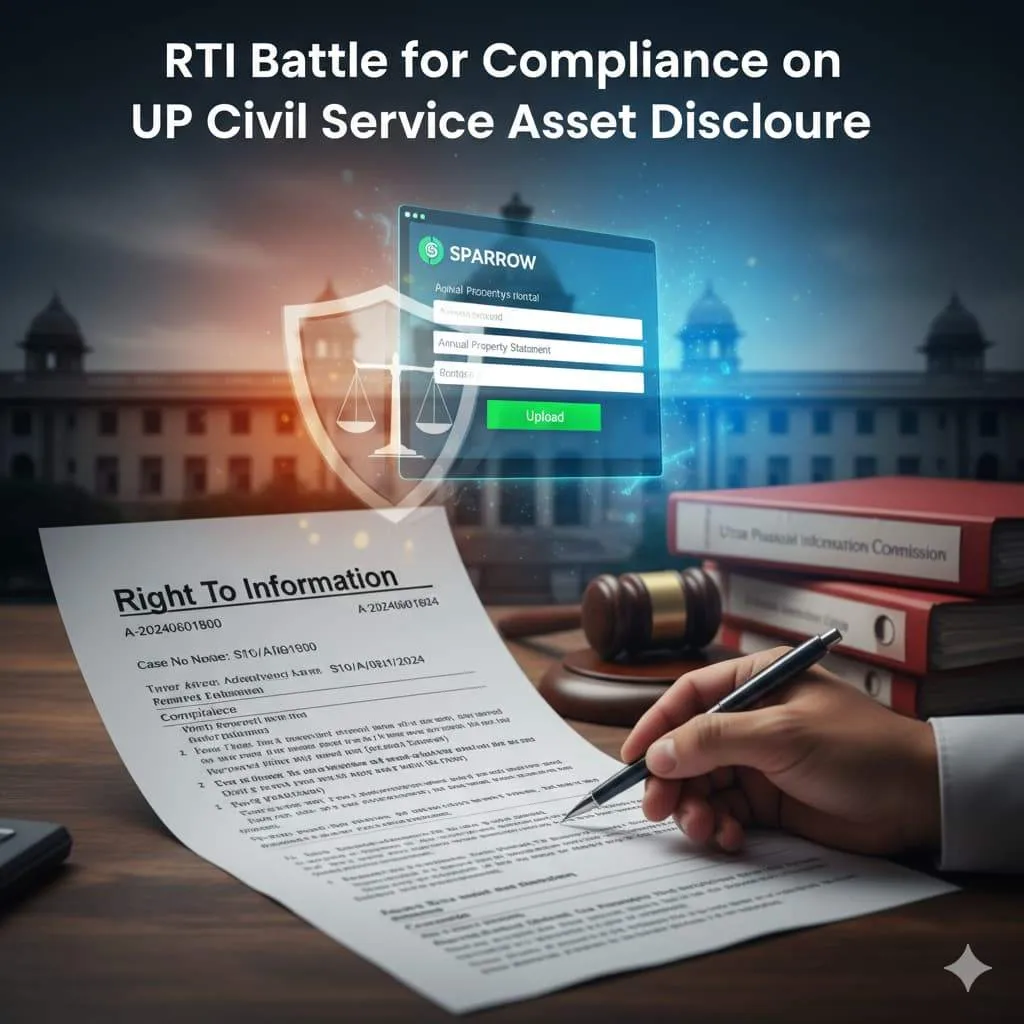
📣 Transparency Showdown: The RTI Battle for Compliance on UP Civil Service Asset Disclosure
Key Takeaways
- The Transparency Showdown revolves around compliance with a government mandate on asset disclosure in Uttar Pradesh.
- Yogi M P Singh’s RTI request seeks information on compliance, not personal wealth details of officers.
- The SPARROW portal requires officers to disclose their assets online by January 31, 2024, under a government order.
- The Public Information Officer denied information, arguing that property details do not need to be publicly displayed.
- The outcome on December 4, 2024, will be crucial for accountability and adherence to transparency mandates.
The Core Conflict about Transparency Showdown: Seeking Compliance, Not Property Details
An ongoing case before the Uttar Pradesh Information Commission (UPIC) sheds light on a significant challenge. This Transparency Showdown involves ensuring transparency and public accountability within the state’s administration. The appellant, Yogi M P Singh, has taken up the fight under the Right to Information (RTI) Act, 2005. He is not seeking details of individual officers’ personal wealth. Instead, he aims to secure information on whether the District Magistrate, Prayagraj’s office is complying with a crucial government mandate.
The case has Registration Number A-20240601800 and File Number S10/A/0811/2024. It is scheduled for a hearing on December 4, 2024, in Hearing Room S-10, marking a pivotal moment in this transparency showdown.
The Government Mandate: “SPARROW” and Online Disclosure
The foundation of the RTI query is a Government Order (G.O.) dated January 4, 2024, issued by Special Secretary Dhananjay Shukla. This directive mandates that officers of the Uttar Pradesh Civil Services (Executive Branch) file their annual property statements. They must include both movable and immovable assets. They will online via the SPARROW portal (sparrow-pcs.up.gov.in) by January 31, 2024, reflecting the state’s commitment to a transparency showdown in asset disclosure.
This move is part of a broader push to modernise the Annual Confidential Entry (ACE) process. It replaces the old “Annual Performance Appraisal Report” with a more transparent, online submission of property details. This change is part of a larger transparency showdown effort.
The Public Information Officer’s (PIO) Denial
The PIO, Vinay Kumar Singh of the Administrative Reforms Department, Prayagraj, denied the requested information on November 7, 2024. The core of the PIO’s argument is:
- Officers use their personal User IDs and passwords on the portal to reveal assets. Since the officers are not disclosing their assets voluntarily. To fix accountability, this information, The applicant has sought.
- The government order does not explicitly direct that every officer’s property be publicly displayed.
The PIO’s stance suggests a conflation of a private property return with public property show.
The Appellant’s Clear Demands: Questions of Compliance
The appellant, Yogi M P Singh, clarifies his inquiry. It is not for property details. He seeks administrative records related to compliance. He makes it clear that the transparency showdown aims to expose non-compliance, not personal wealth.
- Compliance List: Name and designation of staff who voluntarily disclosed assets by January 31, 2024.
- Non-Compliance List: Name and designation of staff who did not reveal their assets by the deadline.
- Action Taken: Details of the action taken by the District Magistrate, Prayagraj, about the G.O. dated January 4, 2024.
- Internal Communications: Copies of communications exchanged with subordinates by the District Magistrate’s office to enforce the G.O.
- Nodal Staff: Name and designation of the staff processing this government order in the DM’s office.
The Stakes: Accountability and Rule of Law
The appeal argues that the PIO’s denial is “arbitrary” and can’t be justified. The information sought pertains to the compliance with a government order, a critical aspect of this ongoing transparency showdown. It is a matter of public accountability, not the private contents of an officer’s property declaration. The refusal to supply this information raises a critical question. Is the administrative machinery adhering to its own rules on transparency?
The appellant urges the Information Commission. They want the Commission to direct the PIO to understand the context of the RTI application. The appellants plea is about the administrative steps taken (or not taken) to implement a major governance reform. In this transparency showdown, understanding these nuances is vital.
This case underscores the delicate balance between an individual’s privacy in their property details and the public’s right to know. The public must be informed about the state of administrative compliance and the enforcement of anti-corruption measures. The outcome of the December 4th hearing will be a key indicator. It will show the commission’s commitment to holding public servants accountable. The commission must adhere to government mandates on transparency to ensure a fair transparency showdown.
Would you like me to find out more about the SPARROW portal? Or should I explore the RTI Act, 2005 provisions about compliance and property disclosure? Search post on the website.
Media speculation of Yogi Aditya Nath about voluntary disclosure of assets by P.C.S. and their family members flapped perfectly
That clarifies things. You are asking about the compliance status of the Government Order (G.O.) regarding the self-declaration of property by PCS (Provincial Civil Service) officers in Uttar Pradesh (UP).
🏛️ UP PCS Property Declaration (IPR) Compliance Status
The requirement for UP PCS officers to file their property returns (Immovable Property Returns – IPR) is a mandatory annual compliance governed by the State Government’s service conduct rules, which mirror the spirit of the Central Civil Services (Conduct) Rules.
The key compliance status points for UP PCS officers are:
1. Digital Filing is Mandatory
- Platform: While the specific portal name for UP PCS officers may vary or be integrated with a larger state HR/Service portal (like Manav Sampada or an equivalent system in the Appointment and Personnel Department), the filing process has largely transitioned to an online/digital mode.
- Compliance Method: Officers must use the designated online module to fill and submit their annual IPR. The traditional physical filing is usually phased out or only used as a signed hard copy of the online submission.
2. Mandatory Due Date
- Deadline: The standard due date for submitting the IPR for the previous calendar year (status as of December 31st) is January 31st of the subsequent year. For example, the IPR for 2024 (as on 31.12.2024) would typically be due by 31.01.2025.
- Circulars: The UP Government’s Appointment and Personnel Department issues specific circulars (G.O.s) near the end of the year or in early January to remind officers and often provides extensions if required.
3. Consequences of Non-Compliance (Denial of Vigilance Clearance)
The compliance is enforced through administrative mechanisms, which are strictly applied:
- Vigilance Clearance is Denied: The most significant and common consequence for a PCS officer who fails to file their IPR on time is the denial of Vigilance Clearance.
- Impact on Career: Denial of vigilance clearance directly impedes career progression, as it is mandatory for:
- Promotion: Being considered for promotion to the next pay scale or grade.
- Empanelment: Selection for senior or sensitive posts.
- Deputation: Applying for deputation to the Central Government or other State Government/Autonomous bodies.
- Training: Attending certain non-mandatory training programs.
4. Transparency Initiatives
The G.O.s are part of the state’s broader commitment to transparency. While the IPRs for All India Service (AIS) officers (IAS, IPS) are often made public on DoPT/MHA websites, the degree of public disclosure for State PCS officers’ IPRs can vary based on the specific UP G.O. or policy decision.
In essence, compliance for UP PCS is monitored electronically and is strictly enforced by linking IPR submission to the issuance of vigilance clearance.


Facing a similar challenge? Share the details in the box below, and our team of experts will do their best to help.