
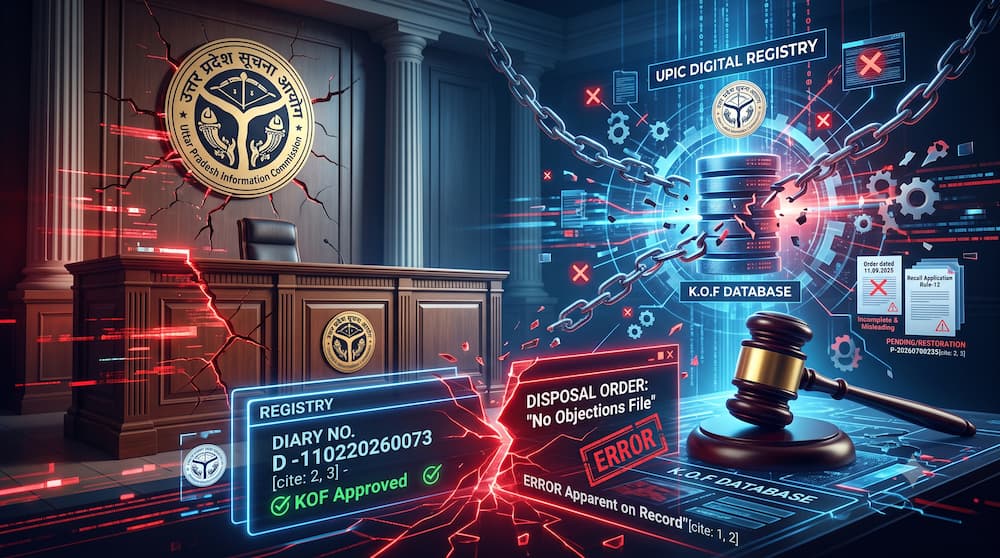
Systemic Failure & UPIC Commissioner Working – it is obvious from the fact that the travesty of justice is taking place in UPIC. There are a few commissioners who are making a mockery of the rule of law. The lack of accountability and transparency within the commission has led to a widespread perception of corruption and inefficiency. Many individuals seeking justice find themselves trapped in a system that prioritizes bureaucratic red tape over genuine resolution. This environment breeds frustration and disillusionment among citizens, who feel their voices are unheard. The principles of fairness and equity are being undermined, leading to an erosion of public trust in the very institutions meant to uphold justice and protect individual rights.
A comprehensive reform is urgently needed to address these critical issues.
Key Takeaways
- The article critiques the Systemic Failure & UPIC Commissioner Working within the UPIC, highlighting issues of accountability and transparency.
- A specific case, Kiran Singh vs. PIO, reveals critical failures in processing and judicial responses despite digital evidence being available.
- The PIO demonstrated non-compliance by failing to provide accurate information, relying instead on recycled reports and avoiding accountability.
- The appellant filed countermeasures, including a first appeal and a recall petition, to challenge fabricated court decisions.
- The report calls for comprehensive reforms to restore public trust in the UP Information Commission and improve the handling of digital records.
Systemic Failure & UPIC Commissioner Working: How Approved Citizen Objections Were Digitally Buried
The integrity of our transparency architecture rests entirely on the smooth operation of public grievance portals. However, a deeply concerning case from the state’s highest transparency desk reveals a massive breakdown in administrative diligence. Specifically, the case of Kiran Singh vs. Public Information Officer, Police Commissionerate, Lucknow (File No. S05/A/0106/2025) exposes critical issues. Consequently, it highlights a profound Systemic Failure & UPIC Commissioner Working pattern that undermines the Right to Information Act, 2005.
In this case, the digital registry successfully processed, approved, and integrated a citizen’s evidence. Yet, the bench threw out the case by claiming no such paperwork existed. Therefore, this blunder forces us to examine institutional decay. To address this, our detailed report breaks down the friction between electronic record-keeping and judicial execution at the Uttar Pradesh Information Commission (UPIC).
1. The Anatomy of an Error on the Face of the Record
The core issue began on 29 April 2026. At that time, the Hon’ble State Information Commissioner (Court S-5) passed a final disposal order on merits. Subsequently, the court formally closed the case after recording a definitive finding. Concretely, the order claimed the appellant was absent. Furthermore, it stated the appellant failed to file objections to the underlying police reports. As a result, the court deemed the applicant “satisfied” with the information.
However, this finding represents a severe Systemic Failure & UPIC Commissioner Working oversight. Indeed, it directly contradicts the Commission’s own electronic database. Meanwhile, the portal’s internal tracking logs confirm that the appellant uploaded comprehensive objections. In addition, the Commission’s registry explicitly vetted them:
- Diary No. D-021220250096: First, the registry formally logged a comprehensive objection rejecting the police department’s defensive stance.
- Diary No. D-110220260048: Second, the system registered a secondary written representation highlighting incomplete data. Then, the registry forwarded it directly to the hearing officer.
- Diary No. D-110220260073: Finally, the portal system explicitly marked this entry as “KOF approved and added to the file” on 11 February 2026.
Thus, a commission bench cannot legally claim that an appellant has “no objections on record” when its own registry formally stamped those objections as approved. Moreover, the registry added them to the file more than two months prior to the hearing. Ultimately, this unmitigated administrative blindspot proves a complete lack of coordination between the electronic data room and the physical courtroom.
2. Total Non-Compliance and Recycled Police “Red Herrings”
We must examine the history of the case file to understand the damage caused by this digital oversight. Previously, on 11 September 2025, the Hon’ble State Information Commissioner reviewed the initial filings. Accordingly, the Commissioner issued a strict interim directive. In particular, the Commission explicitly ruled that the Lucknow Police provided “incomplete and misleading” (अपूर्ण एवं भ्रामक) information. Hence, the Commission ordered the Public Information Officer (PIO) to supply point-wise, accurate data within two weeks. Naturally, the order carried a direct threat of penalty proceedings under Section 20(1) and 20(2).
Mockery of RTI Provisions
Instead of complying with this judicial mandate, the PIO executed an absolute non-compliance strategy. Undeniably, this defiance highlights a deeper issue within the Systemic Failure & UPIC Commission Working framework:
- Zero Fresh Data: To begin with, the PIO failed to generate or serve a single page of fresh, point-wise information to either the Commission or the appellant. PDF+ 1
- The Revenue Red Herring: Instead, the respondent simply re-uploaded a recycled report from Sub-Inspector Ashish Kumar dated 01/12/2025. Crucially, this report focused entirely on plot measurements of 2,615 square feet and 700 square feet. Thereby, the police used these figures to push a defensive narrative. Specifically, they claimed the matter was purely a revenue dispute. PDF+ 4
- Evading Accountability: Consequently, the police department completely evaded the original RTI queries by shifting the burden to the Revenue Department. For example, the original application demanded the legal basis for concluding a path was a “common road. In addition, it sought details on the arbitrary detention of the appellant’s family members at the Krishnanagar Police Station. PDF+ 2
The PIO blatantly refused to comply. Nevertheless, the court accepted a false oral assertion from the police representative during the final hearing. As a consequence, the bench blindly ruled that the applicant was satisfied and threw out the case.
3. Institutional Evasion and Concealment by the SPIO
Furthermore, the issues within the Systemic Failure & UPIC Commissioner Working environment extend to how fresh inquiries regarding internal accountability are handled. For instance, the applicant realized that the registry was mismanaging the case file. Therefore, she filed a fresh RTI request (Registration No. UPICM/R/2026/60247) on 1 May 2026. In this context, the application specifically requested the identity of the staff members responsible for portal uploads. It also sought a copy of the maximum time guidelines from the Citizen’s Charter. Finally, it demanded an Action Taken Report on a post-hearing representation logged under Diary No. D-010520260033.
Regrettably, the response from State Public Information Officer (SPIO) Mumtaz Ahmad on 19 May 2026 further illustrated institutional evasion:
- Blanket Grouping of Queries: First, the SPIO completely refused to provide individual, point-wise answers for Queries B, C, D, and E. PDF
- Hiding Behind Generic Rules: Second, the SPIO clubbed all distinct requests together. Instead of answering, he issued a generic reference to an internal office order dated 13 November 2025 regarding physical file inspections.
- Withholding Active Status Data: Third, the SPIO’s response blocked transparency regarding Diary No. D-010520260033. However, the underlying portal architecture shows the document’s actual status. In fact, the system has marked it as “forwarded to scrutiny” since 1 May 2026. Thus, the SPIO held this data but chose to withhold it from the citizen.
4. Multi-Pronged Legal Countermeasures: Appeal and Recall
Because the bench built the disposal order entirely on a fabricated premise, the appellant launched a multi-pronged legal counter-offensive. In this manner, she intends to bypass this institutional gridlock.
A. First Appeal Activated (Registration No. UPICM/A/2026/60132)
First, the appellant filed an online appeal on 2 July 2026. Clearly, this statutory appeal brings the matter directly before the First Appellate Authority (FAA), Deputy Secretary Tejaskar Pandey. Accordingly, the appeal explicitly challenges SPIO Mumtaz Ahmad’s evasive grouping of queries. Furthermore, it brings formal evidence of the court’s factual blindspot regarding the pre-existing digital submissions.
B. Order Recall Petition Filed under Rule 12 (Registration No. P-20260700235)
Simultaneously, the appellant has invoked Rule 12 of the Uttar Pradesh State Information Commission Rules. As a rule, Rule 12 provides a distinct legal pathway to recall and set aside final orders. Notably, it applies specifically to orders secured via misrepresentation, oversight, or a mistake of facts. Therefore, this petition targets the core of the Systemic Failure & UPIC Commissioner Working lapse. Presently, the appellant has registered this petition for an online hearing. Undoubtedly, this action forces the registry to re-examine the physical case file and account for Diary Nos. D-021220250096 and D-110220260073.
5. Institutional Takeaways and the Path Forward
In conclusion, this entire sequence of events serves as an important case study for RTI practitioners and administrative analysts across the state. Clearly, it highlights a dangerous vulnerability in modern quasi-judicial bodies. Obviously, human operators must review digital tracking systems to make them effective. Hence, for the UP Information Commission to restore absolute public trust, senior leadership must address these operational gaps. Now, clear digital trail logs are pinned to both an active First Appeal and a formal Restoration Petition. Consequently, the burden of correction rests squarely on the Commission’s senior appellate authorities.
Based on the official records of your case, here is the structured table containing all the application identifiers, official email addresses, mobile numbers, and public authority portal links for your active tracking:
Official Contact & Link Tracking Matrix (Systemic Failure & UPIC Commissioner Working)
| Authority / Officer | Application / ID Details | Mobile / Phone | Email Address | Web Portal Links |
|---|---|---|---|---|
| Uttar Pradesh Information Commission (UPIC) | General Portal Ref: UPICR20250000775 PDF Appeal Reg No: A-20250200031 PDF File No: S05/A/0106/2025 PDF | — | — | Main Site: rtionline.up.gov.inCommission Portal: upic.gov.in |
| First Appellate Authority Shri Tejaskar Pandey (Deputy Secretary) | First Appeal No: UPICM/A/2026/60132 PDF (Filed: 02/07/2026) PDF | 9415021746 PDF 945441XXXX PDF | deputysecretary-upic[at]up[dot]gov[dot]in PDF | Appeal Status Link: On the UP RTI Online Tracking Dashboard PDF |
| Court Room S-5 Registry (Hon’ble Padum Narayan Dwivedi Bench) PDF | Diary No (KOF): D-110220260073 PDF Diary No (KOF): D-110220260048 PDF Diary No (KOF): D-021220250096 PDF | — | hearingcourts5.upic[at]up[dot]gov[dot]in PDF+ 1 | Recall App Link: Registered under Rule 12 Entry PDF |
| Rule 12 Recall Registry (Restoration Branch) | Recall Reg No: P-20260700235 PDF (Filed: 02/07/2026) PDF | — | — | Online Hearing Portal: Link generated dynamically to registered email/SMS PDF |
| State Public Information Officer Shri Mumtaz Ahmad (Administrative Officer) | RTI Request No: UPICM/R/2026/60247 PDF (Filed: 01/05/2026) PDF | 9151804317 PDF 0522-2724945 PDF | jansu-section[dot]upic[at]up[dot]gov[dot]in PDF | RTI Reply Link: Downloadable via “View Document” link on dashboard PDF |
| Lucknow Police Commissionerate Shri Naveen Kumar Singh (ADC / PIO) | Respondent Profile PDF+ 1 | 9140770107 PDF | cp-pol.lu[at]up[dot]gov[dot]in PDF jansuchanalko[at]gmail[dot]com PDF | City Police Site: lucknowpolice.up.gov.in |
Key Notice for Tracking: (Systemic Failure & UPIC Commissioner Working)
- For First Appeal (
UPICM/A/2026/60132): Keep tracking the status under the First Appeal section ofrtionline.up.gov.inusing your credentials. - For Online Hearing (
P-20260700235): The Commission will transmit the digital VC hearing link directly to your mobile number 8687593247 and email kiransingh9389752386@gmail.com.
Here are the official portal outbound links formatted as active anchor text. You can use these links to log into your dashboards directly:
- Log in to check your active First Appeal status on the Uttar Pradesh RTI Online Portal.
- Log in with your citizen credentials to monitor your Rule 12 Recall Application on the Uttar Pradesh Information Commission Official Website.
How to use them: (Systemic Failure & UPIC Commissioner Working)
- For Appeal tracking: Click the Uttar Pradesh RTI Online Portal link, select View Status, and enter your appeal number
UPICM/A/2026/60132. PDF - For Recall tracking: Click the Uttar Pradesh Information Commission Official Website link, navigate to your dashboard with ID
UPICR20250000775, and check your running K.O.F registry status. PDF


Facing a similar challenge? Share the details in the box below, and our team of experts will do their best to help.