
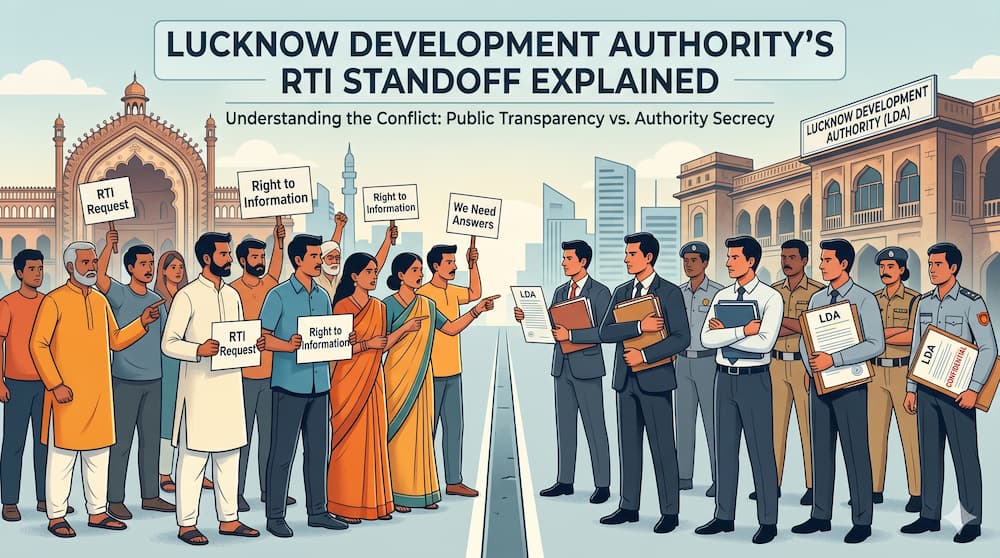
Lucknow Development Authority’s RTI Standoff has highlighted significant transparency issues within the organisation. This ongoing issue, often referred to as the Lucknow Development Authority’s RTI Standoff, has drawn increasing public scrutiny. A growing number of citizens are expressing frustration over the lack of timely responses to their Right to Information requests, which are designed to promote openness and accountability in government operations. Activists argue that the delays are indicative of a deeper problem, potentially obstructing citizens’ fundamental right to access information. As tensions rise, many are calling on the authority to streamline its processes, improve its responsiveness, and foster a culture of transparency that ensures that public interest is prioritised and upheld. The resolution of this standoff could set a precedent for future requests.
Key Takeaways
- The Lucknow Development Authority’s RTI Standoff exposes severe transparency issues within the organization.
- Citizens experience delays and non-responses to their Right to Information requests, indicating a culture of evasion.
- The case involves ongoing legal battles over critical land allotment anomalies and the refusal to disclose internal inquiry details.
- Public authorities misuse RTI exemptions to conceal information, undermining accountability and transparency.
- Advocates must push for legal remedies and financial penalties to combat institutional inaction and ensure accessible information.
Administrative Inaction & The Fight For Transparency: Inside the Lucknow Development Authority’s RTI Standoff
The Right to Information (RTI) Act of 2005 was enacted to dismantle systemic opacity and to hold public institutions accountable. However, the ground reality often tells a completely different story. Instead of experiencing open governance, citizens encounter a frustrating mix of administrative inertia, evasive tactics, and a blatant disregard for statutory oversight.
A prime example of this ongoing struggle currently unfolds before the Uttar Pradesh State Information Commission (UPSIC). Specifically, the battle takes place in Hearing Room S-9, under the stewardship of State Information Commissioner Shakuntala Gautam.
The case—Appeal No: S09/A/1768/2025 (Case Registration No: A-20250702295)—pits the persistent efforts of an ordinary appellant against the chronic non-compliance of the Public Information Officer (PIO) representing the local development body. Consequently, this blog post dissects the core issues of this administrative struggle, widely recognized as the Lucknow Development Authority’s RTI Standoff. In doing so, it highlights the systemic bottlenecks that continue to plague India’s transparency framework.
Lucknow Development Authority’s RTI Standoff: Land Allotment Anomalies and Institutional Silence
The root of this legal battle traces back to an initial RTI application filed under Section 6(1) on April 28, 2025 (Registration No. LKDPA/R/2025/60280). Through this request, the appellant sought critical, point-wise details concerning severe structural and financial irregularities. In particular, these anomalies involved the execution of registries and the allocation of Plots SS-1914 to SS-1918 under the direct jurisdiction of the Lucknow Development Authority.
Rather than providing clear answers, the LDA chose to remain completely silent. As a result of this total lack of response, the appellant filed a Second Appeal, officially registering it on July 26, 2025. Therefore, what should have been a straightforward statutory disclosure quickly turned into a multi-stage legal battle. Ultimately, this situation revealed a deep-seated culture of institutional evasion, setting the stage for the Lucknow Development Authority’s RTI Standoff.
Lucknow Development Authority’s RTI Standoff: The Deliberate Concealment of Public Inquiry Committees
At the very heart of the Lucknow Development Authority’s RTI Standoff lies the LDA’s refusal to disclose the basic composition of an internal investigative body.
- The Evidence of Existence: First, internal communications from the LDA confirm the reality of this probe. Specifically, Letter No. 562/50/2026, dated January 20, 2026, shows that they constituted an active Inquiry Committee to investigate the plot irregularities. PDF+ 1
- The Withholding of Identities: Despite this clear documentation, the PIO has consistently refused to cooperate. In fact, the official has hidden the names, designations, and current postings of the assigned public officials. PDF+ 3
The Legal Misconception of “Pending Inquiries” (Lucknow Development Authority’s RTI Standoff)
Public authorities frequently misuse Section 8 of the RTI Act to shield internal investigations. For example, they vaguely claim that a matter is “under inquiry” to block the release of data. However, under the law, the identity and official standing of public servants performing statutory duties cannot be classified as confidential. Therefore, denying this data does not protect administrative integrity. Instead, it merely fosters an environment where corrupt practices remain shielded from public scrutiny.
Core Issue 2: Chronic Non-Compliance and Contempt of Statutory Directives
Another critical issue highlighted by the Lucknow Development Authority’s RTI Standoff is the growing tendency of PIOs to ignore explicit mandates issued by the State Information Commission.(Lucknow Development Authority’s RTI Standoff)
- Ignored Mandates: To begin with, the Commission issued clear, categorical directions on November 26, 2025. These orders explicitly commanded the LDA PIO to provide clear, point-wise information to the appellant well before the next session. PDF+ 3
- Complete Inaction: Nevertheless, the PIO chose to ignore these orders entirely. Furthermore, the official missed the deadline to submit an action-taken report or provide verified dispatch proofs. PDF+ 3
- Repeated Absences: Additionally, the PIO systematically skipped multiple critical hearings. For instance, the official failed to appear on November 4, 2025, February 5, 2026, and April 8, 2026. PDF+ 3
This consistent pattern of avoiding hearings and ignoring written mandates amounts to institutional contempt. Consequently, it undermines the authority of the State Information Commission. Ultimately, it turns a time-bound legal right into an exhausting war of attrition for the citizen.
The Turning Point: The Commission’s Ultimatum
The turning point in the Lucknow Development Authority’s RTI Standoff arrived during the online session on April 8, 2026. Although both parties were absent from the video conferencing portal, the Commission thoroughly reviewed the case file. As a result, the bench took strict notice of the PIO’s ongoing non-compliance.
During this review, the Commission noted that the appellant had submitted a written protest via email. However, the document lacked a physical signature (अहस्ताक्षरित). Therefore, addressing this technical gap became a vital procedural step for the next phase of the dispute. (Lucknow Development Authority’s RTI Standoff)
Due to the PIO’s persistent absence, the Commission issued a strict conditional ultimatum through the Secretary of the LDA, granting the authority a final opportunity to dispose of the application under the UP RTI Rules 2015. The Commission also explicitly warned that any further failure to comply or appear would lead to immediate adverse ex-parte orders.
The Strategic Response: Curing Anomalies via Diary No. D-140620260026
Realizing that administrative bodies often exploit minor procedural errors to delay disclosures, the appellant took decisive action just before the subsequent hearing scheduled for June 15, 2026. (Lucknow Development Authority’s RTI Standoff)
On June 14, 2026, the appellant officially closed the procedural gap by submitting a formal, fully signed written representation to the Commission via email. The Commission formally accepted and recorded this vital submission under Diary Number – D-140620260026.
UPIC Case Portal Update:- Registration Number : A-20250702295- Diary Number : D-140620260026 (Filed 14/06/2026)- Hearing Room : S-9 (Hon'ble Shakuntala Gautam)
By uploading this signed document, the appellant successfully created an unassailable digital paper trail. Furthermore, a copy was sent directly to senior leadership within the LDA. Therefore, this strategic move effectively eliminated the PIO’s ability to claim they lacked notice or proper documentation.
Key Takeaways for Transparency Advocates (Lucknow Development Authority’s RTI Standoff)
| Core Administrative Failure | Legal & Strategic Remedy |
|---|---|
| PIO Absence & Delay: Ignoring explicit mandates for over a year (April 2025 – June 2026). PDF+ 1 | Section 20(1) Penalties: Demanding statutory financial penalties levied directly against the PIO’s salary. PDF+ 1 |
| Claiming Exemptions: Hiding committee names under the guise of an ongoing probe. PDF+ 1 | Section 8 Clarity: Emphasizing that official postings and public committee details are not legally exempt. PDF |
| Procedural Flaws: Document flagged by the court as unsigned (अहस्ताक्षरित). PDF+ 1 | Portal Logging: Submitting a signed PDF to secure an official diary number ahead of the hearing. PDF+ 1 |
Final Thoughts: Seeking Accountability Under Section 20
In conclusion, this case highlights a vital reality of civil advocacy. The RTI Act remains strong only when citizens actively fight against institutional inertia. When public officials withhold information, citizens must utilize every available legal tool, specifically demanding heavy financial penalties under Section 20(1) and pushing for disciplinary action under Section 20(2). (Lucknow Development Authority’s RTI Standoff)
Ultimately, the ongoing Lucknow Development Authority’s RTI Standoff underscores the need for continuous vigilance. True transparency is rarely volunteered by an administrative body. Instead, it must be systematically pursued through consistent, legally precise, and well-documented citizen action.
Here are the organized identity details, communication credentials, application tracking IDs, and web link connections for all public authorities involved in this case:
1. Uttar Pradesh Information Commission (UPIC) (Lucknow Development Authority’s RTI Standoff)
- Authority Name: Uttar Pradesh Information Commission, Lucknow PDF
- Bench Room: Hearing Room S-9 (Presided by State Information Commissioner Shakuntala Gautam) PDF+ 1
- Case Registration Number:
A-20250702295PDF+ 1 - Appeal File Number:
S09/A/1768/2025PDF+ 1 - Online Submission Diary Number:
D-140620260026(Filed on 14/06/2026) PDF - Citizen Profile ID:
UPICR20240000149PDF - Official Email Address:
hearingcourts9.upic@up.gov.inPDF+ 1 - Active Hearing Web Link: UPSIC Online Hearing Portal (Room S-9) PDF
- General Tracking Web Link: UP Information Commission Case Status PDF
2. Lucknow Development Authority (LDA) (Lucknow Development Authority’s RTI Standoff)
- Public Authority Name: Lucknow Development Authority, Janpad – Lucknow PDF+ 1
- Administrative Routing: Through the Secretary, Lucknow Development Authority, Lucknow (Pincode: 226012) PDF+ 1
- Original RTI Registration Number:
LKDPA/R/2025/60280(Filing Date: 28/04/2025) PDF+ 1 - Concerned Public Information Officer (PIO): Hemchandra Tiwari PDF+ 1
- PIO Mobile Number:
9918005512PDF - PIO Designated Email:
hemtiwari071@gmail.comPDF - LDA Nodal RTI Email:
ldartionline@gmail.comPDF - LDA Vice-Chairman Executive Email:
ldavc@rediffmail.comPDF
3. Appellant Profile Reference (Lucknow Development Authority’s RTI Standoff)
- Appellant Identity Name: Yogi M.P. Singh (Mahesh Pratap Singh) PDF+ 1
- Registered Address: Mohalla Surekapuram, Jabalpur Road, Mirzapur City, Uttar Pradesh, Pincode: 231001 PDF+ 1
- Primary Contact Mobile:
7379105911PDF+ 1 - Primary Contact Email:
yogimpsingh@gmail.comPDF+ 1


Facing a similar challenge? Share the details in the box below, and our team of experts will do their best to help.