
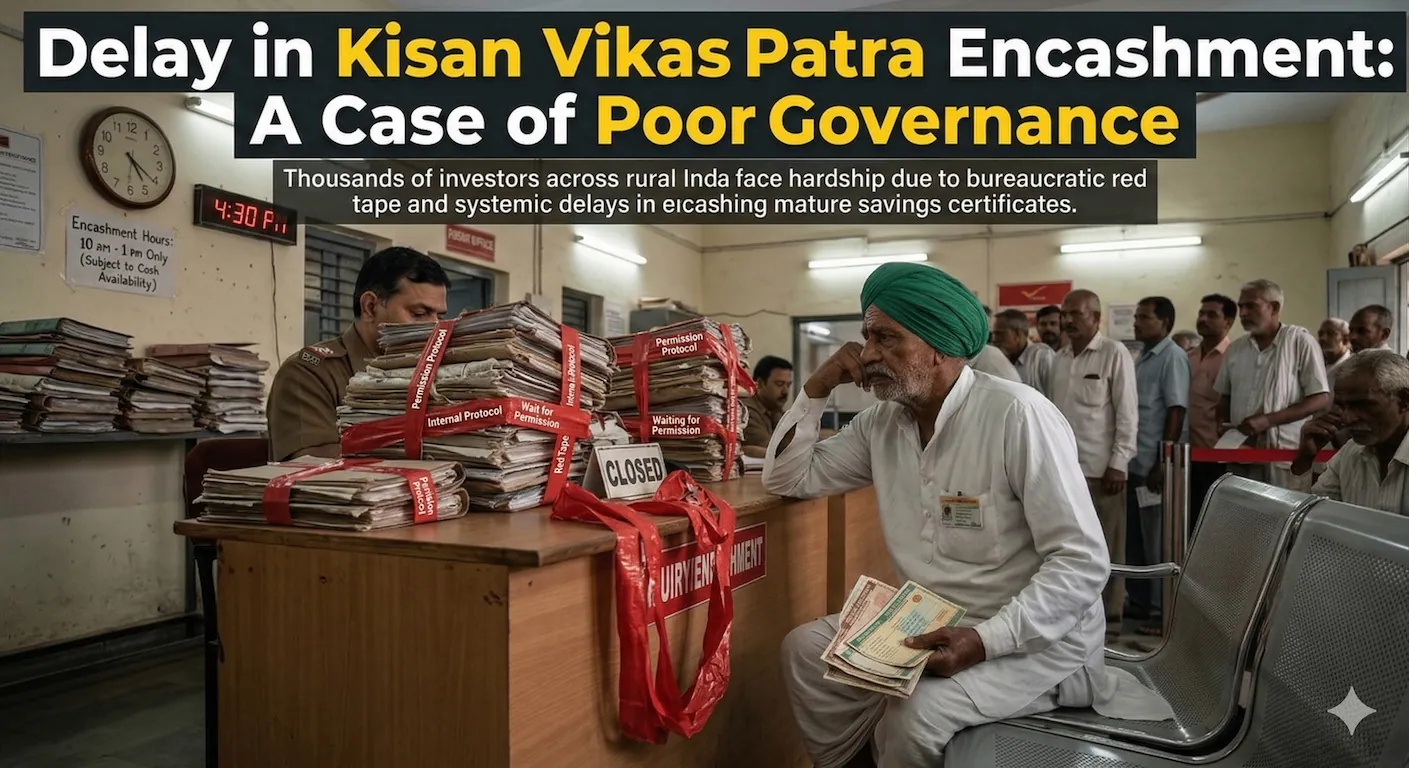
The key takeaway from the blog post is that :
administrative negligence and “red tape” function as a form of systemic corruption, even when no money is explicitly exchanged. One such example is the delay in Kisan Vikas Patra encashment that many people experience.
The case highlights three critical failures in public service:
- Inertia as Injustice: A simple clerical error occurred by sending bonds to the wrong office. This mistake turned into an 18-month ordeal. The department prioritized internal “permission protocols” over the citizen’s right to their matured savings.
- The Illusion of accountability: Saying that “accountability is fixed” lacks meaning. It holds no value if the victim has still not received their money. True accountability must result in the resolution of the grievance, not just internal paperwork. (Delay in Kisan Vikas Patra Encashment)
- Grievance Mismanagement: Companies arbitrarily close digital complaints before addressing the issues. This practice undermines the “Digital India” and “Good Governance” initiatives. This action turns a tool for justice into a tool for bureaucratic evasion.
Ultimately, the post argues that a six-month wait for permission by a government department reflects administrative anarchy. This delay unfairly penalizes honest taxpayers.
The Six-Month Stalemate: Administrative Anarchy and the Struggle for Kisan Vikas Patra Encashment
The Indian postal system is often hailed as the backbone of rural financial inclusion. For millions, the Kisan Vikas Patra (KVP) is not just a savings certificate. It represents years of hard work and discipline. It also signifies the security of a guaranteed future. However, the recent ordeal faced by Shri Deependra Singh and documented by activist Yogi M. P. Singh reveals a grim picture. The events show systemic failure, administrative “anarchy,” and a chilling lack of accountability within the Department of Posts.
When a citizen deposits their life savings into a government-backed scheme, they do so under the umbrella of trust. But what happens when that trust is met with a “clerical mistake” that takes over half a year to rectify?
The Genesis of the Grievance: A Maturity Denied
The case began simply enough. Four Kisan Vikas Patra bonds (IDs: PR/02PB 077964, 077963, 077962, and 077961) matured in January 2024. Following standard procedure, the original bonds were submitted to the Majhigawan Post Office in the Hamirpur District for encashment.
Under normal circumstances, the process should have been swift. Instead, a full year passed without payment. By January 2025, the complainant was forced to move the grievance portal (Registration: DPOST/E/2025/0000008). The core question was simple: How much time does the Department of Post take to encash a matured KVP? Why has it already taken twelve months?
The “Mistake” and the Six-Month Silence (Delay in Kisan Vikas Patra Encashment)
The response from the Department of Posts, received in June 2025, was startling. The department admitted that the physical bonds had been sent to the Director of Postal Accounts (DPA) Lucknow “by mistake.
While human error is a reality in any large bureaucracy, the secondary failure is what points to a deeper malaise. The department’s justification was ongoing. They claimed they were “waiting for permission from higher authorities” to return the bonds from Lucknow.
The Critical Question: Why does it take six months to obtain permission to rectify an internal administrative error?
If the department can misplace or wrongly route financial instruments in a matter of days, it reflects inefficiency. However, requiring 180+ days to retrieve them shows excessive bureaucracy. Consequently, the “Rule of Law” is effectively replaced by a “Rule of Red Tape.” This delay is not merely an inconvenience; it is a denial of the citizen’s right to their own property.
Accountability: Fact or Fiction?
Companies arbitrarily close digital complaints before addressing the issues, undermining the “Digital India” and “Good Governance” initiatives. This practice transforms a tool for justice into a means of bureaucratic evasion. (Delay in Kisan Vikas Patra Encashment)
A transparent administration would specify:
- Who was held responsible for the initial misrouting of the bonds?
- What disciplinary action was taken?
- Why has the “fixed accountability” not resulted in the immediate release of the funds?
To claim accountability is fixed while the victim remains without their money is a contradiction in terms. It suggests a culture where internal paperwork satisfies the “status” of a grievance. However, the actual resolution—the payment to the customer—is a secondary concern.
Administrative Anarchy vs. Good Governance (Delay in Kisan Vikas Patra Encashment)
The complainant, Yogi M. P. Singh, has used strong language, citing “deep-rooted corruption” and “sheer anarchy.” When a department sits on matured funds for 18 months (January 2024 to June 2025), these accusations carry weight.
In a digital age, the Prime Minister’s Office (PMO) champions “Minimum Government, Maximum Governance.” It is unacceptable for a regional postal branch to be unable to communicate effectively. This failure occurs with its own accounting office (DPA Lucknow). This is a systemic failure.
The arbitrary closure of grievances before the actual problem is solved is a recurring issue in the Indian bureaucracy. Closing a case based on a “pending permission” is a tactical move. This action improves department metrics on paper. However, it leaves the citizen in the lurch.
The Constitutional Angle: Article 51A
Interestingly, the complainant invoked Article 51A of the Constitution of India. This article outlines “Fundamental Duties.” It serves as a reminder. Every citizen has the duty to cherish the ideals of the Constitution. These ideals include the right to justice and the expectation that public servants will perform their duties with integrity. (Delay in Kisan Vikas Patra Encashment)
When the Department of Post fails to return matured savings, it isn’t just a financial delay. It is a breach of the social contract. In a village like Majhigawan, a farmer might save those funds for his daughter’s wedding. He might also need them for a medical emergency or to invest in agriculture. Every day of “waiting for permission” is a day of financial hardship.
The Path Forward: What Needs to Change? (Delay in Kisan Vikas Patra Encashment)
This case (PMOPG/E/2025/0088265) is now before the Postmaster General, Kanpur. For justice to be served, the following steps are non-negotiable:
- Immediate Manual Payment: The department is processing the bonds for manual payment through the SB branch. They must expedite this process within 48 hours.
- Interest for the Delay: The depositor should not suffer for a “departmental mistake.” The department should pay penal interest on the funds it withheld. This is applicable beyond the maturity date.
- Transparency in Accountability: Public disclosure is crucial. Reveal the names of the officials responsible for the six-month delay in seeking “permission.” The grievance report should include this information.
- Systemic Audit: This involves reviewing why DPA Lucknow and the Majhigawan Post Office do not have a streamlined protocol. The protocol is for returning wrongly routed documents.
Conclusion
The case of Shri Deependra Singh is a litmus test for the Department of Posts. Since the world’s largest democracy cannot ensure the timely return of a simple savings bond. So its claim to “Good Governance” is questionable. Then its claim to “Good Governance” is questionable. The ability to manage basic financial instruments reflects on governance. The lack of this ability calls into doubt the credibility of governance. These claims appear empty. Corruption isn’t always about the exchange of money. Deliberate inertia often characterises the situation. Officials display calculated indifference, feeling no urgency to serve the public.
It is time for the higher authorities in the Kanpur Region to move beyond “attached letters” and “waiting for permission.” It is time to return the money to its rightful owner.
Here are the structured contact details for the public authorities addressing your grievance regarding the Kisan Vikas Patra (KVP).
1. Principal Authority (Appellate Authority) (Delay in Kisan Vikas Patra Encashment)
This is the officer currently handling your appeal (DPOST/E/A/25/0002704).
- Officer Name: S. S. Srivastava (Assistant Director II)
- Organisation: Postmaster General, Kanpur Region, Kanpur
- Address: Office of the Postmaster General, Kanpur Region, Kanpur, Uttar Pradesh, PIN – 208001
- Email Address: adiirokp@gmail.com
- Contact Number: 0512-2303393
2. Nodal Grievance Office (UP Postal Circle) (Delay in Kisan Vikas Patra Encashment)
If the Kanpur office does not respond, you can escalate to the Circle level in Lucknow.
- Nodal Officer (PG): R. K. Awasthi (Assistant Director, Estt/Plg/PG)
- Email: pg.up@indiapost.gov.in2
- Phone: 0522-26247783
- Address: O/o Chief Postmaster General, UP Circle, Lucknow – 2260014
3. Concerned Office (DPA Lucknow) (Delay in Kisan Vikas Patra Encashment)
Your bonds were sent here “by mistake.” You may contact their administration. Verify if the “permission” for return is being processed.
- Office: Director of Postal Accounts (General Manager, PAF)5
- Address: Postal Accounts Office, Sector-D, Aliganj, Lucknow – 2260246
- Contact Officer: AO (Admin)
- Phone: 0522-2332003 / 0522-23320017
- Email: aoadmin1.up@indiapost.gov.in8
4. Central Oversight (PMO & CPGRAMS)
For your registered PMO grievance (PMOPG/E/2025/0088265).
- Web Link to Track Status: https://pgportal.gov.in/Status/Index
- PMO Facilitation Number: 011-23386447 (For telephonic enquiries)9
- PMO Address: Prime Minister’s Office, South Block, New Delhi – 11001110
- Fax: 011-2301685711
Summary Table for Quick Reference
| Authority | Contact Person | Phone | |
| PMG Kanpur (Appellate) | S. S. Srivastava | adiirokp@gmail.com | 0512-2303393 |
| UP Circle HQ (Lucknow) | R. K. Awasthi | pg.up@indiapost.gov.in | 0522-2624778 |
| DPA Lucknow (Accounts) | AO Admin | aoadmin1.up@indiapost.gov.in | 0522-2332003 |
| India Post Helpline | Customer Care | – | 1800 266 6868 |
Next Step: The Assistant Director II (Kanpur) must review the case since they received the appeal. Would you like me to draft a formal email reminder to Mr Srivastava? I will cite the six-month delay and the “Accountability” clause mentioned in the previous reply. (Delay in Kisan Vikas Patra Encashment)


Facing a similar challenge? Share the details in the box below, and our team of experts will do their best to help.