
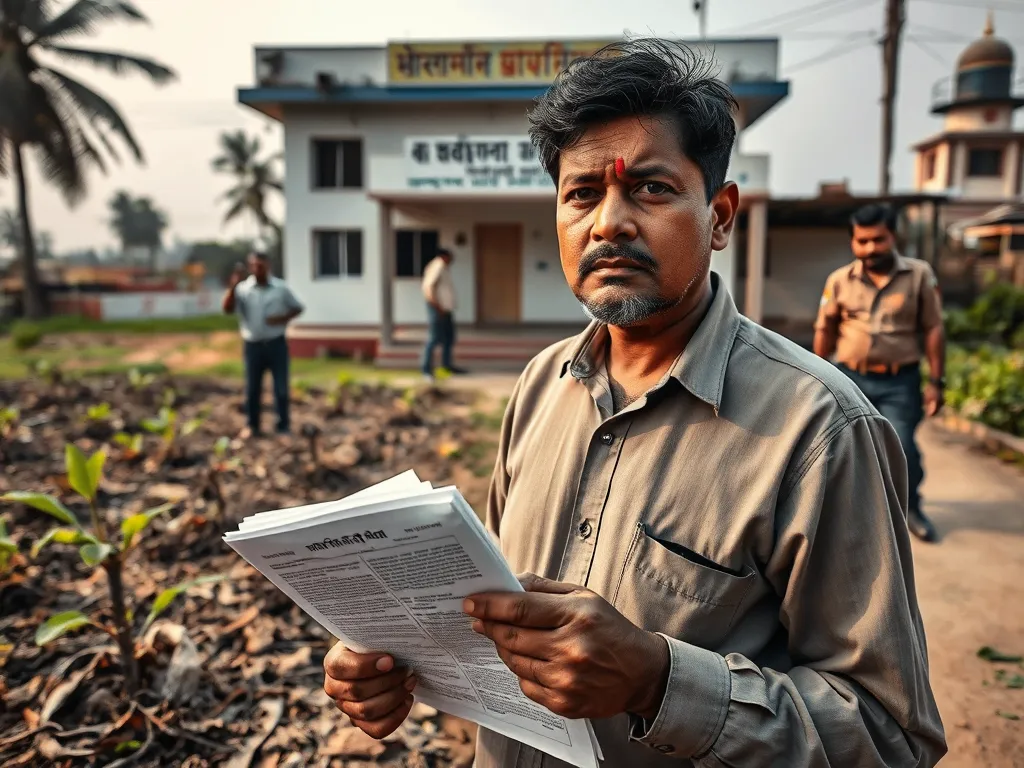
Public Land Sale in Tehsils: Transparent Inquiry Needed for the Araji 164 Scandal
Public Land Sale in Tehsils has become one of the most persistent threats to rural governance across Uttar Pradesh, The cases illustrate this better like Araji Number 164 in Mirzapur. Indeed, when tehsil officials manipulate revenue records, unchecked public land sale in tehsils quietly transfers government property into private hands. Specifically, land parcels get reclassified, bifurcated, and sold, often with little oversight from the very authorities meant to prevent it. As a result, villagers lose roads, common spaces, and public trust simultaneously. Furthermore, this pattern of public land sale in tehsils rarely stays contained to paperworkI it spills into daily life through encroachment and intimidation. Therefore, unless district and state authorities investigate these transactions rigorously, public land sale in tehsils will continue. It erods both rural infrastructure and citizens’ faith in the rule of law.
Key Takeaways
- Public land sale in tehsils erodes rural governance in Uttar Pradesh, exemplified by the Araji 164 case in Mirzapur.
- Officials manipulate land records, allowing the illegal sale and encroachment of public land, undermining village infrastructure and trust.
- Residents report issues like encroachment on roads and intimidation by local ‘muscle men’ connected to corrupt officials.
- The grievance process faces challenges with repetitive, ineffective responses from authorities, leading to a lack of accountability.
- The situation highlights the need for a transparent inquiry and strict oversight to protect public land and restore faith in governance.
Allegations of Land Scams and Institutional Apathy: The Case of Bihasara Khurd, Mirzapur
Public Land Sale in Tehsils is emerging as a troubling pattern across Uttar Pradesh, and the case of Bihasara Khurd in Mirzapur shows exactly why. Indeed, land records form the bedrock of rural governance in India. But what happens when the very officials who guard these records manipulate them? In that case, the system stops protecting people and starts preying on them. For example, Ashok Kumar Maurya has filed a series of formal grievances (Registration Numbers: GOVUP/E/2025/0021969 and GOVUP/E/2024/0034030). Together, they expose a disturbing pattern of alleged corruption, “muscle power,” and administrative collusion in Tehsil Sadar, District Mirzapur, Uttar Pradesh.
Specifically, at the heart of this dispute lies Araji Number 164, a parcel of non-agricultural government land. According to the complaint, local revenue officials have subdivided, sold, and allowed encroachment on this land — a textbook example of unchecked public land sale in tehsils — seemingly under their own watchful, or willfully blind, eyes.
How Public Land Sale in Tehsils Unfolds: The Anatomy of a Land Mutation
First, the complainant alleges a sophisticated “paper trail manipulation, a common tactic behind fraudulent public land sale in tehsils across the state. According to the grievance, the land’s identity kept changing over time. Initially, officials documented it as Araji Number 175. Subsequently, it became 183, then 191. Finally, it settled as Araji Number 164.
Next, and most critically, officials bifurcated Araji 164 into 164 K (क) and 164 Kh (ख). This wasn’t routine, the complainant alleges. Instead, Tehsil Sadar staff allegedly engineered this division as a fraudulent maneuver to facilitate the sale of government-owned land to private individuals.
Meanwhile, the complainant names several residents of Village Bihasara Khurd as alleged beneficiaries — individuals he describes as “muscle men” who wield local influence. For instance, this group reportedly includes Ramraj, Hiramani, Anil Kumar, and others. Overall, the grievance asserts these sales are fundamentally illegal, since the land is public property and the state should have protected it.
The Human Cost: Encroachment and the Obstruction of Public Space
Admittedly, financial corruption is a matter for auditors and investigators. However, the villagers of Bihasara Khurd feel the physical consequences of this alleged scam every day. Specifically, the complainant highlights a critical “spillover” effect: the illegal occupiers haven’t stopped at the plots they allegedly purchased through corrupt means. Instead, they’ve pushed further, a familiar side effect wherever public land sale in tehsils goes unchecked.
Key issues reported by the residents include:
- Encroachment on Public Roads: For example, the illegal occupants have extended their boundaries beyond the disputed plots and onto the road.
- Obstruction of Commuters: As a result, pedestrians and villagers now face significant hurdles in movement, since illegal structures and boundaries are squeezing the thoroughfare.
- Atmosphere of Fear: Furthermore, the involvement of “muscle men” and their reported proximity to Tehsil staff has created a climate where common citizens feel silenced and vulnerable.
A “Parrot Report” Culture: The Failure of Grievance Redressal
Notably, the grievance directs some of its sharpest criticism at the Lekhpal, Revenue Inspector, and Tehsildar of Sadar. Specifically, the complainant describes their responses as “parrot reports” — standardized, repetitive statements that dismiss the core evidence he has provided.
For instance, in an earlier grievance (GOVUP/E/2024/0034030), the local Lekhpal reportedly went so far as to “advise” the complainant to file a civil suit in court. However, villagers haven’t read this as legal guidance. Instead, they see it as a tactical deflection. In other words, by telling a citizen to go to court, the revenue department effectively abdicates its own responsibility to protect government land. In turn, this shifts the burden of proof — and the cost of litigation — onto the victim.
The complainant’s retort is sharp: “The custodians of this land are the officers… why should the citizen be forced into a suit when the state’s own property is being looted?”
Constitutional Duties and the Call for Accountability
To support this, the grievance invokes Article 51 A of the Constitution of India, which lays out citizens’ Fundamental Duties, including the duty to safeguard public property and to abjure violence. By reporting this matter, the complainant argues he is simply fulfilling his constitutional mandate. Yet he finds himself pitted against a wall of institutional apathy.
Ultimately, his demand is clear: he wants a transparent and accountable enquiry. Moreover, he argues that Mirzapur’s current hierarchy — from the District Magistrate (DM) and Chief Revenue Officer (CRO) down to the Sub-Divisional Magistrate (SDM) — must answer for the “tyranny and arbitrariness” currently prevailing in Tehsil Sadar.
The Current Status: A Glimmer of Hope?
As of March 6, 2025, the Chief Minister’s Secretariat in Lucknow has officially received the grievance. Subsequently, officials have forwarded it to Shri Arvind Mohan (Joint Secretary).
Overall, this escalation to the state capital marks a significant step. In particular, it moves the matter out of the immediate influence of Mirzapur Tehsil staff. As well it places it under scrutiny at the highest level of the Uttar Pradesh government. Therefore, for the villagers of Bihasara Khurd, this offers hope that the “anarchy” described in the grievance will finally meet a “cogent approach.”
Conclusion: Why Public Land Sale in Tehsils Matters
Clearly, the case of Araji Number 164 isn’t just about a single village in Mirzapur. Instead, it’s a microcosm of the challenges facing land governance across India, and a warning sign of how routine public land sale in tehsils can become when nobody watches the paperwork. Indeed, when government land becomes a commodity for the powerful, the “common man” loses more than just a road — he loses faith in the rule of law.
Therefore, if the Uttar Pradesh government is serious about its “zero-tolerance” policy toward land mafias, then the investigation into Tehsil Sadar must be rigorous, public, and swift. In short, the documents are attached, the names are listed, and the villagers are watching.
Following Up on Your Grievance: Contacts and Next Steps
First, to help you follow up on your grievance regarding the alleged land irregularities in Village Bihasara Khurd, here are the contact details and digital portals for the relevant authorities.
Since officials have forwarded your grievance (Registration Number: GOVUP/E/2025/0021969) to the Chief Minister’s Secretariat, you can use these channels for escalation and tracking.
1. State Level Authority (Current Handler) (Public Land Sale in Tehsils)
Because your case now sits with the Joint Secretary in Lucknow, these details are your primary point of contact for high-level intervention.
- Officer Name: Shri Arvind Mohan (Joint Secretary)
- Department: Chief Minister Secretariat, Uttar Pradesh
- Office Address: Room No. 321, U.P. Secretariat, Lucknow, PIN – 226001
- Phone Number: 0522-2226350
- Official Email: arvind.12574@gov.in
- Web Portal: Jansunwai-Samadhan (IGRS UP)
2. District Level Authorities (Mirzapur) (Public Land Sale in Tehsils)
Additionally, your grievance names the District Magistrate and Tehsildar as parties who should safeguard the land. So, you may also need to correspond with these offices directly:
| Office | Designation | Official Web Link/Contact |
|---|---|---|
| District Magistrate (DM) | DM Mirzapur | mirzapur.nic.in |
| Chief Revenue Officer | CRO Mirzapur | Contact Directory |
| Tehsil Sadar | SDM/Tehsildar Sadar | Ph: 05442-252449 (Collectorate) |
3. Digital Tracking & Application Details (Public Land Sale in Tehsils)
To keep your records organized, use the following links to check live status updates:
- IGRS Status Link:Track Your Grievance
- Input your Registration Number: GOVUP/E/2025/0021969
- CM Helpline: Dial 1076 (Toll-Free within Uttar Pradesh). You can call this number to provide your Application ID and register a reminder if the “Date of Action” passes without resolution.
4. Summary of Application Identifiers (Public Land Sale in Tehsils)
Keep these details ready for any email or telephonic correspondence:
- Primary Application ID: GOVUP/E/2025/0021969 (Dated: 06/03/2025)
- Previous Reference ID: GOVUP/E/2024/0034030 (Dated: 06/06/2024)
- Subject Matter: Fraudulent bifurcation of Araji No. 164 and encroachment of public roads in Bihasara Khurd — one more example of unregulated public land sale in tehsils.
Next Steps for You (Public Land Sale in Tehsils)
Caution: When emailing the Joint Secretary (arvind.12574@gov.in), make sure you attach the PDF evidence mentioned in your grievance. This matters because officials often rely on these attachments to verify whether the “parrot reports” from the local Lekhpal are factually incorrect.
Would you like a formal follow-up email drafted for the Joint Secretary — one that specifically highlights the “parrot reports” and the violation of Article 51 A?at specifically highlights the “parrot reports” and the violation of Article 51 A?



Facing a similar challenge? Share the details in the box below, and our team of experts will do their best to help.