
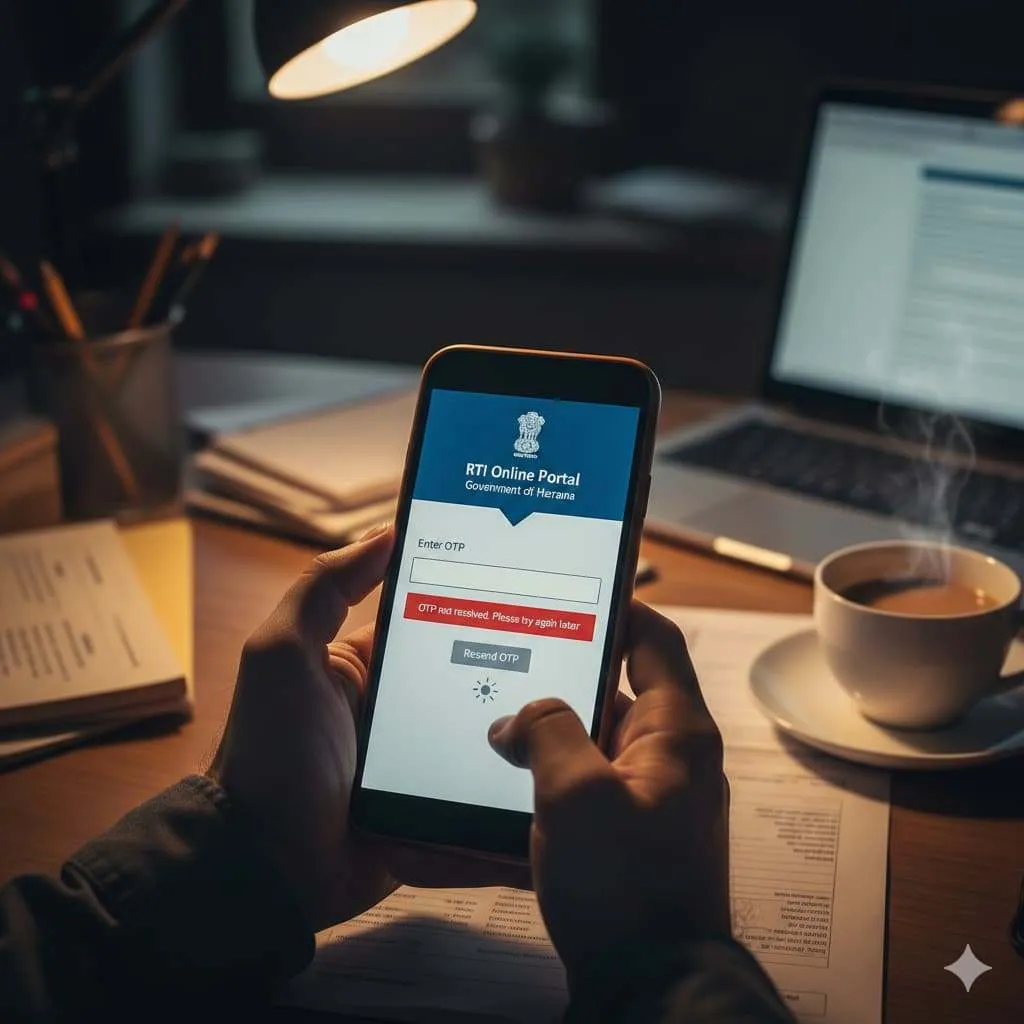
The Haryana RTI Portal & OTP Delivery system was supposed to make filing an RTI request faster and more secure. Instead, it has turned into one of the biggest obstacles citizens face when they try to exercise their right to information. Across Haryana, applicants report the same frustrating experience: they enter their details, wait for an OTP, and nothing arrives. As a result, they can’t log in, submit new applications, or even check the status of existing ones. Meanwhile, officials insist the Haryana RTI Portal & OTP Delivery process is “functioning smoothly,” pointing to high success rates as proof. However, this claim sits uneasily against the mounting complaints from real users. Consequently, what should be a simple login step has become a genuine barrier to transparency and accountability.
Key Takeaways
- The Haryana RTI Portal & OTP Delivery system has become a significant barrier for citizens trying to access information due to OTP delivery failures.
- Applicants across Haryana experience frustration as they cannot log in, submit requests, or check application statuses.
- Officials claim the system functions smoothly, conflicting with reports of widespread user problems and frustrations.
- Failures in the system undermine the core purpose of the RTI framework, affecting transparency and accountability in governance.
- Citizens can take action by filing grievances, sending complaints to authorities, and requesting manual submissions to ensure their rights are upheld.
🔐 The OTP Crisis on RTI Portals: A Barrier to Transparency
The Haryana RTI Portal & OTP Delivery system was meant to boost security. Instead, it has become a major roadblock. As a result, it now stops citizens from exercising their right to information.
Haryana shows this problem clearly. For instance, applicants there report repeated failures in Haryana RTI Portal & OTP Delivery, the process that’s supposed to let them log in and file requests. Consequently, many describe frustration and confusion.
Citizens rely on this system to check government actions and decisions. However, when OTP delivery fails, applicants can’t log in. Because of this, repeated attempts often end in failed authentication, leaving people stuck.
Furthermore, authorities haven’t clearly explained the technical glitches behind these OTP failures. As a result, this silence leaves applicants unsure when, or if, officials will fix the issue.
The security measure was meant to protect privacy. Instead, the broken Haryana RTI Portal & OTP Delivery process has become a barrier to transparency and accountability. In short, this undermines the RTI framework’s core purpose.
🛑 Impact of Haryana RTI Portal & OTP Delivery Failures
The OTP failure locks citizens out of the digital RTI system. Therefore, it blocks their access to information that matters for transparency and accountability in government.
Meanwhile, users feel frustrated by this lack of access. It also erodes public trust and, in turn, leaves many citizens feeling shut out of decisions that affect their lives.
Additionally, the failure hits some groups harder than others. In particular, people who depend on timely information for advocacy or legal cases suffer the most when the digital platform doesn’t work. Ultimately, this technical glitch threatens participatory democracy and good governance.
Specifically, three patterns stand out:
- Denied Access: Many applicants can’t receive their OTP by email or mobile. As a result, this stops them from submitting new applications or checking existing ones.
- Frustration and Delay: The glitch frustrates users and delays the process. Moreover, it undermines the core purpose of the RTI Act, 2005: timely transparency and accountability.
- Sporadic Performance: Users report sporadic OTP delivery, long wait times, and portal stalls. Likewise, the problems worsen when they try to view official replies.
For example, Mahesh Pratap Singh lived this failure firsthand. Specifically, he struggled to register his application because he never received the OTP on his mobile number. His case, therefore, illustrates a much wider pattern playing out across the state.
🏛️ Public Grievance vs. Official Stance on Haryana RTI Portal & OTP Delivery
The Haryana RTI Portal & OTP Delivery issue reveals a gap between user experience and official claims. On one hand, applicants describe a system that routinely fails them. On the other hand, officials insist the system works as intended.
- Public Action: Public-spirited individuals and RTI activists escalated the matter. Accordingly, they made a formal representation to the Chief Information Commissioner (CIC) of Haryana and urged immediate action.
- Government Claim: In contrast, the Department of Personnel and Training (DoPT) says the OTP feature is “functioning smoothly.” To support this, officials cite a high number of successful logins as evidence.
- The Reality Gap: However, users keep reporting real technical barriers, which directly contradicts the official claim. Indeed, one applicant called these failures “wicked techniques” that deprive information seekers of their rights.
Overall, this disagreement matters because it shapes whether officials treat the problem as urgent. As long as the government maintains that nothing is wrong, meaningful fixes are unlikely to follow.
💡 Why Haryana RTI Portal & OTP Delivery Problems Matter
This technical barrier carries serious consequences for democracy and governance. Specifically, three implications stand out:
- Negating Digital Purpose: First, OTP delays and failures cancel out the convenience digital RTI services were supposed to deliver.
- Stalling Accountability: Second, citizens can’t raise urgent issues about corruption, public welfare, and governance because a technical glitch blocks them.
- The Second Appeal Digitalisation Issue: Finally, a related problem persists too. Specifically, Haryana’s State Information Commission (SIC) has moved slowly on digitalising second appeals, even after a Supreme Court order set a deadline of end-2023. Consequently, this points to a wider pattern: officials keep delaying digital transparency measures.
Taken together, these three issues show that the OTP problem isn’t an isolated glitch. Rather, it’s one symptom of a broader reluctance to make government processes fully transparent.
📢 Recommended Action Plan for Haryana RTI Portal & OTP Delivery Failures
So, what can citizens actually do? Fortunately, they can take several concrete steps to push past the digital roadblock and demand accountability:
- File a Public Grievance: First, lodge a complaint on the Public Grievance Portal. Be sure to cite the OTP failure and attach screenshots or other evidence.
- Formal Complaint to SIC: Next, send a direct, formal complaint to the State Information Commission, Haryana. In this complaint, detail exactly how the portal issue stops you from filing or checking applications.
- Request Manual Submission: Alternatively, if the portal stays down, formally request a manual RTI submission option. This step, importantly, protects your legal right to information even when the technology fails.
- Escalate to DoPT: Finally, contact the Department of Personnel and Training (DoPT) directly by email or social media. When you do, reference the OTP failure and explain its impact on the RTI Act.
Together, these four steps create a paper trail. As a result, they make it much harder for authorities to dismiss the problem as a one-off complaint.
“बर्बाद गुलिस्ताँ करने को बस एक ही उल्लू काफ़ी था/ हर शाख़ पे उल्लू बैठा है अंजाम-ए-गुलिस्ताँ क्या होगा”
This couplet captures the moment well. On the one hand, one failure can disrupt a system and worry the public. On the other hand, many governance failures, including technical neglect, can wreck the promise of transparency and accountability altogether. Either way, they erode trust in institutions meant to serve the people.
Conclusions and Outcome
Indeed, these interconnected problems compound each other. As a result, they create chaos and leave citizens disillusioned. After all, people expect their leaders to uphold ethical standards and keep systems running smoothly, systems built to protect their rights and welfare. Ultimately, this pattern of Haryana RTI Portal & OTP Delivery failure threatens progress. In the end, it stifles the ideals a robust society depends on.
So, where does this leave citizens? In short, they must keep documenting failures, keep filing grievances, and keep pushing officials to acknowledge the gap between what the portal promises and what it actually delivers. Only then will the Haryana RTI Portal & OTP Delivery system serve the purpose it was built for.
Would you like me to draft a template for a formal complaint to the State Information Commission about the OTP issue?
Based on verified official sources, here are outbound links to the concerned public authorities for this article:
Where these fit in the article:
- “File a Public Grievance” step → link “Public Grievance Portal” text to
https://pgportal.gov.in/ - “Formal Complaint to SIC” step → link “State Information Commission” text to
https://cicharyana.gov.in/ - “Escalate to DoPT” step → link “Department of Personnel and Training (DoPT)” to
https://dopt.gov.in/ - New addition: link the phrase “Haryana RTI Portal” (wherever it first appears, e.g., in the intro or “Impact” section) to
https://rtiharyana.gov.in/— the actual portal citizens are complaining about. - Optional: cite
https://haryanait.gov.in/rti-web-portal/in the intro when explaining who built/runs the portal, since that’s the Haryana IT department’s own description of it.


Facing a similar challenge? Share the details in the box below, and our team of experts will do their best to help.