
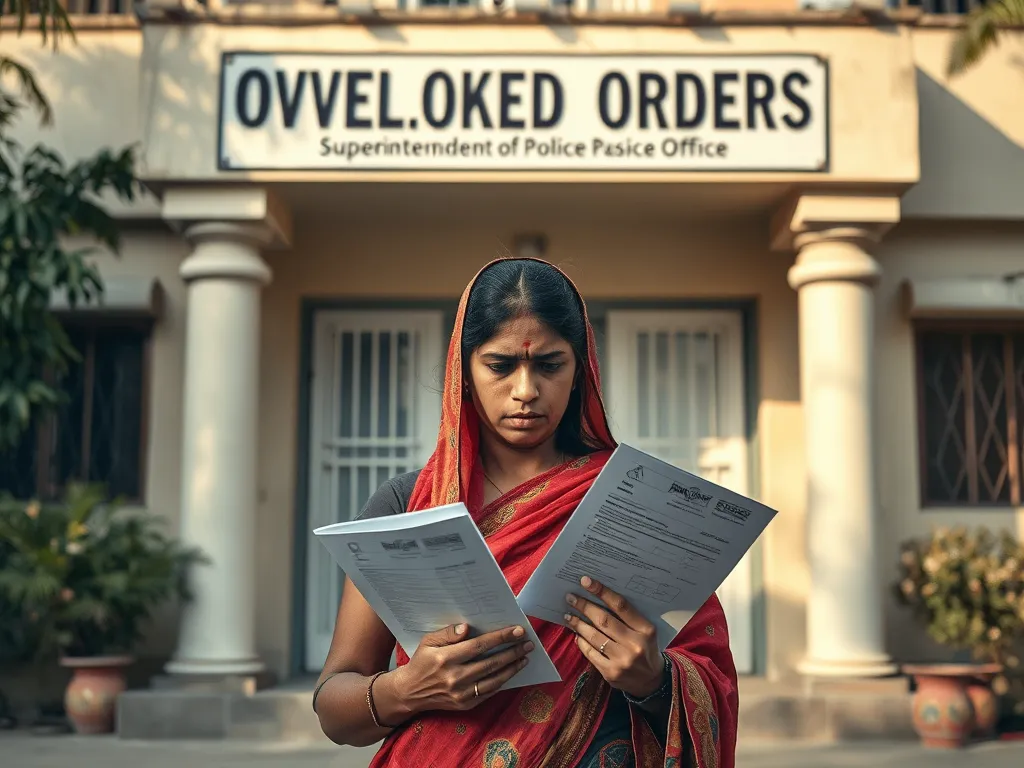
Case Study: RTI Intervention in Police Grievance Redressal
The Mahima Maurya vs. Superintendent of Police (Mirzapur) Case
In the complex landscape of Indian administration, the Right to Information (RTI) Act 2005 serves as a vital bridge between the common citizen and state transparency. A recent case involving Ms. Mahima Maurya from Mirzapur, Uttar Pradesh, highlights the tension between citizen grievances, the directions of the State Human Rights Commission (UPHRC), and the ground-level response of the police department.
1. Background: The Quest for Justice
The matter originated from a dispute in the village of Gorsar Sarpati, under the jurisdiction of the Vindhyachal Police Station. The applicant, Mahima Maurya, alleged that the local police failed to register a First Information Report (FIR) and overlooked her representations regarding a specific incident of violence.
Feeling unheard by the local authorities, Ms. Maurya approached the Uttar Pradesh Human Rights Commission (UPHRC). Under Diary No. 4672/IN/2024, the Commission perused her allegations and issued a clear directive on October 21, 2024:
“The Superintendent of Police, Mirzapur shall look into the matter and do the needful in accordance with law… within six weeks with the intimation to the complainant.”
2. The RTI Application: Seeking Accountability
When the six-week window for action began to close without a satisfactory resolution, Ms. Maurya utilized the RTI Act to track the progress of the UPHRC’s order. Her application, filed on November 14, 2024 (Registration No: SPMZR/R/2024/60208), sought specific details:
- Receipt Details: Who received the UPHRC order in the SP’s office?
- Internal Notings: What were the file notings made by officials regarding the order?
- Action Taken Report (ATR): What specific steps were taken based on the Commission’s direction?
- Reason for Inaction: If no action was taken, what was the administrative reasoning?
- Processing Personnel: The names and designations of staff who handled the file.
This application is a classic example of using RTI to ensure that “orders on paper” translate into “action on the ground.
3. Analysis of the Police Department’s Reply
On December 31, 2024, the office of the Superintendent of Police, Mirzapur, provided a reply based on an inquiry conducted by Sub-Inspector Vinod Kumar Yadav of Vindhyachal Police Station.
The Police Version of Events:
The investigation report (attached to the RTI reply) revealed a different perspective on the incident:
- Cross-Cases (NCRs): The police stated that the dispute was a mutual fight between relatives on September 14, 2024. Both parties had cases registered against each other under Sections 115(2) and 352 of the Bharatiya Nyaya Sanhita (BNS) (Non-Cognizable Reports or NCRs).
- Preventive Action: The police initiated proceedings under Sections 170/126/135 of the BNSS to maintain peace.
- Medical Discrepancies: The police report claims that while the applicant alleged a finger fracture, the medical report from the date of the incident showed no such injury. They suggested the applicant was attempting to escalate a minor scuffle into a more serious criminal case.
Administrative Conclusion:
The Public Information Officer (PIO), Om Prakash Singh (ASP Operation), disposed of the request by providing these findings, essentially stating that the “needful action” as per the UPHRC order had been completed through the existing investigation and registration of NCRs.
4. Legal Significance of the RTI Process
This case illustrates several critical components of the Indian legal and administrative framework:
A. The “Right to Reason”
The applicant cited a profound legal principle: the Right to Reason. In administrative law, any decision (or lack thereof) by a public authority must be backed by a rational explanation. By asking for “reasons for inaction,” the applicant forced the police to document their stance formally.
B. UPHRC vs. Police Discretion
While the Human Rights Commission can direct an SP to “look into the matter,” the police retain the discretion to determine if a cognizable offense has occurred. However, the RTI act ensures that this discretion is not used to hide negligence; the police must justify why an FIR was not registered despite a Commission’s intervention.
5. Challenges in the Response
While the police did provide a reply, certain gaps often remain in such RTI disposals:
- Specific Notings: RTI applicants frequently seek the exact comments made by senior officials in the file. Providing a general summary (the SI report) sometimes bypasses the specific “file notings” requested in Point 2 of the application.
- Timelines: The UPHRC gave a six-week window. The RTI response was finalized on December 31, roughly ten weeks after the UPHRC order, highlighting common delays in administrative processing.
6. Conclusion: The Road Ahead for the Applicant
The RTI response has effectively closed the “information” chapter, but for Ms. Maurya, the legal battle may continue. Since the police have categorized the matter as a mutual dispute with no serious injury (NCR), her next legal steps would involve:
- Filing a Protest Petition: If she disagrees with the police inquiry, she can approach the Magistrate’s court.
- First Appeal: If she feels the RTI information provided was incomplete (e.g., missing specific names or notings), she can file an appeal under Section 19(1) of the RTI Act.
This case serves as a reminder that the RTI Act is not just about getting documents; it is about holding the machinery of the state accountable to the promises of the Constitution and the directives of Human Rights bodies.
Based on the documents provided and the details of the RTI application, here is a structured analysis of the case involving Mahima Maurya and the Mirzapur Police.
1. Overview of the RTI Request
- Applicant: Mahima Maurya, resident of Village- Gorsar Sarpati, Mirzapur.
- Target Authority: Superintendent of Police (SP) Office, Mirzapur.
- Primary Objective: To obtain an Action Taken Report (ATR) and internal file notings regarding an order dated 21/10/2024 issued by the Uttar Pradesh Human Rights Commission (UPHRC).
- Status: The request was officially “Disposed Of” as of 14/01/2025.
2. Key Findings from the Police Inquiry Report
The police response includes an inquiry report conducted by Sub-Inspector Vinod Kumar Yadav of Vindhyachal Police Station. The following points were highlighted:
Legal Actions Taken
- Mutual Dispute: The inquiry found that the dispute was between relatives (brothers’ families) over an old grudge.
- Cross-Cases (NCRs):
- NCR No. 104/24: Registered on 14/09/24 by the applicant against the opposing party under Sections 115(2) and 352 of the BNSS.
- NCR No. 105/24: Registered by the opposing party (Saroja Devi) against the applicant and her husband under the same sections.
- Preventive Measures: Due to ongoing tension, the police initiated preventive action against both parties under Sections 170, 126, and 135 of the BNSS on 14/09/24.
Discrepancies in Allegations
- Injury Claims: The applicant claimed a finger fracture and sought a more serious criminal case. However, the police report states that the medical (Doctor’s) report dated 14/09/24 showed no signs of a fracture.
- Police Conclusion: The Sub-Inspector concluded that all necessary legal actions have been taken and no further police intervention is required at this stage.
3. Dissection of the RTI Response (Letter No. 103/2024)
The official reply, signed by Vivek Jawla (Circle Officer City, Mirzapur) on 31/12/2024, conveys the following:
- Information Source: The details provided were collected from the Vindhyachal Police Station.
- Attachment: Two pages of the inquiry report/investigation findings were attached and provided to the applicant.
- Advice to Applicant: The police noted that the applicant was informed that since the investigation is complete, she should seek further relief from the Honorable Court if she remains unsatisfied.
4. Critical Assessment
While the police have provided an explanation of the underlying dispute, there appears to be a gap between the specific questions asked in the RTI and the answers provided:
| Applicant’s Specific Question | Police Response Status |
| Names/Designations of staff who received the UPHRC order? | Not specifically addressed in the provided report. |
| Internal File Notings regarding the UPHRC communication? | Not provided; only the final inquiry report was shared. |
| Action Taken Report on UPHRC order? | Partially addressed by explaining the existing NCRs. |
| Reasons if no specific action was taken on the order? | Addressed by stating the medical report did not support the claim. |
5. Summary of Parties Involved
- Public Information Officer (PIO): Om Prakash Singh (ASP Operation).
- Nodal Officer: Omprakash Singh (Addl. SP).
- Inquiry Officer: Vinod Kumar Yadav (Sub-Inspector, Vindhyachal).
- Approving Officer: Vivek Jawla (Circle Officer City).
Based on the information provided, here are the relevant IDs, contact numbers, emails, and web links for Mahima Maurya’s RTI case:
1. Application and Case IDs
- RTI Application Registration Number: SPMZR/R/2024/60208 (Filed: 14/11/2024).
- RTI Transaction ID: SPMZRR20240000000256.
- First Appeal Registration Number: SPMZR/A/2025/60032.
- Second Appeal Registration Number: A-20250401121.
- UPHRC Case/File Number: 14054/24/55/2024.
- UPHRC Diary Number: 4672/IN/2024.
2. Contact Numbers
- Applicant (Mahima Maurya): +91-9198010433.
- PIO (Om Prakash Singh, ASP Operation): 9125608556 or 9454401105.
- First Appellate Authority (Somen Varma, SP/SSP Mirzapur): 9454400299 or 7007941679.
- UP State Information Commission (UPSIC): 0522-2724930.
- UP RTI Online Technical Helpline: 0522-7118629.
3. Email Addresses
- Applicant: mahimamauryagonasar@gmail.com.
- PIO (ASP Operation): aspopmzp@gmail.com or asp-op.mi@up.gov.in.
- First Appellate Authority (SP Mirzapur): spmzr-up@nic.in.
- Nodal Officer: addlspopmzr@gmail.com.
- UP Human Rights Commission: uphrclko@yahoo.co.in.
- UP Information Commission (Webmaster): webmaster-upic@up.gov.in.
4. Essential Web Links
- UP RTI Online Portal: rtionline.up.gov.in (To track application status).
- UP State Information Commission: upsic.up.gov.in.
- UP Human Rights Commission: uphrc.up.nic.in.
- NHRC HRCNet Portal: nhrc.nic.in/status.
- UP Police Officer Profiles: uppolice.gov.in.







Facing a similar challenge? Share the details in the box below, and our team of experts will do their best to help.