
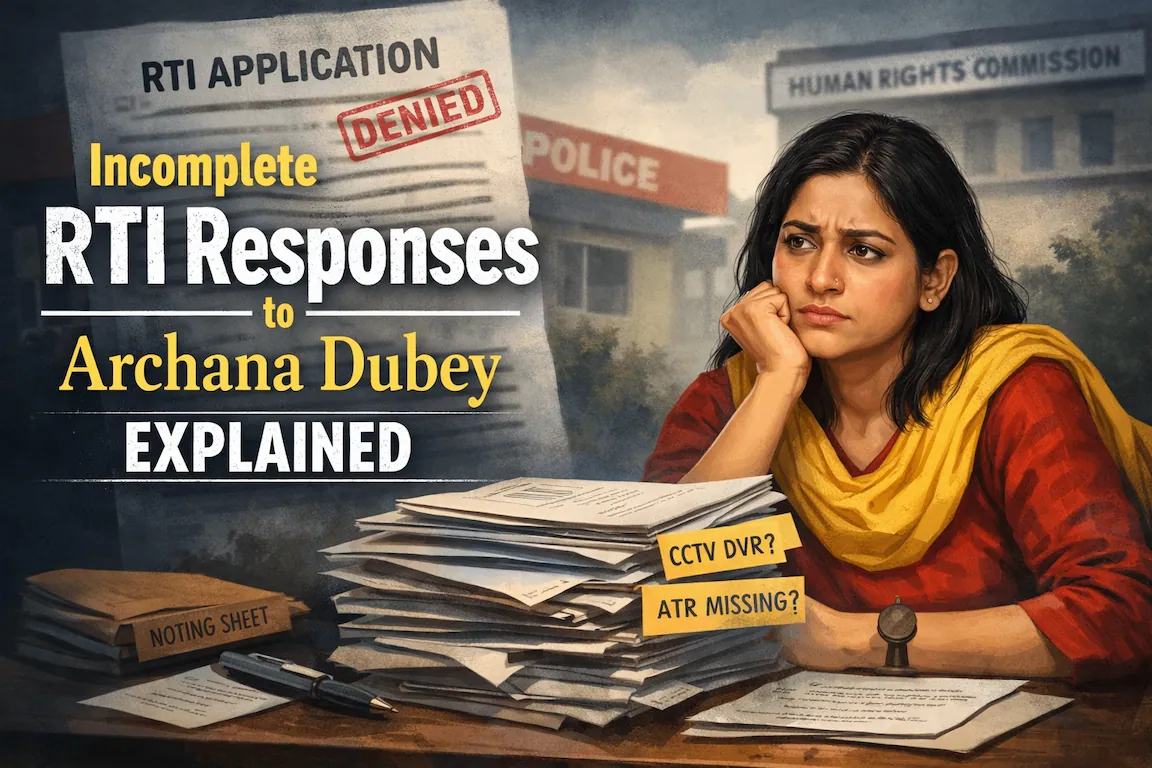
Incomplete RTI Responses to Archana Dubey: A Case Study of Transparency Failures and Accountability Gaps
Incomplete RTI responses provided to Archana Dubey have raised concerns regarding transparency and accountability within the system. The lack of comprehensive answers undermines the purpose of the Right to Information Act, which aims to ensure citizens can access information held by public authorities effectively. This situation calls for immediate attention and resolution.
Key Takeaways
- Incomplete RTI responses to Archana Dubey highlight significant transparency failures and accountability gaps within the system.
- The incomplete responses fail to provide critical documents, including the Action Taken Report and evidence handling details.
- Systemic issues arise as the First Appellate Authority upholds the flawed responses, indicating weak governance.
- Key concerns include the lack of specificity, absence of procedural details, and possible suppression of crucial evidence.
- The case underscores the need for stricter enforcement of the RTI Act to restore trust between citizens and public authorities.
Introduction: The Promise of RTI vs Ground Reality
Parliament enacted the Right to Information (RTI) Act, 2005, to empower citizens, promote transparency, and hold public authorities accountable. The Act gives citizens a legal way to access government records and ensures public institutions act fairly and lawfully. Yet, the incomplete RTI responses to Archana Dubey show a sharp gap between the law’s intent and its execution.
In practice, the effectiveness of RTI depends entirely on the sincerity of public authorities. The incomplete RTI responses to Archana Dubey highlight this failure—authorities withheld crucial information, gave evasive replies, and diluted accountability. The following sections present the full factual and legal picture.
Background of the Case
The case began with a complaint to the State Human Rights Commission (SHRC), which directed the Superintendent of Police (SP), Mirzapur, on 29 December 2025, to:
- Associate the complainant in the process.
- Submit an Action Taken Report (ATR)
To verify compliance with this order, the applicant filed an RTI request for the ATR, noting sheets, evidence-handling details, and the SP’s official directions.
Key Information Requested Under RTI
The RTI application was precise and legally valid. It sought:
- A certified copy of the Action Taken Report (ATR) submitted to the SHRC.
- Noting sheets showing day-to-day file movement
- Information regarding seizure of CCTV DVR, including seizure memo or reasons for non-seizure
- Names and dates of officers recording statements
- Copies of directions issued by the SP to subordinate officers
These requests clearly fall within the RTI Act’s definition of “information” and are vital to transparency in investigations and compliance.
The Problem: Incomplete RTI Responses to Archana. Instead of providing the requested documents, the Public Information Officer (PIO) attached only a general inquiry report. As a result, this response raises several serious concerns:s several concerns:
1. Lack of Specificity
The PIO did not address each query individually. Instead, the reply offered only a broad narrative, forcing the applicant to infer answers.
2. Missing Documents
The PIO did not provide crucial records — such as note sheets and the ATR — at all.
3. Silence on Key Evidence
The PIO provided no clear information on whether the CCTV DVR — an important piece of evidence — was seized.
4. Absence of Procedural Details
The statements lacked dates, preventing verification of timelines and procedure, thus undermining transparency and accountability.
The incomplete RTI responses to Archana Dubey undermine the RTI Act’s aim of clear and complete disclosure—a standard the PIO did not meet.
Failure of the First Appellate Authority
The applicant filed a first appeal highlighting these deficiencies. However, the First Appellate Authority (FAA) failed to provide meaningful relief. (Incomplete RTI Responses to Archana Dubey)
The FAA upheld the PIO’s response without addressing the gaps. This shows systemic failure, as appellate mechanisms merely endorsed the initial decision.
Such passive appeal disposal weakens the intended accountability framework of the RTI Act.
Core Issue 1: Denial of Noting Sheets
Noting sheets are critical records that show how decisions are made within government offices. They reveal:
- Movement of files
- Opinions of officials
- Decision-making process
Denying access to the notepads is serious. It blocks transparency in administrative decision-making.
Under the RTI Act, citizens possess an unequivocal right to access these records unless authorities invoke a clear exemption. In this case, no exemption exists, making the denial blatant and indefensible.
Core Issue 2: Non-Disclosure of CCTV DVR Status (Incomplete RTI Responses to Archana Dubey)
The most significant issue here is the missing information about the CCTV DVR.
The applicant specifically asked whether the DVR was seized and requested:
- A copy of the seizure memo, or
- Recorded reasons for non-seizure
The PIO’s refusal to answer this crucial point is indefensible. This prompts urgent and unavoidable concerns:
- Was proper procedure followed?
- Is there an attempt to suppress crucial evidence?
Evidence handling is fundamental to any investigation. This silence is not just a procedural lapse—it may undermine the integrity of the investigation.
Core Issue 3: Missing Action Taken Report (ATR) (Incomplete RTI Responses to Archana Dubey)
The SHRC directed the SP to act and report back. The ATR is the primary document showing compliance.
However:
- No clear ATR was provided
- No correspondence with SHRC was shared.
This raises a critical question: Was the SHRC order followed?
This outright failure to provide the ATR is a direct, indefensible violation of the RTI Act. It also casts grave doubt on whether the authorities ever intended to comply with critical human rights directives.
Core Issue 4: Lack of Procedural Transparency
The lack of dates in statements is recurring in the incomplete RTI responses to Archana Dubey. This makes events and possible irregularities unverifiable, undermining accountability.
- Authorities cannot verify the event sequence or identify delays. Genuine transparency requires complete, meaningful information.
Legal Implications
The deficiencies in this case point to clear violations of the RTI Act:
- Section 7(1): Failure to provide complete information
- Section 7(1): Failure to provide complete information. Section 2(j): Denial of access to records. These violations, combined with noncompliance with SHRC instructions, raise further accountability concerns.
Why the Incomplete RTI Responses to this case go far beyond a single RTI failure. IC breakdowns across multiple levels of governance: systemic breakdowns:
- Evasive responses by public authorities
- Weak enforcement of transparency laws
- Lack of accountability in handling evidence
- Ineffective appellate oversight
If authorities continue to provide incomplete responses and oversight remains weak, the RTI Act’s powers erode, undermining citizen empowerment and transparency.
Conclusion: Lessons from the Incomplete RTI Responses to Archana Dubey
The RTI Act’s success depends on strict enforcement. Cases like this show incomplete responses are failures of governance, not minor lapses.
This case underscores the need for:
- Stronger penalties for non-compliance
- Greater accountability of appellate authorities
- Transparent handling of evidence in investigations
- Active role of Information Commissions in enforcing the law
Ultimately, the incomplete RTI responses to Archana Dubey serve as a stark reminder. Unless authorities consistently enforce transparency in both letter and spirit, trust between citizens and the state will remain fragile. In conclusion, accountability is not merely a legal obligation — it is the essential guarantee that citizens’ rights are protected in practice.
Reference Details (Case Metadata)
RTI Application ID: SPMZR/R/2026/60047
First Appeal ID: SPMZR/A/2026/60016
Second Appeal Registration: A-20260401256
Commission Portal ID: UPICR20260002329
Public Authority: Superintendent of Police Office, Mirzapur
PIO Details:
- Name: Manish Kumar Mishra (ASP)
- Mobile: 9454401105
- Email: asp-op.mi@up.gov.in
First Appellate Authority (FAA): (Incomplete RTI Responses to Archana Dubey)
- Name: Aparna Rajat Kaushik
- Mobile: 9473567333
- Email: spmzr-up@nic.in
Online Hearing Contact:
- Mobile: 8840098979
- Email: archanadubeymzp1995@gmail.com
Web Portal / Tracking Links:
- Uttar Pradesh RTI Portal: https://rtionline.up.gov.in
- Uttar Pradesh Information Commission Portal: https://upic.gov.in


Facing a similar challenge? Share the details in the box below, and our team of experts will do their best to help.