
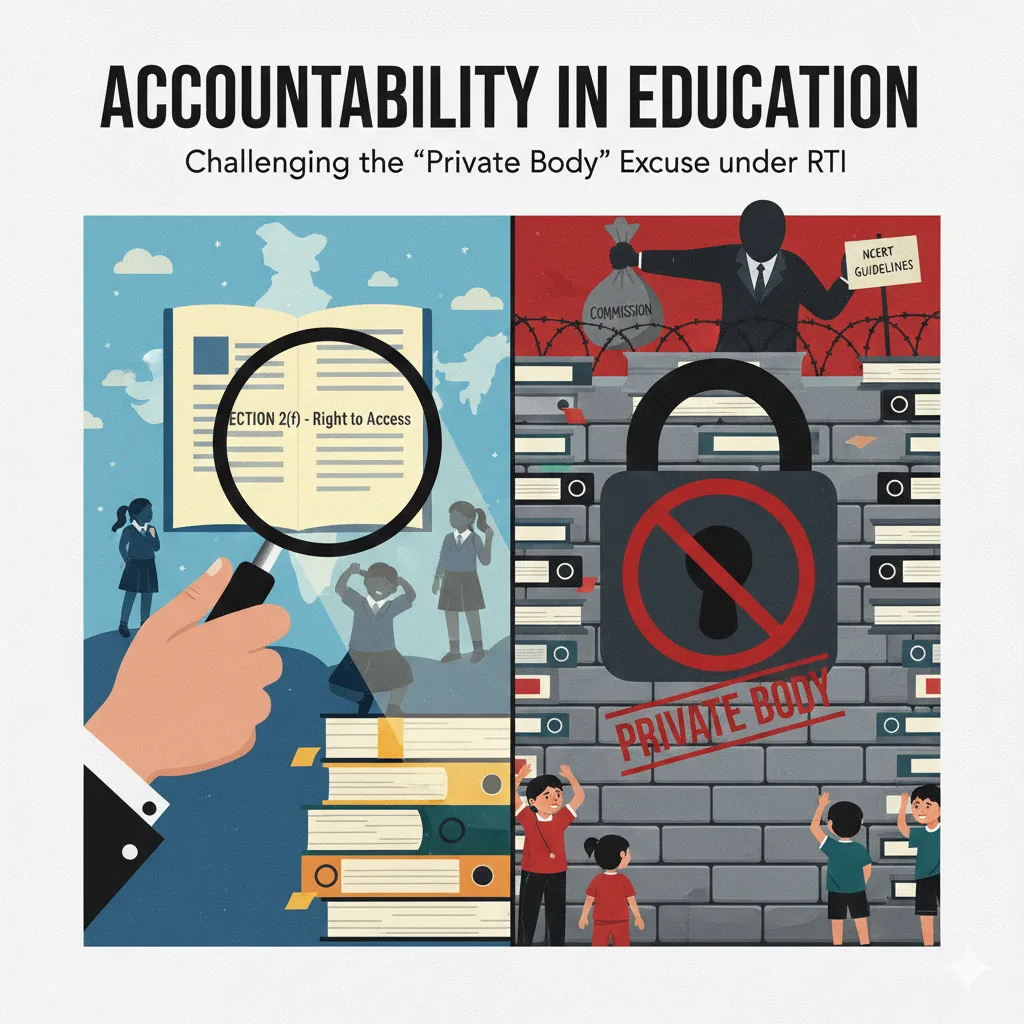
RTI Act and Accountability: Challenging the “Private Body” Excuse under RTI
The integrity of our educational system relies on transparency. Furthermore, this transparency is crucial, especially when it concerns the welfare of students. Additionally, it is also important regarding the financial burden on parents. The RTI Act and Accountability play a vital role in ensuring such transparency. For many issues within education, the RTI Act and Accountability offer essential mechanisms. They are particularly useful for financial matters. Parents and students can use these mechanisms to seek information. They can also demand responsibility. Moreover, a significant issue has emerged regarding the mandatory purchase of non-NCERT books. More importantly, officials often use legal hurdles to avoid disclosing information about these practices.
The Core Issue: Transparency vs. The “Private Body” Shield (RTI Act and Accountability)
This is any office, department, or group that the government funds or controls. They must be transparent and respond to questions from the public.
- Example: The District Inspector of Schools (DIOS) is a Public Authority because it is a government office. If you ask them how much money the government spent on school textbooks last year, they must tell you.
2. Private Educational Institutions (RTI Act and Accountability)
These are schools or colleges run by private trusts or individuals rather than the government. Most of them claim they are “private bodies” and therefore do not have to answer RTI questions directly.
In Case Number S-08/A/1436/2025, the DIOS Mirzapur claimed that a school is a private, recognised institution. Therefore, it is not a “Public Authority” under Section 2(h) of the RTI Act. As a result, it is exempt from disclosure.
However, this argument ignores the regulatory framework of the education department. Under the UP Intermediate Education Act, the DIOS maintains the legal power to inspect and regulate these schools.
The Legal Counter: Section 2(f) of the RTI Act
The most critical tool for citizens in this situation is Section 2(f) of the RTI Act. It defines “information” to include: (RTI Act and Accountability)
“…any material relating to any private body. This includes materials accessed by a public authority under any other law for the time being in force.
The DIOS must gather information if it has the legal right to ask a school for its records or inquiry status. The DIOS must then provide it to the RTI applicant.
Procedural Failures and “Deemed Refusal” (RTI Act and Accountability)
Beyond the legal definitions, administrative negligence often delays justice. Furthermore, in the matter involving Registration Number A-20251000614, several procedural red flags emerged:
- Excessive Delay: A response was provided more than 160 days after the initial filing, far exceeding the 30-day statutory limit.
- Deemed Refusal: Under Section 7(2), such a delay is legally treated as an intentional refusal to provide information.
- Incomplete Responses: Authorities often provide “point-wise” replies. These replies ignore the most sensitive questions—such as the status of government orders (GOs) regarding NCERT books.
The Path to Accountability (RTI Act and Accountability)
When officials provide “cryptic and mysterious” dealings, the Information Commission serves as the final arbiter. For the upcoming hearing on January 19, 2026, the focus will be on enforcing Section 20(1) penalties. These penalties are aimed at officials who fail their statutory duties.
True accountability is achieved only when public authorities stop shielding private entities and start upholding the public’s right to know.
Core Information Sought: Action Taken on Public Grievances (RTI Act and Accountability)
The primary objective of your application is to obtain transparency regarding the handling of Central Government Grievance No. DOSEL/E/2025/0003990, which involves the mandatory purchase of non-NCERT books in Mirzapur schools.
1. Action Taken by the Secretariat
- Request: You sought the specific action taken by the Additional Chief Secretary(Secondary Education). This was in response to the Government of Uttar Pradesh to the grievance. The grievance was forwarded by the Central Government on May 19, 2025.
- Status: This point remains largely unaddressed by the Secretariat PIO, Jay Karan Yadav. (RTI Act and Accountability)
2. Identification of Responsible Staff (RTI Act and Accountability)
- Request: You requested the names and designations of the public staff members. They work within the Department of Secondary Education. These staff members are currently processing this grievance.
- Status: Incomplete. The DIOS Mirzapur provided his own name in a subsequent letter. However, the Secretariat staff details have not been disclosed.
3. Inquiry Details regarding Specific Schools
- Request: You sought the names and designations of the officials. They were conducting inquiries into The Lions School (Bhujwa ki Chowki) and Lions School (Laldiggi). The inquiries were regarding the pressure on students to buy non-NCERT books.
- Status: Refused. The DIOS Mirzapur claimed these are private institutions and therefore not “Public Authorities” under Section 2(h).
4. Enforcement Action by DIOS Mirzapur (RTI Act and Accountability)
- Request: You requested a report on the action taken by the District Inspector of Schools (DIOS). They acted against institutions selling private publishers’ books. These sales were conducted through cryptic or forced methods.
- Status: Refused. The DIOS used the same “private body” exemption to avoid disclosing their own regulatory actions.
5. Legal and Policy Framework (NCERT Mandate) (RTI Act and Accountability)
- Request: You sought copies of office memos. You requested government orders (GOs), circulars, and guidelines issued by the UP Government. These documents mandate the use of NCERT books in public schools.
- Status: Ignored. The DIOS response dated December 22, 2025, did not address this point at all.
Current Procedural Deficiencies
Based on your submissions to the Information Commission (Diary Number: D-050120260070), the following failures in providing the sought information have been identified:
- Statutory Obligation (Section 2f): Information regarding private schools is accessible to the DIOS under the UP Intermediate Education Act. Therefore, they are legally bound to provide it to you.
- Deemed Refusal: The requested information was not provided within the 30-day limit, resulting in a delay of over 160 days.
- Incomplete Disclosure: The PIO failed to provide “point-wise” information as directed by the Commission’s order dated November 7, 2025.
Next Step: During the hearing on January 19, 2026, focus on the PIO’s failure to address Point 5 (Public GOs). Make sure this point is clear. Also, emphasize their illegal refusal of Points 3 and 4 under the guise of the “private body” exemption.
The analysis is based on the legal framework of the RTI Act and the documents provided regarding your case. It examines the obligation of CBSE-affiliated institutions to follow NCERT guidelines. The analysis also highlights how local authorities are failing to enforce these guidelines.
1. Mandatory Nature of NCERT Guidelines for CBSE Schools (RTI Act and Accountability)
- CBSE Mandate: The Central Board of Secondary Education (CBSE) has issued circulars. Consequently, they make the use of NCERT textbooks mandatory. This ensures academic uniformity and, furthermore, prevents the financial exploitation of parents.
- Regulatory Compliance: Any institution affiliated with CBSE is legally bound to follow the bylaws and circulars issued by the Board. Failure to do so can lead to the withdrawal of affiliation.
- Your Information Sought: In your RTI application DPSED/R/2025/60524, you specifically requested the “office memo, govt orders, circulars, and guidelines.” These documents mandate the use of NCERT books in schools.
2. Collusion and the “Private Body” Shield
- The DIOS Refusal: The DIOS Mirzapur refused to provide details. This was, in fact, in response to your query regarding the inquiry into Lions School for forcing students to buy non-NCERT books. They claimed, furthermore, that the school is a “private institution” and not a “Public Authority”.
- Legal Obligation under Section 2(f): This refusal is, ultimately, a significant legal error. Specifically, under Section 2(f) of the RTI Act, information includes material relating to a private body. Consequently, such material can be accessed by a public authority under any other law.
- Regulatory Failure: The DIOS is the local regulatory authority for education in the district. Consequently, it is their obligatory duty to access the school’s records. Moreover, they must ensure the schools are following CBSE/State mandates regarding textbooks. By refusing your request, the local authorities are, therefore, effectively shielding these private institutions from public accountability. (RTI Act and Accountability)
3. Why Information is Being Denied
- Deemed Refusal: Your application suffered a “Deemed Refusal.” The PIO failed to act within the 30-day limit. They only responded 160 days later after a Commission order.
- Status of Grievance (DOSEL/E/2025/0003990)
- Administrative Action: The Central Government forwarded the grievance to the State authorities for “necessary action.”
- The Compliance Gap: The Public Information Officer (PIO) has failed to provide an Action Taken Report (ATR).
- Key Ambiguities: (RTI Act and Accountability)
Action for Hearing (January 19, 2026) (RTI Act and Accountability)
In Hearing Room S-8 for Case Number S-08/A/1436/2025, you should emphasize that:
- Affiliation creates a duty: CBSE affiliation requires following NCERT guidelines; therefore, the records of such compliance are public interest documents.
- DIOS is the gatekeeper: Moreover, the DIOS cannot claim ignorance of a private school’s actions. Furthermore, they have the legal “right to access” those schools’ records under Section 2(f).
- Penalty is necessary: The delay indicates a deliberate attempt to obstruct the RTI process. The evasive response regarding the “huge commission” practices further supports this suggestion.
To ensure you have a complete record, here is the structured list. Furthermore, this list is for your upcoming hearing on January 19, 2026. In addition, it will take place in Hearing Room S-8. Finally, the list includes all identification numbers, contact details, and web references.
1. Key Identification Numbers (RTI Act and Accountability)
- Applicant Registration ID (UPICR): UPICR20250005050
- Commission Registration Number: A-20251000614
- Commission File Number: S08/A/1436/2025
- UPIC Diary Number: D-050120260070 (Assigned to your objection filed on 05.01.2026)
- Original RTI Registration No. (6(1)): DPSED/R/2025/60524
- Central Grievance Registration No.: DOSEL/E/2025/0003990
2. Public Authority Contact Details
| Authority | Name & Designation | Mobile Number | Email Address |
| Secondary Education Dept (Lucknow) | Jay Karan Yadav (PIO / Section Officer) | 9454412692 | educationsection2@gmail.com |
| First Appellate Authority (Secretariat) | Sanjay Kumar (Under Secretary) | 9454412276 | sanjay.12276@gov.in |
| DIOS Mirzapur (Current Office) | Maya Ram | 945441XXXX* | rmsa.mirzapur@gmail.com |
Contact Information Discrepancy (RTI Act and Accountability)
Regarding the official correspondence dated December 22, 2025, we note the following details:
- Signatory Identified: DIOS Maya Ram signed the letter.
- Missing Data: The provided documentation does not contain the complete mobile number for this official.
3. Essential Web Links for Tracking & Submission
- UP RTI Online Portal: https://rtionline.up.gov.in/ (To monitor the status of DPSED/R/2025/60524).
- UP Information Commission (UPIC) Status: http://upsic.up.gov.in/ (To track Case S-08/A/1436/2025).
- Central Grievance Portal (CPGRAMS): https://pgportal.gov.in/ (To track the original grievance DOSEL/E/2025/0003990).
4. Strategic Focus for the Hearing (RTI Act and Accountability)
The core of your information sought remains the Action Taken Report (ATR) regarding CBSE/State mandates on NCERT books. Therefore, during the hearing, present your Applicant Registration ID (UPICR20250005050) and provide your Diary Number (D-050120260070) to confirm your objection. Additionally, you filed this objection against the DIOS’s attempt to shield private schools under the “private body” excuse. Consequently, the DIOS must provide this information to you under Section 2(f) of the RTI Act.
Your hearing for Case Number S-08/A/1436/2025 is on January 19, 2026. It will take place in Hearing Room S-8. Furthermore, you raise a critical concern about the accountability of the Secondary Education Department (Secretariat).
If the DIOS denies receiving the communication, your efforts do not become baseless. Instead, the legal responsibility shifts directly back to the Secretariat PIO, Jay Karan Yadav. This occurs due to a failure in his statutory duties.
1. Why the Secretariat Remains Responsible (RTI Act and Accountability)
The RTI application DPSED/R/2025/60524 was filed directly with the Secondary Education Department (Secretariat). Under the RTI Act, the Secretariat is the “Custodian of Information” for the following reasons:
- Direct Receipt of Grievance: The Central Government grievance (DOSEL/E/2025/0003990) reached the Principal Secretary on May 19, 2025. It also reached the Additional Chief Secretary on the same date. It was forwarded specifically to them from the Secretariat.
- Duty to Track: The Secretariat must track the “Action Taken Report” (ATR). This is a mandatory duty for any grievance they receive from the Center.
- Section 6(3) Liability: If the PIO Jay Karan Yadav transferred the application to the DIOS, he had certain requirements. He was required to do so within 5 days. If the DIOS claims non-receipt, it proves that the Secretariat PIO either did not transfer it correctly. Alternatively, the PIO failed to follow up.
2. Counter-Strategy for the Hearing
If the DIOS makes this claim during the hearing, you should present these arguments to the Commissioner:
- Proof of Forwarding: Present the Central Government’s order from June 2025. This order confirms that the grievance was sent to the Additional Chief Secretary at Bapu Bhawan, Room No. 732.
- Secretariat’s Negligence: Argue that if the information has “not reached” the DIOS, then the Secretariat PIO is guilty. They are guilty of suppressing information. The Secretariat PIO is violating Section 5(4) and 5(5) of the RTI Act. This Act treats any officer whose assistance is sought as a PIO for the purpose of penalties.
- Point 5 is Independent: Regardless of the grievance transfer, Point 5 of your RTI is information the Secretariat definitely possesses. It involves requesting Government Orders/Circulars on NCERT books. The Secretariat has failed to provide this information.
3. Secretariat Contact & Identification Summary (RTI Act and Accountability)
- Applicant Registration ID: UPICR20250005050
- Secretariat PIO: Jay Karan Yadav, Section Officer
- Mobile: 9454412692 | Email: educationsection2@gmail.com
- Secretariat FAA: Sanjay Kumar, Under Secretary
- Mobile: 9454412276 | Email: sanjay.12276@gov.in
Conclusion (RTI Act and Accountability)
The DIOS’s denial would actually strengthen your case for a Section 20(1) penalty against the Secretariat PIO. It would prove a total breakdown of the official information chain.
Case Number S-08/A/1436/2025 and Registration Number A-20251000614 is therefore scheduled for a hearing on January 19, 2026. Moreover, your focus on the Central Government communication is the basis for your information demand. This approach is not only legally sound but also strategic.
If the DIOS Mirzapur denies receipt of the communication, it does not invalidate your efforts. It directly indicts the Secretariat for failing to track a high-level grievance.
1. Accountability of the Secretariat
The Secondary Education Department (Secretariat) in Lucknow received the original RTI (DPSED/R/2025/60524). The Secretariat acts as the official “Custodian of Information” for the following:
- Grievance Forwarding: The Principal Secretary received Central Grievance DOSEL/E/2025/0003990 on May 19, 2025. The Additional Chief Secretary of the UP Secretariat also received it.
- Tracking Duty: The Secretariat actively monitors the progress of every grievance forwarded by the Central Government. It ensures that each grievance is resolved properly.
- Transfer Responsibility: PIO Jay Karan Yadav had a legal obligation when transferring the RTI to the DIOS. According to Section 6(3) of the RTI Act, he needed to transfer it within 5 days. If it “never reached” the DIOS, the failure lies entirely with the Secretariat PIO.
2. Legal Liability Under Section 5(4) and 5(5) (RTI Act and Accountability)
If the DIOS claims they never received the communication, the Secretariat PIO cannot escape liability.
- Deemed PIO Status: Under Section 5(4) and 5(5) of the RTI Act, a PIO may seek assistance from any officer. That officer then becomes involved in duty discharge. This officer is treated as a “Deemed PIO”.
- Contravention: If the Secretariat PIO failed to ensure the communication reached the necessary official, they are personally liable. This liability is for the contravention of the Act.
- Penalty: The Commission can impose a Section 20(1) penalty on the Secretariat PIO. This happens when there is a failure to maintain the chain of information. This is especially concerning in matters of “wide public interest”.
3. Strategic Hearing Points (RTI Act and Accountability)
You should present the following arguments during your hearing in Room S-8:
- Evidence of Receipt: Point to the Central Government’s June 2025 order. This order confirms the grievance was delivered to Bapu Bhawan, Room No. 732.
- Independent Demand (Point 5): Point 5 of your RTI (requesting Government Orders on NCERT books) contains information. The Secretariat itself holds this information. Emphasize that they should have provided it regardless of whether the grievance reached the DIOS.
- Proof of Tracking: Ask the Commissioner to direct the Secretariat PIO to provide the “Proof of Dispatch.” Alternatively, request the entry from the Secretariat’s grievance register showing when it was sent to Mirzapur. (RTI Act and Accountability)
Conclusion: The DIOS’s denial would not make your case “baseless.” It would prove malafide suppression of information by the Secretariat. This makes them liable for the maximum penalty.
Would you like me to draft a specific “Show Cause” request? You can present this to the Commissioner for the Secretariat PIO.


Facing a similar challenge? Share the details in the box below, and our team of experts will do their best to help.