
🌧️ Mirzapur Flooding Exposes Governance Gaps: A Wake-Up Call from Surekapuram
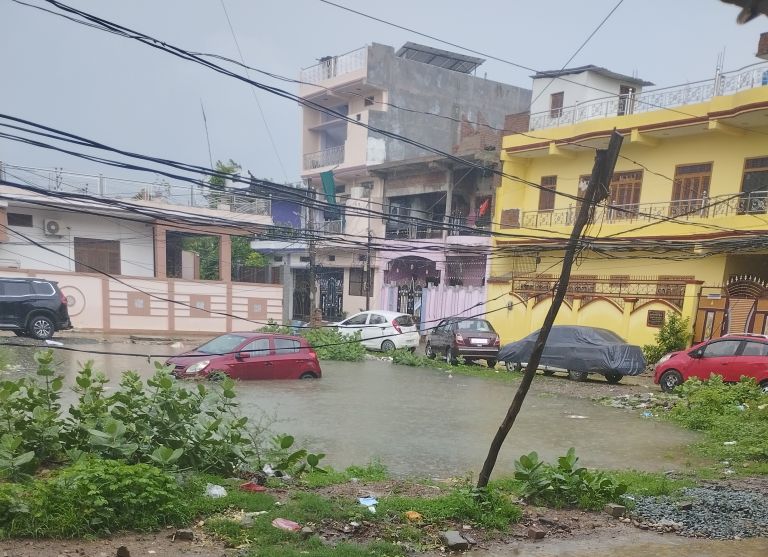
The recent flooding in the Surekapuram colony, Jabalpur Road, Mirzapur City following the rains on July 17, 2025, highlights critical infrastructure issues. It also underscores governance problems plaguing local administration. The recent flooding in the Surekapuram colony, Jabalpur Road. The rains on July 17, 2025, highlight critical infrastructure issues. The health risks of water logging become apparent when a formal grievance (Registration Number: GOVUP/E/2025/0080843) filed by Mr. Yogi M. P. Singh outlines a dire situation. Routine rainwater has overwhelmed the locality. This raises serious questions about the claims of “good governance” and development.
The Ground Reality in Surekapuram
The grievance paints a disturbing picture of life in the colony:
- Widespread Water Logging: Roads are “over flooded” and parks are “inundated.”
- Confinement and Difficulty of Movement: Residents are effectively “confined to their houses.” They face extreme difficulty coming out due to the logged water.
- Blame on Local Administration: The complainant explicitly attributes the crisis to the “mismanagement” of the Executive Officer. They also cite the “short sightedness” of the Executive Officer, Municipality Mirzapur City.
This situation directly contradicts the developmental narratives often espoused by political leaders. It reflects a significant disconnect between policy rhetoric and on-the-ground execution.
🚨 Serious Health Hazards and Sanitation Failure
The most alarming aspect of widespread water logging is the inevitable threat it poses to public health. The grievance rightly highlights the failure of the Clean and Sanitation Campaign initiated by the Prime Minister. Stagnant water is not just an inconvenience; it is a public health time bomb.
Key Health Risks Outlined:
| Category | Diseases | Risk Factors |
| Vector-Borne | Malaria, Dengue Fever | Stagnant water multiplies mosquito breeding. |
| Waterborne | Cholera, Typhoid, Dysentery, Hepatitis A & E | Spread through contaminated water and poor sanitation. |
| Other Infections | Leptospirosis, Dermatitis, Fungal Infections | Contact with animal urine-contaminated or dirty water. |
| Respiratory Issues | Asthma, Bronchitis, Pneumonia | Mold growth in damp environments. |
The complainant’s question is potent. “Whether the sick people may be instrumental in the development of the country” is a challenge to the administration. It suggests that negligence in public health undermines all developmental goals.
📢 The Administration’s Response: Zero Sensitivity Claim
The grievance points out the administration’s complete lack of sensitivity. This insensitivity relates to the problems of common people. The escalation of the matter to the highest levels (Chief Minister Secretariat) indicates a breakdown in local accountability.
- Grievance Status: Received on 17/07/2025.
- Action Taken: Forwarded to Shri Arvind Mohan (Joint Secretary) in the Uttar Pradesh Chief Minister Secretariat.
- Contact Information: arvind.12574$$at$$gov$$dot$$in, 05222226350.
The formal process is underway. However, the urgency of the problem demands that we act immediately and decisively at the executive level. We must not merely forward it bureaucratically. The situation requires us to create a comprehensive plan for:
- Immediate Drainage and Water Removal.
- Sanitation and Disinfection Drives to prevent the spread of disease.
- Long-term Planning for robust storm-water drainage systems in Mirzapur City.
Key Takeaway for Good Governance
The Mirzapur flooding incident demonstrates that “Good Governance” is not measured by grand claims. It is measured by how efficiently and sensitively local bodies handle fundamental issues like drainage and sanitation. The well-being and health of citizens form the bedrock of any successful development model.
🔎 Grievance Follow-Up: Status of Surekapuram Flooding (GOVUP/E/2025/0080843)
As of today, December 4, 2025, a specific final resolution is not available. The closing status for the grievance filed on July 17, 2025, is not available in the search results.
However, the search results do provide critical context, indicate ongoing related issues, and confirm the chronic nature of waterlogging in Mirzapur:
1. ⚠️ Grievance Status and Related Complaints
- The initial grievance regarding the Surekapuram flooding (GOVUP/E/2025/0080843) was received. It was transferred to Shri Arvind Mohan (Joint Secretary). This occurred in the Chief Minister Secretariat on the same day, July 17, 2025.
- No public-facing official resolution document or “Grievance Disposed” notice was found.
- Recurring Issues: The same complainant, Yogi M. P. Singh, filed a separate grievance (GOVUP/E/2025/0114687). This was a subsequent grievance on September 30, 2025. It concerned an urgent complaint about negligence in sanitation and road cleaning in Mohalla Surekapuram, Mirzapur City. This strongly suggests that underlying issues of sanitation persisted in the colony. The issues included local municipal service failure. These problems remained well after the initial July flooding incident.
2. 🌊 Mirzapur’s Chronic Flooding Problem
The search results confirm that the Surekapuram incident is part of a larger, recurring problem in the Mirzapur region:
- Geographical Vulnerability: Mirzapur is situated where water from the Vindhya hills and several rivers tends to stagnate. This includes the Ganga. This geological setup makes it naturally susceptible to waterlogging.
- Monsoon Havoc (July 2025): The heavy rains in mid-July 2025 caused widespread devastation across southern Uttar Pradesh. Mirzapur experienced hill streams overflowing. Villages were, cut off from each other. This confirmed that the Surekapuram incident was part of a major regional rain event.
- Infrastructure Gaps: Experts point to the need for restoring vegetation to slow runoff and strictly enforcing floodplain zoning. A drain status report for Mirzapur (July 2025) identifies numerous drains. These drains are, untapped or have inadequate flow capacity. This suggests a systemic flaw in the city’s storm-water and sewage management.
3. 🤔 Next Steps for the Complainant/Locality
Since the initial grievance was filed in July 2025, the issue was still recurring in September 2025. The local administration’s response appears to be slow. It is inadequate for a long-term fix.
To get the current status of your specific grievance number (GOVUP/E/2025/0080843), you would need to:
- Check the Official UP Integrated Grievance Redressal System (IGRS) Portal: Search using the registration number. Use it directly on the official platform where it was filed.
- Contact the Concerned Officer: Reach out directly to Shri Arvind Mohan (Joint Secretary). Use the email address provided in the grievance: arvind.12574$$at$$gov$$dot$$in or phone 05222226350.
That’s a logical next step, especially since the grievance’s status remains unclear. I will provide the official link to the UP Integrated Grievance Redressal System (IGRS). I will also summarize the current status of Mirzapur’s drainage and sewage projects. This will help us understand what long-term solutions are planned.
1. 🔗 Official Link to UP IGRS Portal (Jansunwai)
The platform for checking the status of your registration number (GOVUP/E/2025/0080843) is the Jansunwai-Samadhan portal. It functions as the Integrated Grievance Redressal System (IGRS) for the Government of Uttar Pradesh.
| Action | URL | Key Features |
| Check Grievance Status | http://jansunwai.up.nic.in/ | Enter your Registration Number to track the latest action and resolution status. |
| Alternative Portal | https://pgportal.gov.in/ (CPGRAMS) | This is the Centralized Public Grievance Redress System, which is connected to all states, including UP. |
Note on Resolution: Search results indicate that a high “resolved” rate on the IGRS portal (99.06% disposal rate statewide) sometimes does not reflect on-the-ground action. If the status says ‘Resolved’ but the issue persists, you may be able to file an appeal or submit feedback marking the resolution as ‘Poor’ on the portal.
2. 🚧 Status of Mirzapur’s Drainage and Sewage Projects (Late 2025)
The search results confirm that significant infrastructure projects are underway in Mirzapur. These projects are under schemes like the Namami Gange Project and the AMRUT (Atal Mission for Rejuvenation and Urban Transformation). However, they also highlight specific bottlenecks. These bottlenecks could explain the chronic waterlogging.
A. Sewage Treatment Plant (STP) and Drainage Gaps
-
Namami Gange Project (Mirzapur): The authorities sanctioned a major project for Interception & Diversion (I&D) of drains in May 2020. They also approved a Sewage Treatment Plant (STP) at that time.
- Status: The team has completed the works, but they face an ongoing issue with the final discharge point for the treated effluent.
- Bottleneck: The decision-makers denied permission to discharge into an irrigation canal. The team needs a variation proposal for the new location (Khajuri River), which was still pending final approval in mid-2024. This delay is likely affecting operationalization in 2025.
- Drainage Network: A study indicates that Mirzapur has 49 major drains flowing into the Ganga. Many of these drains are still, untapped or partially tapped. The issue in Surekapuram is likely a combination of inadequate storm-water drains and poorly managed open drains/sewers.
B. Master Plan and Urban Planning
- The Mirzapur-Vindhyachal Master Plan (2011-2031) highlights a systemic flaw. The lack of separate commercial zones and the mixing of land uses have resulted in heavy traffic congestion. This also leads to poor drainage and sewerage facilities.
- The AMRUT scheme focuses on sewerage, septage management, and storm water drainage in its projects. However, full implementation across all areas takes time, especially in expanding colonies like Surekapuram.
C. Water Conservation Accolades
- In November 2025, the National Water Awards recognized Mirzapur as the Best District in the Northern Zone. This award primarily acknowledges successes in rural water conservation (Jal Jeevan Mission, pond rejuvenation, and groundwater rise). These efforts differ from urban flood control and municipal drainage systems, which present separate engineering challenges.
Conclusion: Mirzapur is actively pursuing large-scale water and sewage projects. However, the flooding in Surekapuram likely stems from localized issues. These issues include poor municipal execution, blockages, or insufficient local drainage networks. The city struggles to fully operationalize its modern sewage infrastructure. Historical flaws in its urban master plan further exacerbate these problems.
Key Takeaways
- The recent flooding in Surekapuram highlights serious infrastructure issues and governance failures in Mirzapur City.
- Water logging poses significant health risks, including vector-borne and waterborne diseases, due to stagnant water.
- Residents face confinement and blame local administration for mismanagement and lack of effective response.
- The administration’s insensitivity exacerbates public health risks and raises questions about developmental claims.
- To address ongoing issues, immediate drainage solutions and comprehensive sanitation plans are essential.


Facing a similar challenge? Share the details in the box below, and our team of experts will do their best to help.