
🚨 The Rule of Law Under Strain: A Case Study of Alleged Illegal Detention in Mirzapur and the Demand for Accountability
The pursuit of justice and the enforcement of the rule of law are cornerstones of any democracy. When these foundations are shaken by allegations of misconduct by the very institutions sworn to uphold them, public trust inevitably erodes. The detailed grievance filed by Mahima Maurya, referencing multiple registration numbers (GOVUP/E/2025/0014667 and GOVUP/E/2025/0008765), brings to light a profoundly troubling case involving the alleged illegal detention of her husband, Pramod Kumar Kushwaha, by Mirzapur Police.
This case is not merely about one individual’s experience; it is a critical test of the police administration’s commitment to transparency, accountability, and, crucially, the strict adherence to governmental directives designed to protect citizens’ fundamental rights.
📜 The Allegations: A Challenge to the Police Narrative
Mahima Maurya’s primary contention revolves around the illegal detention of her husband, Pramod Kumar Kushwaha, on September 14, 2024. The police documents, she asserts, offer a contradictory and arbitrary account.
- The Police Document: The initial grievance (GOVUP/E/2025/0008765) and the subsequent closure report indicate that preventative action was taken against Mahima Maurya’s younger brother, Mithilesh Maurya, and other parties under sections of the Bharatiya Nagarik Suraksha Sanhita (BNSS), specifically Section 170/126/135 BNSS (formerly Sections 107/116/151 CrPC in the context of the government circular mentioned). The closure report states that “preventative action was taken under Section 170/126/135 BNSS against both parties” on September 14, 2024.
- The Complainant’s Claim: Mahima Maurya emphatically states that her husband, Pramod Kumar Kushwaha, was the one arrested/detained at the location of Mithilesh Maurya. She asserts that her husband was subsequently granted bail by the Sub-Divisional Magistrate Sadar on the same date. The core of her argument is that the police records, which allegedly point to Mithilesh Maurya’s arrest, are manipulated or inaccurate, and that the factual position is her husband was illegally detained.
The discrepancy between the official police record and the complainant’s claim, supported by a purported bail order from the Magistrate, casts a serious shadow of doubt on the veracity of the police investigation and record-keeping. The police report, which labels the complainant as being “addicted to repeatedly submitting applications” despite being told to seek remedy in court, seems dismissive, rather than a thorough rebuttal of the documented judicial action (the alleged bail).
💰 The Demand for Compensation: Enforcing Government Mandates
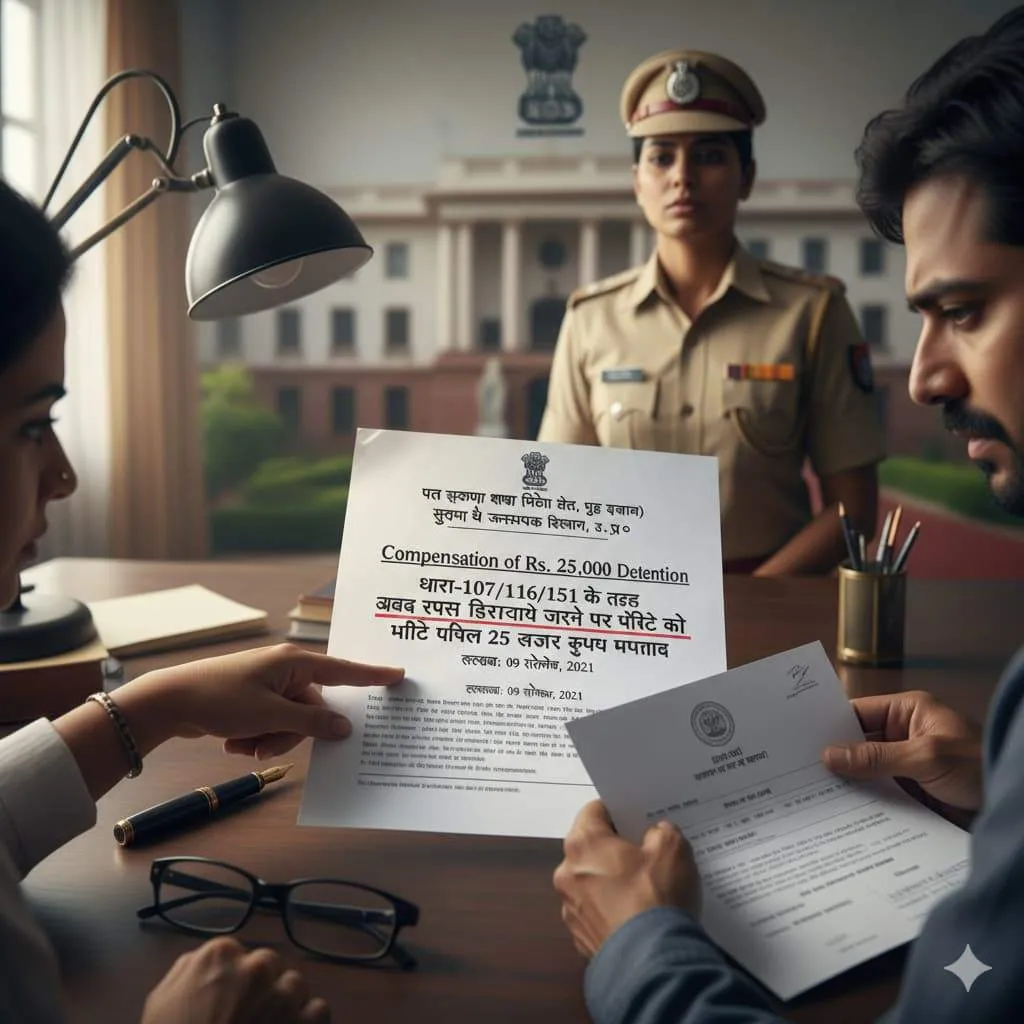
A critical component of the grievance is the demand for ₹25,000 in compensation for the victim of the alleged illegal detention. This demand is rooted in a specific, high-level governmental order.
The grievance explicitly references a press note from the Information and Public Relations Department, U.P., dated September 9, 2021, which clearly states:
“धारा-107/116/151 के तहत अवैध रूप से हिरासत पाये जाने पर पीड़ित व्यक्ति को मिलेगा 25 हजार रूपये मुआवजा” (Under Section 107/116/151, a victim of illegal detention will receive ₹25,000 in compensation.)
The press note further mandates:
अवैध हिरासत किये जाने के उत्तरदायी अधिकारी के विरूद्ध भी होगी नियमानुसार दण्डात्मक कार्यवाही” (Punitive action will also be taken as per rules against the officer responsible for the illegal detention.)
This order, issued in the wake of directives from the Allahabad High Court, establishes a clear, enforceable mechanism for redressal. The state government, through its various authorities (District Magistrates, Director General of Police, etc.), was explicitly instructed to ensure its strict compliance.
Mahima Maurya’s case thus transcends a typical police complaint; it becomes a direct challenge to the Mirzapur Police and the wider administration to adhere to the state government’s own mandatory circular. The police, having submitted an arbitrary report that closes the case without acknowledging or addressing the judicial record (the bail granted to the husband), appear to be circumventing this directive.
🏛️ The Imperative of Institutional Accountability
The final part of the grievance is a call for systemic reform, driven by the immediate need for justice in this specific case. The arguments raised are foundational to good governance:
- Strict Enforcement of Directives: There must be a clear and enforceable mechanism to ensure that “office memos, circulars, advisories, notifications, and government orders” are strictly followed by subordinate officers in the field. Non-compliance renders the rule of law “meaningless.
- Fixing Accountability: The Superintendent of Police, Mirzapur, is expected to take “immediate and appropriate action against the guilty police personnel involved” and set a precedent by “holding the responsible officers accountable.
- Reinforcing Public Trust: Prompt redressal, including adequate compensation, is essential to “reinforce public trust in the justice system.” The police administration cannot afford to be perceived as a body that shields its own personnel when fundamental rights are violated.
The grievance report’s final status—”Case closed”—with the reasoning that the complainant should “seek shelter in the Court of law for investigation” and the dismissive remarks about her being an “addict” to filing applications, are concerning. While seeking judicial remedy is a citizen’s right, the administrative grievance mechanism (CPGRAMS in this case) is intended to address failures in administrative compliance—such as following the September 2021 compensation circular and investigating allegations of illegal detention and manipulated records.
🌟 Conclusion: A Test for Transparency and Justice
This Mirzapur case serves as a stark reminder that the ideal of a police force committed to transparency, accountability, and respect for citizens’ rights is not automatic; it must be constantly and vigorously enforced from the top down.
The path forward is clear:
- The administrative authority, specifically the Joint Secretary and the Chief Minister Secretariat, must reopen the grievance and issue a clear directive for the Mirzapur Police to submit a fresh report that specifically addresses the judicial record (the alleged bail granted to Pramod Kumar Kushwaha).
- A dedicated investigation must be conducted to establish the factual position: who was detained, under what sections, and by whose order.
- If illegal detention under the relevant preventative sections is established, the ₹25,000 compensation must be paid promptly to Pramod Kumar Kushwaha as per the September 2021 government order.
- Concurrently, departmental action must be initiated against the personnel responsible for the illegal detention and the submission of potentially inconsistent or arbitrary reports, thereby fixing the necessary accountability.
Only when administrative authorities move beyond cursory closures and take decisive, corrective action will citizens believe that the rule of law is a reality and not just an ideal. The credibility of the entire justice system hinges on the resolution of cases like this.


Facing a similar challenge? Share the details in the box below, and our team of experts will do their best to help.