
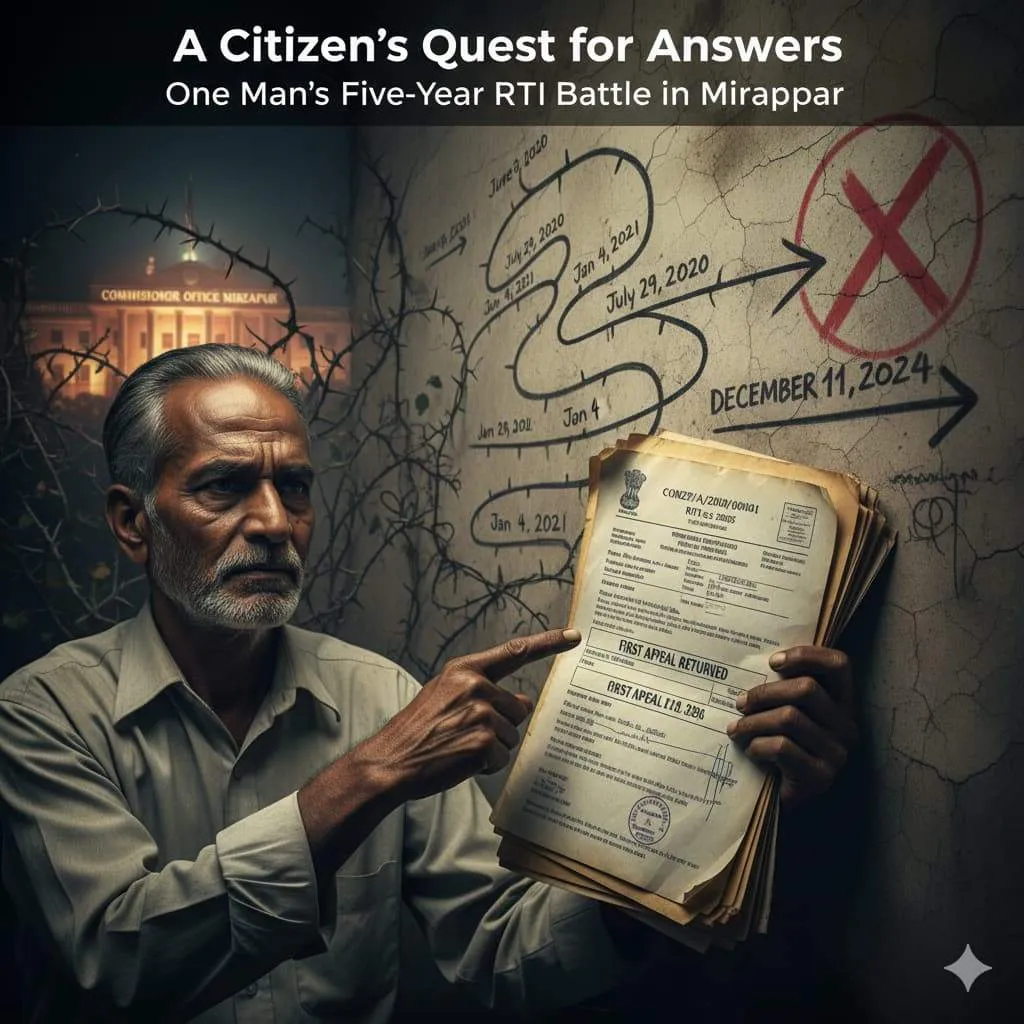
A Citizen’s Quest for Answers: One Man’s Five-Year RTI Battle in Mirzapur
Have you ever filed a complaint, only to see it marked “resolved” without any real solution? Well, that’s exactly what happened to Harishchandra, a resident of Adampur village in Mirzapur, who found himself caught in a web of red tape and unresponsive authorities. His experience is a stark reminder of the challenges many face when trying to seek justice and transparency in governance.
Consequently, this is a Citizen’s Quest, which narrates the story of his long and frustrating journey through the maze of bureaucracy, using the Right to Information (RTI) Act to demand answers and accountability. 🧐 With countless visits to government offices, endless paperwork, and encounters with indifferent officials, Harishchandra’s determination shines as he navigates the often convoluted processes designed to discourage the average citizen.
Indeed, a Citizen’s Quest like Harishchandra’s requires not only persistence and resilience but also an unwavering belief in the power of informed advocacy to enact change.
The Spark of A Citizen’s Quest: A Grievance Marked ‘Disposed’
Harishchandra submitted grievances on the Uttar Pradesh government’s Jansunwai (public hearing) portal, seeking redress for several ongoing issues that have significantly impacted his daily life and the lives of those in his community.
The Chief Minister’s office classified his issues under a ‘C-category,’ indicating that they were considered less urgent compared to other grievances lodged through the portal.
However, officials quickly marked them as “disposed of,” which left Harishchandra feeling dismissed and frustrated.
The official note stated, “the commissioner approved action on the feedback,” but the vague response did not provide any clarity on the specific measures that would be taken or if any real action was planned to address the concerns raised.
This left Harishchandra with a simple but powerful question: Why? What documents or reports convinced the Commissioner that they had solved his problems? To find out, he actively sought information through the Right to Information Act during his Citizen’s Quest.
On June 3, 2020, he filed an RTI application (No. COMZP/R/2020/60001) with the Commissioner’s Office, Mirzapur, asking for:
- The documents that led to the disposal of his grievances.
- The name and designation of the staff who processed the case.
- The posting details of that staff member.
- Give a copy of any survey or measurement report (‘Paimaish’ report) you created, or provide a reason why you didn’t generate one.
The Labyrinth of Bureaucracy: A Timeline of Delays
What should have been a straightforward 30-day process turned into a multi-year saga of transfers and dead ends, fraught with confusion and frustration at every turn.
Each step seemed to lead to another obstacle, creating a labyrinth of bureaucracy that felt impossible to navigate.
Nonetheless, this determined Citizen’s Quest continued, fueled by an unwavering dedication to seeing the process through and a deep-seated belief that persistence would eventually pay off.
Even in the face of setbacks, the journey became a testament to resilience and the power of perseverance.
A Wall of Silence & The First Appeal
The 30-day deadline for a response, as mandated by the RTI Act, came and went without any acknowledgment from the authorities involved.
With no information in sight and mounting anxiety regarding the lack of transparency, Harishchandra felt compelled to take action and subsequently filed a First Appeal on July 29, 2020 (No. COMZP/A/2020/60001).
His frustration was palpable in his appeal, where he clearly articulated his discontent, stating that the Commissioner had violated the RTI Act either out of ignorance or by deliberately denying him the critical information he sought.
This blatant disregard for the law not only undermined his rights as a citizen but also emphasized the need for accountability and responsiveness within public institutions.
Harishchandra hoped that his appeal would shed light on the opaque bureaucratic processes and serve as a reminder of the importance of transparency in governance, which is essential for a healthy democracy.
A Bizarre Twist due to A Citizen’s Quest
The system chose a different direction instead of addressing the appeal, which led to a growing sense of frustration among those awaiting a resolution.
Six months after the initial RTI was filed, on January 4, 2021, the Commissioner’s Office transferred the original request to the District Magistrate’s Office in Mirzapur, citing reasons related to jurisdiction and the need for thoroughness in the investigation process (New No. DMOMR/R/2021/80001).
This decision to transfer was unexpected and raised numerous questions about the efficiency of the system and the criteria used in determining such actions, leaving the applicants in a prolonged state of uncertainty about the status of their request.
Finally, on May 31, 2021—nearly a year after his initial request—the transferred RTI was marked as “Disposed Of.” The official reply was a two-word note: “akhya uplaod” (report uploaded), provided by Hemant Kumar, the Tehsildar. It remains unclear if this uploaded report fully answered Harishchandra’s original four questions in his Citizen’s Quest.
The Appeal That Went Nowhere
What happened to the First Appeal filed back in July 2020? The answer is the most shocking part of this journey, revealing unexpected twists and turns that no one could have anticipated.
As the months unfolded, the layers of complexity surrounding the appeal deepened, leading to surprising developments that challenged our assumptions and heightened the stakes involved.
This journey has been filled with moments of uncertainty and suspense, ultimately leading to an outcome that left all parties involved in complete disbelief.
According to the records, the status as of December 11, 2024—more than four years later—is: “FIRST APPEAL APPLICATION RETURNED TO APPLICANT.” The remark simply says, “appeal on concerned DM office.” After years of waiting, his appeal wasn’t heard; it was simply sent back with instructions to file it somewhere else.
Key Takeaways from Harishchandra’s Journey
Harishchandra’s case is a powerful illustration of the challenges ordinary citizens face when seeking transparency. His journey highlights several critical issues within the system:
- Lack of Timely Response: A clear violation of the 30-day rule stipulated in the RTI Act.
- Bureaucratic Shuffling: Instead of providing a direct answer, the administration transferred the application between departments, causing significant delays.
- Failure of the Appeal Process: The system should have the First Appellate Authority as a check, but officials neglected the appeal for years and returned it on a technicality.
This story reflects one man’s struggle and highlights the persistence required to demand accountability, showcasing the crucial importance of the Right to Information Act as a tool for the common person. Such is the essence of A Citizen’s Quest.
Department of revenue forwarded the matter to D.M. Mirzapur to provide sought information to Harishchandra but D.M. took under teeth it



Facing a similar challenge? Share the details in the box below, and our team of experts will do their best to help.