
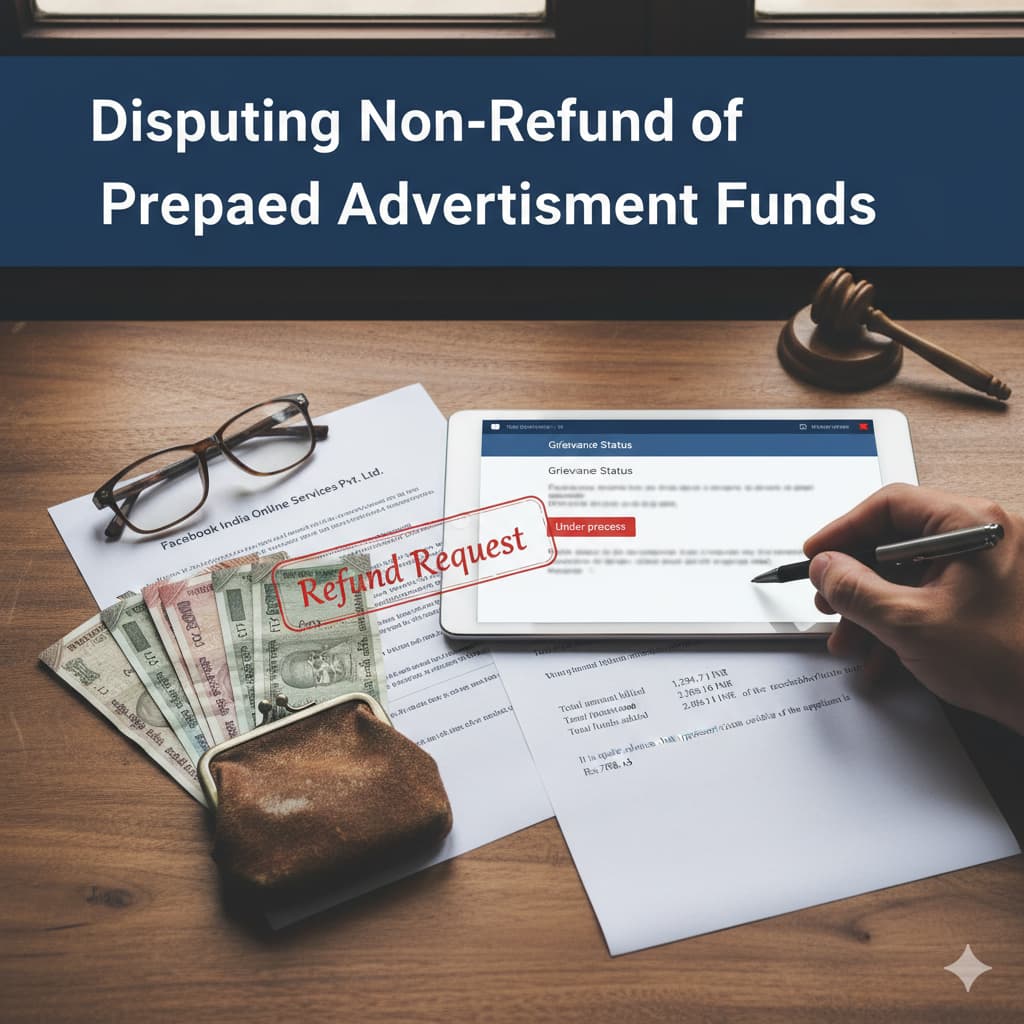
Disputing Non-Refund of Prepaid Advertisement Funds: Facebook India Grievance Status
The grievance regarding the non-refund of prepaid advertisement funds by Facebook India Online Services Pvt. Ltd. was officially filed with the Ministry of Corporate Affairs (MCA) to seek resolution and accountability.
This complaint is currently Under Process, reflecting the procedural steps being undertaken as of the last action date of 02/12/2024.
The assigned registration number for this grievance is DCOYA/E/2024/0007285.
This ongoing issue not only highlights individual inconveniences but also underscores the broader challenges that many users have faced with Facebook India concerning the management and refund of unused prepaid advertisement funds.
Many businesses and advertisers rely on these funds to effectively carry out their marketing strategies, and failures in addressing these concerns raise questions about the reliability of the platform and its commitment to customer satisfaction.
It is imperative for both the authorities and Facebook India to expedite this process and address the grievances of affected parties to restore trust and ensure that such situations are resolved amicably in the future.
The core of the issue is a dispute over the non-refund of an alleged Rs. 788.45 balance of prepaid funds remaining after the company reportedly cancelled the applicant’s ads. The applicant asserts that this non-refund constitutes cheating. The applicant has also expressed dissatisfaction. The Registrar of Companies (ROC) closed a previous similar grievance. This was because the matter relates to a breach of agreement/contract. It is not within the purview of the Companies Act, 1956/2013.
Key Details of the Grievance about Facebook India (DCOYA/E/2024/0007285)
| Detail | Information Provided in Grievance |
| Complainant Name | Yogi M. P. Singh |
| Date of Receipt | 02/12/2024 |
| Concerned Ministry | Corporate Affairs |
| Grievance Description | Non-Refund of application money (Corporate Affairs >> Investors Greivance) |
| Company Name | Facebook India Online Services Pvt. Ltd. |
| CIN | 06AABCF5150G1ZZ |
| Grievance Status | Under process |
| Officer Concerned | GAURAV (DEPUTY ROC), ROC Delhi |
| Disputed Refund Amount | Rs. 788.45 (Total funds added: Rs. 2,083.16 – Total amount billed: Rs. 1,294.71) |
Nature of the Dispute and ROC’s Stance
The applicant, Yogi M. P. Singh, argues that the advertisements were cancelled due to unforeseen circumstances, leading to a significant disruption in the expected service delivery.
Therefore, Facebook India was under an “obligatory duty” to refund the paid and unused amount, as retaining such funds without providing the promised service would not only be unjust but also contrary to the principles of good faith in commercial transactions.
The applicant mentions the importance of following the guidelines set by the Reserve Bank of India (RBI), which have been established to protect consumers in their financial dealings and ensure that their rights are upheld.
These guidelines pertain to refunds of prepaid money related to services like those provided by Facebook India, emphasizing that such refunds are not merely a courtesy but a regulatory requirement designed to foster transparency and accountability in the digital economy.
The adherence to these guidelines serves to reinforce consumer trust and promote a fair marketplace, ultimately benefitting both consumers and service providers alike.
Stance of the Registrar of Companies (ROC)
The record mentions a previous, similar grievance (DCOYA/E/2023/0008962) that was closed by the ROC-Delhi with the remark: this specific case, despite the complexities involved, provided crucial insights into the procedures that the ROC-Delhi follows when addressing such grievances.
It underscores the importance of thorough investigation and timely resolution while highlighting the challenges faced by complainants in navigating through bureaucratic channels.
The closure of this grievance not only sets a precedent for future cases but also emphasizes the need for continuous improvement in handling complaints to ensure transparency and accountability within the system.
- Jurisdiction: “The Matter does not fall under the purview/domain of Companies Act, 1956/2013 and rules made thereunder.”
- Recommendation: “It appears that the allegations are a breach of agreements/contract. Complainant may approach court of law if so advised, having jurisdiction in the matter.”
This is a common position for the ROC to take. When a complaint pertains to a commercial transaction dispute (like non-refund for services/goods). If not a clear violation of the statutory provisions of the Companies Act. Which are minimum subscription refund, non-filing of documents, etc.. If it is not gross financial fraud impacting the public as defined under the Act.
Potential Avenues for the Aggrieved Applicant
The ROC previously dismissed a similar complaint as a “breach of contract,” which set a precedent for future cases. Therefore, the applicant’s recourse is generally directed toward specialized bodies that possess the expertise and authority necessary for resolving such matters.
These bodies handle a variety of disputes, including those related to consumer and business issues, as suggested by the ROC itself.
In addition, they provide a structured framework for mediation and arbitration, ensuring that both individuals and enterprises can present their grievances in a fair environment.
It is vital for applicants to understand the specific roles of these specialized bodies, as they often offer more tailored solutions compared to general legal proceedings, making the process more efficient and less daunting.
1. Consumer Protection Authority
The dispute is over a pre-paid service amount (advertisement fees). This amount was not fully utilized. Therefore, the applicant may pursue the matter with a Consumer Forum (now called District Consumer Disputes Redressal Commission).
- Consumer Protection Act, 2019: This Act includes disputes over deficiency in service, unfair trade practices, or overcharging. Consumers can argue that the non-refund of an unused prepaid balance constitutes a deficiency in service or an unfair trade practice, specifically involving a major platform like Facebook India.
2. Legal Action for Breach of Contract
The ROC noted that the matter is fundamentally a contractual dispute between the advertiser and Facebook India Online Services Pvt. Ltd.
- The applicant may file a civil suit in a court of competent jurisdiction. This is to recover the outstanding balance. They can also seek compensation for the alleged loss and damages incurred by their engagement with Facebook India.
3. Alternative Dispute Resolution (ADR)
- Mediation or Arbitration: The terms and conditions for advertising on the Facebook platform may specify a clause for resolving disputes. This may be done through mediation. They could include a clause for arbitration. Alternatively, the terms may include a clause for arbitration. They may also specify a clause for arbitration. This could be a faster mechanism than civil court, making it a viable option for resolving issues with Facebook India.
4. Direct Corporate Grievance (Meta/Facebook) about Facebook India
The applicant’s experience with the company’s internal process appears frustrating, as many users have reported similar difficulties navigating the complex system.
For non-statutory commercial disputes, the Meta (formerly Facebook) Ads support/billing team is the primary authority for initiating a refund, which can often feel like an uphill battle for those unfamiliar with the requirements.
This process frequently necessitates opening a support ticket directly through the business or ads account, a method specifically applicable to dealings with Facebook India, where guidelines can be unclear and responses slow.
Users often feel overwhelmed by the lack of transparent communication and outdated procedures that do not easily accommodate the unique challenges faced by advertisers, leading to a sense of dissatisfaction and doubt in the reliability of the support system.
- The company’s own Advertising Policies and Terms of Service set the rules for refund procedures. These apply to unused prepaid funds after an ad account is restricted or closed, providing a framework for resolving issues with Facebook India.
If Facebook is not doing advertisement, then it must refund amount
Government must not promote cheating activities of the Facebook India


Facing a similar challenge? Share the details in the box below, and our team of experts will do their best to help.