
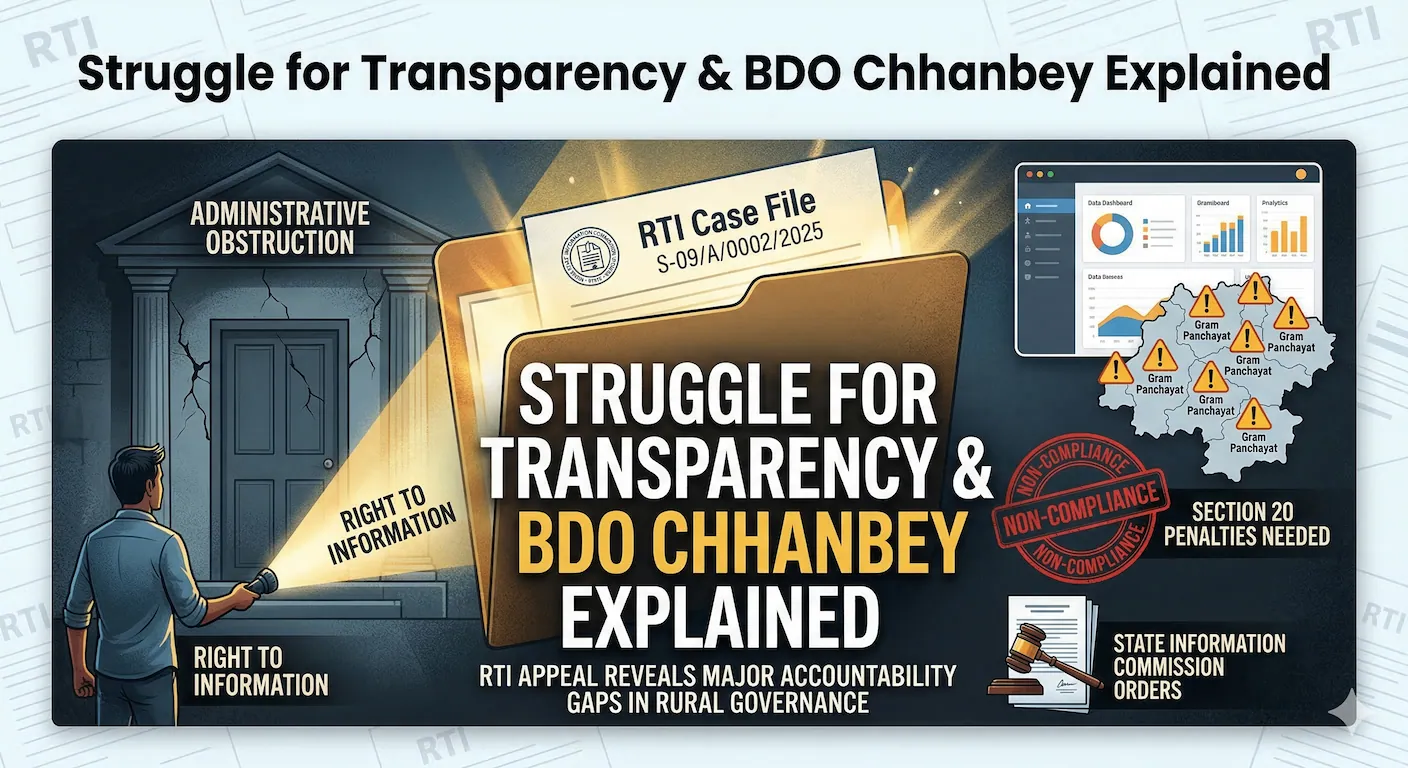
The Struggle for Transparency & BDO Chhanbey: A Citizen’s Fight for Accountability in RTI Appeal S‑09/A/0002/2025
Key Takeaways (Struggle for Transparency & BDO Chhanbey)
- The RTI appeal highlights severe transparency failures under BDO Chhanbey. Only 12 out of 97 Gram Panchayats comply with upload mandates.
- The PIO’s misleading reply obstructed the applicant’s right to accurate information and revealed administrative evasiveness.
- The PIO falsely claimed that compilations were not mandatory, contradicting national guidelines from the Ministry of Panchayati Raj.
- A troubling pattern exists with the PIO’s non-compliance with Commission orders. This showcases a lack of accountability within the administrative system.
- This case underscores the urgent need for stronger penalties under Section 20 of the RTI Act. These measures are essential to bolster transparency and accountability.
RTI Appeal Exposes Major Transparency Failures Under BDO Chhanbey (Struggle for Transparency & BDO Chhanbey)
The RTI application revealed important information. Out of 97 Gram Panchayats, only 12 complied with mandatory uploads. These uploads concern the Public Information Board (PIB) and Gram Sabha images on the GPDP Portal. This leaves 85 Panchayats non‑compliant under the jurisdiction of BDO Chhanbey. This situation highlights a clear struggle for transparency and accountability. The ongoing Struggle for Transparency & BDO Chhanbey is evident in the serious breakdown in monitoring. Supervision and transparency suffer within the block development structure related to BDO Chhanbey.
PIO’s Misleading Reply Shows Administrative Obstruction
Instead of providing information relevant to the RTI, the PIO submitted details belonging to an entirely different RTI (No. 60644) filed by another individual, Shri Ashok Kumar Singh. This misleading response obstructed the applicant’s right to accurate information and demonstrated administrative evasiveness.
False “Uploads Not Mandatory” Claim Contradicts National Guidelines (Struggle for Transparency & BDO Chhanbey)
During the 28‑11‑2025 proceedings, the PIO falsely claimed that uploading PIB photos to the GPDP portal was “not mandatory.” However, the Ministry of Panchayati Raj clearly mandates geo‑tagged uploads under the Sabki Yojana Sabka Vikas campaign. Therefore, the PIO’s statement was factually wrong and seemed intended to avoid accountability.
Repeated Defiance of Information Commission Orders by the PIO
Despite multiple orders, the PIO repeatedly failed to submit written statements. These orders include those dated 28‑11‑2025, 27‑01‑2026, and the notice on 19‑02‑2026. The PIO did not provide the required information. This persistent defiance shows a pattern of disregard toward statutory obligations and Commission directives.
Citizen’s Six KOF Submissions Prove Consistent Compliance )(Struggle for Transparency & BDO Chhanbey
In contrast to the PIO, the appellant submitted six detailed KOF representations, each recorded and forwarded by the Commission. These submissions were filed on various dates. They range from 02/09/2025 to 18/03/2026. This shows the citizen’s consistent compliance and commitment to the process.
Pattern Reveals Systemic Accountability Gaps in Rural Governance
The case highlights widespread gaps in rural administrative governance. There is inadequate monitoring by local officials. Responses to RTI are evasive. Enforcement mechanisms are weak. The issues are not isolated—they reflect deeper structural deficiencies in transparency practices within Panchayat Raj institutions.
Stronger RTI Penalties Needed to Strengthen Transparency Mechanisms
The PIO’s repeated non‑compliance and misleading submissions are concerning. This case underscores the urgent need for stronger enforcement of penalties under Section 20 of the RTI Act. Without penalties, officials face no real consequences, and transparency remains dependent on citizen persistence rather than institutional responsibility.
Struggle for Transparency & BDO Chhanbey: When Transparency Meets Bureaucratic Resistance
The Struggle for Transparency & BDO Chhanbey encapsulates a much larger battle in India. Citizens are demanding accountability, while authorities resist disclosure. The ongoing RTI second appeal S‑09/A/0002/2025 filed by Shri Yogi M. P. Singh is revealing administrative negligence. Misleading replies weaken the Right to Information Act’s foundational purpose. The Commission’s notices and orders clearly highlight repeated non‑compliance by the Public Information Officer (PIO).
The Core RTI Issue: Transparency in Gram Panchayat Functioning
Background of the Request
The appellant sought critical information on 12/10/2024 regarding transparency failures in 97 Gram Panchayats under BDO Chhanbey. Shockingly, transparency mandates require every Panchayat to upload Public Information Board (PIB) photos on the GPDP portal. Only 12 complied. However, 85 Gram Panchayats failed to meet the requirement.
What Information Was Requested?
The RTI sought:
- Reasons for non‑uploading
- Names of responsible officers under BDO Chhanbey
- Monitoring failures by Panchayat Secretaries and Facilitators
- Fund‑flow details
- Accountability at District Panchayat Raj Officer (DPRO) level
Consequently, the RTI addressed structural transparency lapses directly linked to BDO Chhanbey’s supervisory role.
Misleading Replies and Evasion by the PIO (Struggle for Transparency & BDO Chhanbey)
The Wrong RTI Response
Instead of addressing the RTI, the PIO shockingly submitted information belonging to a different case—RTI No. 60644 filed by an unrelated individual (Shri Ashok Kumar Singh). This fact is documented in the Commission‑recorded submissions.
Why This Matters
Moreover, supplying irrelevant information is not accidental; it:
- Misleads the applicant
- Misleads the Commission
- Violates Section 7(1)
- Obstructs the citizen’s right to know
Thus, this episode highlights a deeper governance problem.
False Claim: “Uploads Not Mandatory”
The PIO’s Incorrect Stand
During the 28‑11‑2025 hearing, the PIO claimed uploading PIB images to the national portal was “not mandatory.” This statement is recorded in official Commission documents.
Why the Claim Is False
However, under the Ministry of Panchayati Raj’s Sabki Yojana Sabka Vikas guidelines, uploading:
- Geo‑tagged PIB photographs
- Gram Sabha images
…is mandatory, not optional. The PIO’s stand is inconsistent with central guidelines. It appears designed to escape accountability for monitoring failures within the jurisdiction of BDO Chhanbey.
Repeated Non‑Compliance with Commission Orders
A Pattern Evident in the Official Record
The Commission issued several orders to enforce cooperation:
- 28‑11‑2025: PIO claims “revised information” was sent; Commission directs next appearance.
- 27‑01‑2026: Both parties absent; a final opportunity granted.
- 19‑02‑2026: PIO ordered to submit a written reply two days before the hearing and appear personally.
Yet the PIO Did Not Comply
Furthermore:
- No written statements were submitted
- No correct information was provided
- No proof of diligence was furnished
Therefore, the PIO violated Section 19(5), which places the burden of proof entirely on the public authority.
Citizen’s Persistent Compliance vs. Official Negligence (Struggle for Transparency & BDO Chhanbey)
Six KOF Submissions as Proof of Diligence
Similarly, the UPIC portal shows the appellant submitted six detailed KOF objections. These range from D‑020920250010 to D‑180320260067. Each was forwarded to the hearing officer.
The Contrast is Stark
While the citizen complied at every stage, the authorities demonstrated:
- Continuous evasion
- Repeated disobedience
- Lack of accountability
This contrast amplifies the Struggle for Transparency & BDO Chhanbey, exposing systemic administrative weaknesses.
Conclusion: Transparency Should Not Depend on Citizen Persistence
The RTI appeal S‑09/A/0002/2025 represents more than a personal grievance—it illustrates how bureaucratic indifference undermines the RTI Act. Unless Information Commissions impose penalties under Section 20, this will not change. Public authorities like DPRO Mirzapur and officers under BDO Chhanbey will continue to disregard transparency obligations.
The right to information must not depend on a citizen’s persistence. It must not rely on their knowledge. It should flow naturally from the government’s commitment to openness.
Application / Appeal Identification Details (Struggle for Transparency & BDO Chhanbey)
• Registration Number
• File Number
• Diary Numbers (KOF Submissions)
- D‑020920250010
- D‑281120250001
- D‑260120260012
- D‑020320260046
- D‑180320260067
Email Addresses of Concerned Authorities (Struggle for Transparency & BDO Chhanbey)
• UP Information Commission – Court S‑09
hearingcourts9.upic@up.gov.in
• District Panchayat Raj Officer (PIO)
dpromi-up@nic.in
• Deputy District Panchayat Raj Office
ddprmi-up@nic.in
• ADO Chhanbey
adochhanveymzp@gmail.com
• Appellant’s Email
yogimpsingh@gmail.com
Mobile Numbers of Authorities
• Public Information Officer (DPRO Mirzapur)
☎ 9415375150
• Appellant’s Mobile Number
☎ 7379105911
Web Links Mentioned in the Case (Struggle for Transparency & BDO Chhanbey)
• UPIC Online Hearing Link
https://upsic.up.gov.in/cispu/onlinehearing/e34f5b
• UPIC Official Portal
• National GPDP Portal
Official Office Address
• PIO / District Panchayat Raj Officer, Mirzapur
District Panchayat Raj Officer Office, Mirzapur – 231001


Facing a similar challenge? Share the details in the box below, and our team of experts will do their best to help.