
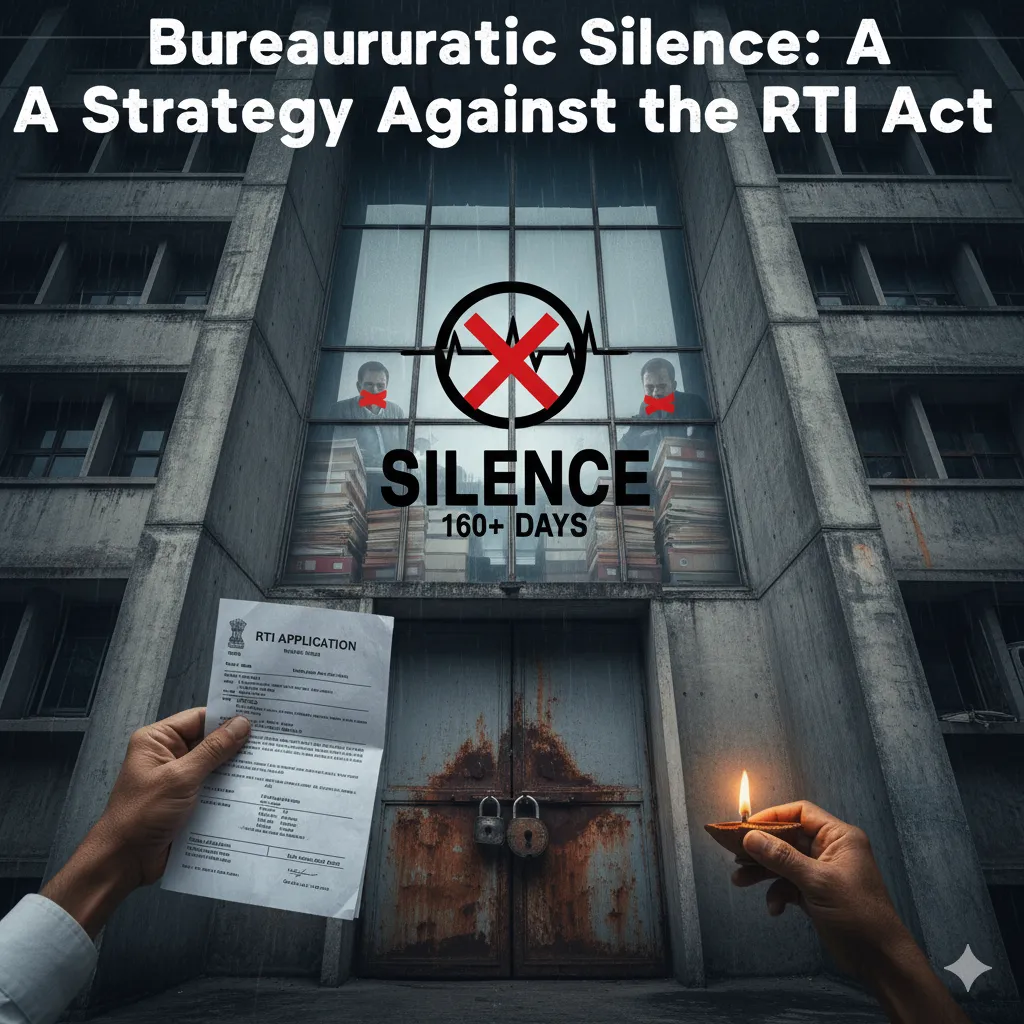
The key takeaway from the blog post: (Bureaucratic Silence)
is that bureaucratic silence is a deliberate strategy to defeat the law. Only personal financial accountability can restore the power of the RTI Act.
Here are the four specific pillars of that message:
1. Silence is “Malafide” Obstruction
The post argues that when a PIO (like the DPRO Bhadohi) ignores a request for 160+ days, it is not an oversight. It is a deliberate act. It is a wilful act of suppression. By forcing the citizen into the long appeal process, the official effectively “hides” the information for an extended period. This effectively defeats the purpose of “time-bound” disclosure.
2. The Erosion of Rural Democracy (Bureaucratic Silence)
Village Panchayat meetings and proposals provide essential evidence of democracy. However, the refusal to share meeting minutes or Panchayat NIRNAY portal records indicates a systemic attempt to bypass local self-governance. This refusal aims to conceal potential irregularities in the management of village funds and decisions.
3. The Failure of Digital Systems
The post highlights a “Digital Irony”: while the Commission moves toward a Paperless Inquiry. However, the system fails to deliver basic hearing notices to citizens via email. This “digital gap” benefits the negligent official. It punishes the proactive citizen. This situation creates a “Mockery of the Act”. Technology becomes a barrier rather than an enabler.
4. Penalties are the Only Solution (Bureaucratic Silence)
The most critical takeaway is that penalty-free orders serve no purpose. The post urges the State Information Commission to stop its leniency. We can only break the culture of “Deemed Refusal” by invoking Section 20(1). It is essential to deduct fines (up to ₹25,000) from the personal salary of the officers.
This blog post examines the systemic failure of transparency in rural governance. It uses your specific case as a case study for the “Mockery of the RTI Act” by local authorities.
Bureaucratic Silence: How Local Bureaucracy is Sabotaging the RTI Act
The Right to Information (RTI) Act of 2005 heralded a “Second Independence” for Indian citizens. It aimed to dismantle the “Iron Curtain” of bureaucratic secrecy and empowered the common man to hold the government accountable. However, twenty years later, in the heart of rural Uttar Pradesh, the reality falls far short of this vision.
The case of Village Panchayat – Dhanwatiya (Bhadohi) serves as a stark reminder. Without strict enforcement, penalties become ineffective. The very officers sworn to uphold the RTI Act are reducing it to a “paper tiger”.
1. The Core Issue: Deemed Refusal as a Tool of Obstruction (Bureaucratic Silence)
The fundamental promise of the RTI Act is time-bound disclosure. Under Section 7(1), a Public Information Officer (PIO) must respond within 30 days. When a PIO, such as the District Panchayat Raj Officer (DPRO) of Bhadohi, remains completely silent for over 160 days, it’s more than just a delay. It is a Deemed Refusal.
The official employs silence as a calculated strategy. By not responding, they force the citizen into a long, expensive cycle of appeals. This “war of attrition” aims to tire out the applicant until they abandon their quest for the truth. In the case of RTI No. DIRPR/R/2025/61924, DPRO Bhadohi’s silence since July 2025 serves as a textbook example of this bureaucratic defiance.
2. Rural Governance and the Veil of Secrecy
Why is information regarding a Gram Panchayat so hard to obtain? The request in question was simple:
- Records of meetings convened.
- Copies of proposals passed by ward members.
- Signatures of representatives.
- Data uploaded to the Panchayat NIRNAY Portal.
Local development lacks transparency when we hide these documents, which serve as the “blueprints.” This raises a chilling question: What are we concealing? Without holding meetings, the Panchayati Raj system suffers. Additionally, proposals passed without the consent of ward members disrupt the structure. The 73rd Constitutional Amendment established this system.
3. The Failure of the First Appellate Authority (FAA)
The RTI Act provides a safety net: The First Appeal. However, the Deputy Director of Panchayats (Mirzapur) failed to act on the appeal filed in September 2025. When the FAA remains as silent as the PIO, the system is broken. Internal checks and balances prove to be ineffective.
This “Double Silence” creates a vacuum of accountability. It suggests a culture of mutual protection within the department. Senior officers overlook the negligence of their juniors. As a result, the citizen has no choice. They must knock on the doors of the State Information Commission in Lucknow.
4. The Digital Divide: “Paperless Inquiry” vs. Practical Reality
The Uttar Pradesh State Information Commission has moved toward a “Paperless Inquiry” system. On paper, this is a brilliant move toward modernization. In practice, as seen on January 16, 2026, the system still has deep cracks.
The failure to deliver a hearing notice via email is a violation of the Principles of Natural Justice. A citizen must proactively track their status online. Otherwise, they would lose their case simply because the “digital system” failed to notify them. The Commission goes paperless. However, the PIOs ignore digital portals. They fail to upload responses, leaving the digital record blank.
5. A Mockery of the Law: Defying the Apex Court
The Supreme Court of India has repeatedly emphasized this. “Information is the currency that every citizen requires.” Citizens need it to participate in the life and polity of society. By ignoring RTI applications, officers are not just defying an Act of Parliament. They are in contempt of the spirit of the Constitution.
When a PIO ignores an application for five months, they are committing a “malafide” act. The law provides a remedy under Section 20(1)—a penalty of ₹250 per day. Yet, these penalties are rarely imposed in their maximum capacity. Unless the Commission takes action, nothing will change. They should deduct ₹25,000 directly from the personal salaries of negligent DPROs. Only then will the “Mockery of the RTI Act” cease.
6. The “Nirnay” Portal: Transparency or Eyewash?
The Panchayat NIRNAY Portal allows officials to monitor Gram Sabha meetings in real time. This is possible because the Government of India launched it. It aims to serve as a “pillar of local self-governance.” However, the authorities refuse to provide data about this portal. This suggests a discrepancy between the digital records and the ground reality.
The government risks sabotage of its Digital India mission if it does not upload the meetings. The mission also faces threats if grassroots levels bypass the portal. Officers responsible for data entry operate in “slow-motion,” preventing transparency from being “real-time.”
7. The Way Forward: Accountability Through Penalty
The only way to save the RTI Act from becoming a relic is through Personal Accountability.
- Mandatory Penalties: Every case of “Deemed Refusal” should result in an automatic show-cause notice for a penalty.
- Compensation for Harassment: Under Section 19(8)(b), government authorities must compensate citizens for the time they lost. They must also compensate for the mental agony caused by their bureaucratic silence.
- Digital Integrity: The Commission must deliver hearing notices via SMS and Email simultaneously to prevent “hidden” hearings.
Conclusion
The struggle for information in Dhanwatiya, Bhadohi goes beyond one man’s fight for documents. It embodies a battle for the soul of Indian democracy. A citizen should not have to fight for six months just to discover when a village meeting occurred. If this is necessary, the system is not only failing. It is also being intentionally dismantled.
We do not seek “favors” from the DPRO; we seek our Legal Right. The Information Commission must now act as a judge, not just a mediator. It is time to stop the mockery and start the accountability.
About the Author: Devi Prasad Gupta is a social activist. He is an RTI applicant dedicated to ensuring transparency in the Panchayati Raj system of Uttar Pradesh.
Here is the structured directory of the authorities involved in your case. This ensures you have everything in one place for your records. It will help with the upcoming proceedings.
1. Case & Application Identification
| Authority | Identification Number |
| Original RTI (SPIO) | DIRPR/R/2025/61924 (Filed: 31/07/2025) |
| First Appeal (FAA) | DIRPR/A/2025/61900 (Filed: 20/09/2025) |
| Second Appeal (SIC) | S02/A/2109/2025 (Registered: 27/11/2025) |
2. Contact Directory: Public Authorities
A. State Public Information Officer (SPIO)
- Designation: District Panchayat Raj Officer (DPRO), Bhadohi (Sant Ravidas Nagar)
- Address: Office of the DPRO, Collectorate, Bhadohi, Uttar Pradesh – 221401
- Mobile: 9450981727
- Email:
dprosr-up@nic.in
B. First Appellate Authority (FAA)
- Designation: Deputy Director (Panchayat), Mirzapur Division
- Address: Divisional Commissioner’s Office Compound, Mirzapur, UP – 231001
- Mobile: 9412445037 / 9759296425
- Email:
ddprmi-up@nic.in
C. Nodal Officer (Panchayati Raj Directorate)
- Name: Nodal Officer, RTI Cell
- Mobile: 9795140577
- Email:
up.panchayatiraj@gmail.com
3. Uttar Pradesh State Information Commission (UPSIC)
- Hearing Room: S-2 (Court of Shri Sudhir Kumar Singh)
- Address: 7/7A, RTI Bhawan, Vibhuti Khand, Gomti Nagar, Lucknow – 226010
- S-2 Hearing Court Email:
hearingcourts2.upic@up.gov.in - General Inquiry Email:
webmaster-upic@up.gov.in - Registrar Email:
registrar-upic@up.gov.in
4. Essential Web Links
- Case Status & Cause List (UPSIC):http://upsic.up.gov.in/
- Navigate to “Cause List” to find daily schedules for Room S-2.
- UP RTI Online Portal:https://rtionline.up.gov.in/
- Use this to track the live status of the original application.
- Panchayat NIRNAY Portal:https://nirnay.gov.in/
- The Ministry of Panchayati Raj portal you cited in your application.
- e-GramSwaraj (For Finance/Voucher details): [suspicious link removed]
Strategic Next Step
Now that the hearing is active today, keep a copy of this list. If the Commissioner asks for the specific email where you sent your submission, you have the numbers ready. If they want to call the PIO directly during the hearing, you have the numbers ready.
Would you like me to draft a “Non-Compliance Report”? I can send it to the Nodal Officer if the DPRO fails to follow today’s orders.


Facing a similar challenge? Share the details in the box below, and our team of experts will do their best to help.