
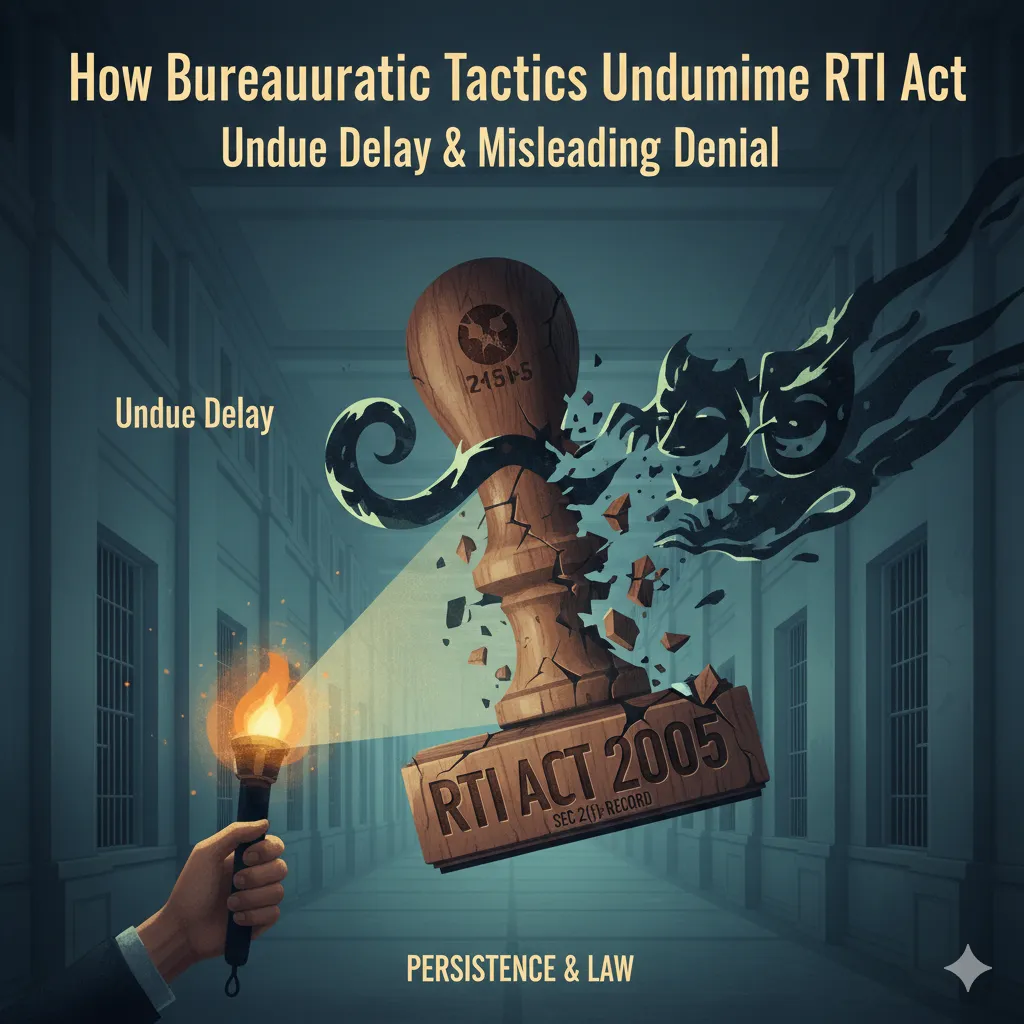
The core message of the blog post is that the Right to Information (RTI) Act is being systematically weakened. Bureaucratic Tactics Undermine RTI when they are used to shield corruption. Furthermore, they also help avoid accountability.
Here are the four key takeaways: (Bureaucratic Tactics Undermine RTI)
1. The “Inquiry” as a Shield for Delay
Public authorities often use the existence of an “internal committee” or “ongoing investigation” as a way to stall for years. This “undue delay” renders the information useless by the time it is finally released, effectively protecting those involved in irregularities.
2. Misuse of Legal Technicalities (Bureaucratic Tactics Undermine RTI)
PIOs frequently resort to “misleading denials” by claiming a request seeks “opinions” or “interpretations” (often citing Rule 4); however, this occurs even when the citizen requests basic, documented facts. For instance, examples include the names of committee members or official deadlines. Moreover, these are clearly “records” under Section 2(f).
3. The Pattern of “Tactical Rejection”
Using the Lucknow Development Authority (LDA) case as a prime example, the blog highlights a pattern. Authorities acknowledge a problem, such as land scams.
4. Accountability through Penalties (Bureaucratic Tactics Undermine RTI)
The only effective way to counter these tactics is, therefore, for the Information Commission to stop granting endless adjournments. Consequently, they must start imposing personal financial penalties (Section 20) on PIOs. Furthermore, citizens must remain persistent, file formal rejoinders, and demand that the Commission treat misleading denials as a serious legal violation.
Bureaucratic Tactics Undermine RTI: Navigating Undue Delays and Misleading Denials in the RTI Process
The Right to Information (RTI) Act of 2005 was hailed as the “sunlight”; indeed, it was intended to disinfect the corridors of Indian bureaucracy. Moreover, it was designed to empower the common citizen. Specifically, the act aimed to turn a “subject” into a “citizen” by giving them the right to question those in power. However, twenty years later, a shadow has unfortunately fallen over this transparency regime. Consequently, two specific tactics have emerged as the primary weapons of the bureaucracy: Undue Delay and Misleading Denial.
We examine recent cases involving urban development authorities and land irregularities. We explore how these tactics undermine the rule of law. Additionally, we discuss what citizens can do to fight back.
1. The Strategy of “Silent Attrition”: Understanding Undue Delay (Bureaucratic Tactics Undermine RTI)
The RTI Act is built on the foundation of time-bound service. Specifically, Section 7(1) clearly mandates that information must be provided within 30 days. However, for many applicants, the 30-day mark is just the beginning of a marathon.
The “Committee” Trap
A frequent cause of delay is the internal inquiry. When a citizen asks about a scam or an irregularity, the Public Information Officer (PIO) often responds by stating that a “committee has been formed.” The matter is “under investigation.” While this sounds proactive, it is often a black hole. Cases have shown committees sitting for four to five years without producing a single page of findings. By the time the inquiry “concludes,” the information sought often becomes obsolete, or the responsible officers have retired.
The Impact on Justice (Bureaucratic Tactics Undermine RTI)
Delay in information is a denial of justice. If an applicant seeks details about a fraudulent land registry, it should not be delayed. A delay of six months makes the information useless. By then, the building is already up.
2. The Art of the Misleading Denial: Misinterpreting the Law
When silence doesn’t work, PIOs often resort to creative—and often illegal—interpretations of the RTI Act’s provisions. The goal is to reject the application on technical grounds that look legal but are actually baseless.
The “Interpretation” Excuse (Rule 4)
The claim that the applicant is seeking “interpretation, analysis, or opinion” is one of the most abused clauses. Bureaucratic tactics undermine RTI as applicants often pursue this rather than “information.” Under Section 2(f), information includes any material in any form, including records, documents, memos, and emails.
If an applicant asks, “Who are the members of the committee investigating the LDA scam?”, this is a request for a record. Yet, PIOs frequently reject such requests by claiming the applicant is asking for an “opinion.” This is a deliberate attempt to mislead the applicant and the Commission.
The “Frivolous” Label (Bureaucratic Tactics Undermine RTI)
Another common tactic is labeling a request as “vexatious” or “frivolous” to avoid disclosing sensitive data. The public authority attacks the intent of the seeker instead of the content. This approach shifts the burden of proof onto the citizen.
3. Case Study: The Lucknow Development Authority (LDA) Pattern
Recent proceedings at the Uttar Pradesh Information Commission reveal a disturbing pattern of denial regarding land irregularities. In one specific instance, an applicant wanted the names of committee members. They also sought the timeframe for an inquiry. This inquiry had been pending since 2021.
The PIO rejected the request, citing that providing names required “new analysis.” Moreover, this is a textbook example of a misleading denial. The names of committee members are already on an office order. Therefore, no “analysis” is needed to read a list of names. Consequently, such rejections are not just errors; they are calculated attempts to shield departmental corruption from public scrutiny. Bureaucratic tactics undermine RTI.
4. The Psychological Toll on Information Seekers (Bureaucratic Tactics Undermine RTI)
The RTI process is often a David vs. Goliath battle. Therefore, an applicant sitting in a district like Mirzapur must navigate a complex web of appeals in Lucknow.
- Financial Strain: The cost of travel, printing, and legal advice adds up.
- Intimidation: Questioning powerful departments often leads to subtle or overt pressure.
- Frustration: Watching a PIO provide a blatantly false rejection can lead to “RTI fatigue,” where citizens simply give up.
5. Fighting Back: How to Counter Delay and Denial
If you are facing a misleading denial, your response must be clinical and grounded in law.
A. Define the Record (Section 2f)
In your appeal, explicitly state: “I am not seeking an opinion. I am seeking a copy of the Order/Letter dated XX/XX/XXXX which contains the names of the officers. This is a record as defined under Section 2(f).”
B. Invoke Section 4 (Proactive Disclosure)(Bureaucratic Tactics Undermine RTI)
Remind the Commission of a key requirement under Section 4(1)(b) of the RTI Act. Every public authority is required to publish the details of its boards, councils, and committees. If they haven’t done it, they are in violation of the Act.
C. Demand Penalties (Section 20)
The only thing a PIO fears is a personal penalty of ₹250 per day (up to ₹25,000). Consequently, always pray for the Commission to impose a penalty under Section 20(1) for “malafide denial” and “knowingly giving incorrect information.”
6. The Role of the Information Commission (Bureaucratic Tactics Undermine RTI)
The State Information Commission (SIC) is the final guardian of this Act. For the RTI Act to survive, the Commission must:
- Stop giving “last chances” to PIOs: Frequent adjournments only help the delayer.
- Verify Compliance: Ensure that PIOs don’t just “provide information” but provide correct and certified information.
- Strict Enforcement: A few high-profile penalties against senior officers would significantly reduce the culture of denial.
7. Conclusion: Transparency is Not a Favor
The bureaucracy must be reminded that providing information is not an act of charity; it is a statutory duty. Every misleading denial is an insult to the Constitution, and every undue delay is a theft of the citizen’s time.
As citizens, we must continue to file “rejoinders,” attend hearings (even virtually), and call out the misuse of legal clauses. Sunlight is indeed the best disinfectant, but only if we keep the windows open.
Here is a comprehensive directory of the contact details, application IDs, and web links for the public authorities involved in your case.
1. Uttar Pradesh State Information Commission (UPSIC) (Bureaucratic Tactics Undermine RTI)
This is the appellate body where your hearing is scheduled today.
- Location: 7/7A, RTI Bhawan, Vibhuti Khand, Gomti Nagar, Lucknow – 226010.
- Helpline/Phone: 0522-2724930 / 0522-2288949
- Email (General): webmaster-upic@up.gov.in / webmaster.upic@gmail.com
- Court S-5 Email: hearingcourts5.upic@up.gov.in (This is the specific court handling your appeal).
- Official Website: upsic.up.gov.in
- Case Tracking: UPIC Case Status Portal
2. Lucknow Development Authority (LDA)
This is the Public Authority that initially rejected your request.
- Nodal Officer (Online RTI): Ramsingar Verma
- Mobile: 9838463194
- Email: ldartionline@gmail.com
- PIO (Current): Atul Krishna (Chakbandi Adhikari)
- Mobile: 9918001554 (listed previously for the post)
- Email: hemtiwari071@gmail.com (Previous PIO email)
- General LDA Helpline: 0522-2307868 / 0522-2307872
- Head Office Address: Sector 38A, 2A, Vipin Khand, Gomti Nagar, Lucknow – 226010.
- Official Website: ldalucknow.in
3. Application & Appeal References
Keep these numbers handy for all future correspondence.
| Reference Type | Reference Number |
| Appeal Diary Number | D-140120260005 |
| Commission File Number | S05/A/0428/2024 |
| RTI Registration Number | LKDPA/R/2024/60056 |
| Appeal Registration Number | A-20240601211 |
| Grievance Reference | GOVUP/E/2023/0081676 |
4. Useful Web Links (Bureaucratic Tactics Undermine RTI)
- UP Online RTI Portal: rtionline.up.gov.in (For filing new requests/first appeals).
- Jansunwai (IGRS) UP: jansunwai.up.nic.in (To track the grievance mentioned in Point 5 of your RTI).
What you should do with this info:
You have already sent the email to Padum Narayan Dwivedi (the court official). I recommend you call the Commission Helpline (0522-2724930). Ask to speak with the “Peshkar of Court S-5”.
Give them your Diary Number (D-140120260005). Confirm that your written submission has been placed on the record for today’s hearing.
Would you like me to help you draft a specific follow-up message? We can address it to the Nodal Officer, Ramsingar Verma. This message will demand they comply with the Commission’s earlier order.


Facing a similar challenge? Share the details in the box below, and our team of experts will do their best to help.