
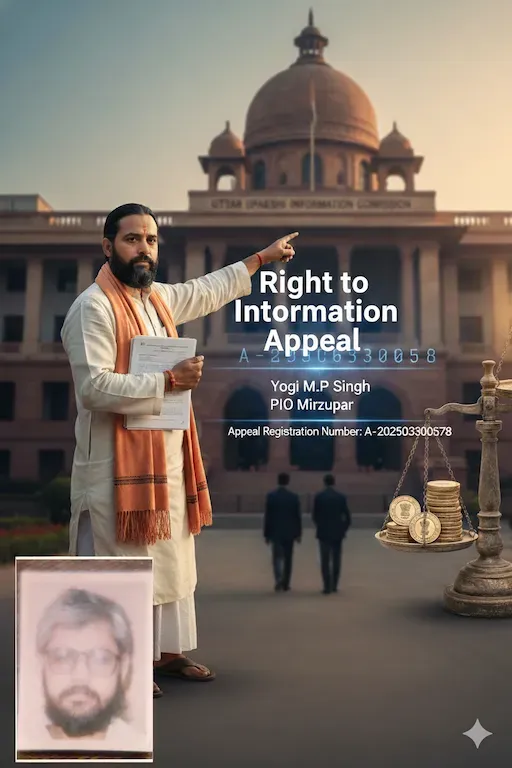
The blog post highlights a significant legal clash. It also discusses an ethical confrontation between a citizen’s right to know and a government department’s claim to privacy. This case illustrates the complexities faced during a Right to Information Appeal. Here are the key takeaways from the case of Yogi M.P. Singh vs. Social Welfare Officer, Mirzapur:
1. The Core Dispute: Public vs. Private
The central conflict involves the interpretation of Section 8(1)(j) of the RTI Act.
- The PIO’s Stance: Claims that staff transfer and posting details are “personal information” that could invade an individual’s privacy.
- The Appellant’s Stance: Argues that transfers are official administrative actions (public work) and therefore cannot be classified as private data.
2. Allegations of “Institutionalized Secrecy”
The post suggests that withholding transfer data isn’t just a legal disagreement, but a potential cover for corruption.
- Backdoor Income: The appellant alleges that “illegal gratification” (bribes) allows certain staff to stay in lucrative positions for years.
- Policy Violations: Secrecy prevents the public from verifying whether the government is following or bypassing its “New Transfer Policy.”
3. The “Parliamentary Test”
The application of the RTI Act’s proviso serves as a major legal takeaway. If the State Legislature or Parliament cannot deny the information, they cannot deny it to a citizen. Since legislative bodies routinely share transfer lists, the law should ensure they are accessible to the public.
4. Transparency as a Tool for Accountability
The post emphasizes that the RTI Act’s primary goal is to promote transparency and accountability.
- If individuals label “working data” (like who is posted where) as personal, the Act becomes toothless.
- The appellant argues that the media publishes large-scale transfers of high-ranking officials (IAS/IPS), so local staff should not be exempt from the same level of scrutiny.
5. Upcoming Legal Precedent
The decision by the Uttar Pradesh Information Commission (Court S-9) on the next hearing date (August 20, 2025) will be a landmark moment. It will determine whether administrative movements in Uttar Pradesh are protected by privacy laws or subject to public audit.
Transparency vs. Privacy: Is Government Transfer and Posting Data “Personal Information”?
The Right to Information (RTI) Act of 2005 was hailed as the “sunshine law” of Indian democracy. It was designed to illuminate the dark corners of bureaucracy. However, a growing trend is among Public Information Officers (PIOs). They use Section 8(1)(j) as a shield to withhold data, often leading applicants to file a Right to Information Appeal for access. A recent case involving Yogi M.P. Singh vs. The District Social Welfare Officer, Mirzapur, has raised a critical question. It questions the Uttar Pradesh Information Commission about whether the transfer and posting details of public officials are private. Or do they belong to the public domain?
The Genesis of the Dispute: Appeal No. A-20250300578
The case originated when the appellant, Yogi M.P. Singh, sought six-point information regarding the staff and administrative movements within the Social Welfare Directorate in Mirzapur. The PIO, Shri Trinetra Kumar Singh, denied the request on July 10, 2025, citing Section 8(1)(j) of the RTI Act.
This section exempts “personal information” that has no relationship to any public activity or interest. It also exempts information that would cause an “unwarranted invasion of the privacy of the individual.” The appellant has since filed a formal objection, arguing that administrative movements are the very definition of “public activity.”
The Legal Tug-of-War: Section 8(1)(j) Explained
To understand the gravity of this case, one must look at the fine line between what is public and what is private.
1. What Qualifies as Public Information?
Public information consists of data maintained by government institutions that impacts the community at large. This includes:
- Official Policies and Budgets: How taxpayer money is spent.
- Court Judgments and Land Records: Decisions that affect civil rights.
- Administrative Actions: Decisions made by officers in their official capacity.
2. What Qualifies as Personal Information?
The RTI Act protects sensitive data like:
- Medical Records and Biometrics: Intimate physical data.
- Financial Details: Personal bank accounts or PAN numbers.
- Family Details: Information that doesn’t impact job performance.
The appellant’s core argument is that transfer and posting orders do not fall into this private category. When an officer moves from one post to another, it is an exercise of executive power. It is not a private lifestyle choice.
The “Backdoor Income” and Policy Violations
The objection filed with the State Information Commission (Court S-9) raises a stinging point. It highlights the link between secrecy and corruption. The appellant alleges that:
- Violation of Transfer Policy: Many staff members use “illegal gratification” to stay at lucrative posts for years. They defy standard rotation policies.
- The “Lucrative Source”: If transfer lists are kept secret, the public cannot verify if an officer has overstayed their tenure. It is also impossible to confirm if the “New Transfer Policy” is being bypassed.
By labeling these movements as “personal,” the department effectively prevents citizens from auditing administrative integrity. The media regularly publishes large-scale transfer lists of IAS or IPS officers. Why should the transfer of local social welfare staff be treated as a state secret?
The “Parliamentary Test”: A Crucial Proviso
A frequently overlooked aspect of the RTI Act is the proviso to Section 8(1)(j), which states:
“Provided that the information which cannot be denied to the Parliament or a State Legislature shall not be denied to any person.”
If a Member of the Legislative Assembly (MLA) asked for the transfer history of a Social Welfare Officer in the U.P. Assembly, the department would be legally obligated to provide it. Therefore, under the RTI Act, that same information cannot be denied to a common citizen.
Why Transparency in Postings Matters
Transparency in human resource management within the government is vital for several reasons:
| Feature | Impact of Transparency | Impact of Secrecy |
| Accountability | Officers are held to their tenure limits. | “Cronyism” and long-term stays in one post. |
| Public Trust | Citizens know who is responsible for services. | Anonymous “gatekeepers” facilitate corruption. |
| Efficiency | Transfers are merit-based and policy-driven. | Transfers become a punishment or reward tool. |
The Role of the State Information Commission
The Uttar Pradesh Information Commission, specifically Court S-9, now must make a pivotal decision. The hearing scheduled for August 20, 2025. This hearing will likely set a precedent for how Mirzapur interprets “personal information.” This decision will also impact areas beyond.
The appellant’s plea is simple: The RTI Act promotes transparency. It does not provide a vocabulary for its suppression. The Act aims to ensure accountability and reduce corruption. To achieve these goals, public authorities must make their workings visible to the people they serve.
Conclusion: The Path Forward
The case of Yogi M.P. Singh is more than just a dispute over a few documents. It is a battle for the soul of the RTI Act. Public authorities sometimes use privacy as a pretext. They hide administrative irregularities this way. Then, the “Right to Information” becomes a “Right to Refusal.
As we await the Commission’s ruling, one thing remains clear: A government staffer’s official seat and tenure are public property. Protecting that data doesn’t protect “privacy”—it protects the status quo of opacity.
Key Takeaways
- The case of Yogi M.P. Singh vs. Social Welfare Officer highlights the conflict between public knowledge and government privacy claims.
- It revolves around Section 8(1)(j) of the RTI Act, which questions whether staff transfer data is public or private information.
- The appellant argues that administrative actions should be transparent to prevent corruption and uphold accountability.
- The upcoming ruling by the Uttar Pradesh Information Commission on August 20, 2025, could set a legal precedent for access to transfer data.
- Ultimately, the RTI Act aims to enhance transparency, but misuse of privacy claims could undermine its objectives.
To assist you in following up on your case or submitting further documentation, here are the official contact details and web links for the public authorities involved in your matter.
1. Uttar Pradesh Information Commission (UPIC)
This is the primary body handling your Second Appeal (Court S-9).
- Official Website: upsic.up.gov.in
- Court-Specific Email (S-9):
hearingcourts9.upic@up.gov.in - General Inquiry Email:
jansu-section.upic@up.gov.in - Address: 7/7A, RTI Bhawan, Vibhuti Khand, Gomti Nagar, Lucknow, Uttar Pradesh – 226010.
- Office Phone: 0522-2724930
2. Directorate of Social Welfare, Uttar Pradesh
Since your case involves the Social Welfare Directorate, these are the high-level contacts for the department.
- Official Website: samajkalyan.up.gov.in
- Directorate Address: Kalyan Bhawan-3, Prag Narayan Road, Butler Colony, Lucknow, UP – 226001.
- General Email:
up.skcc@gmail.com - Director’s Email:
director.sw@dirsamajkalyan.in - Phone: 0522-3538700
3. District Social Welfare Office (DSWO) – Mirzapur
The specific office you are contesting against.
- PIO Name: Shri Trinetra Kumar Singh
- Official Email:
dswmirzapur@dirsamajkalyan.in(As per your documents) - Alternate Email:
ddswmirzapur@dirsamajkalyan.in - District Magistrate Mirzapur (CUG): 9454417567
- District Website: mirzapur.nic.in
4. Online RTI Tracking & Filing
If you need to file new requests or check the status of your existing ones digitally:
- UP RTI Online Portal: rtionline.up.gov.in
- Status Tracking: You can use your Registration Number (A-20250300578) on this portal to see the latest updates from the PIO or Appellate Authority.
Important Reference IDs for Your Case
Keep these handy for all future correspondence:
- Appeal Registration No: A-20250300578
- File Number: S09/A/0563/2025
- Diary Number: D-150720250006


Facing a similar challenge? Share the details in the box below, and our team of experts will do their best to help.