
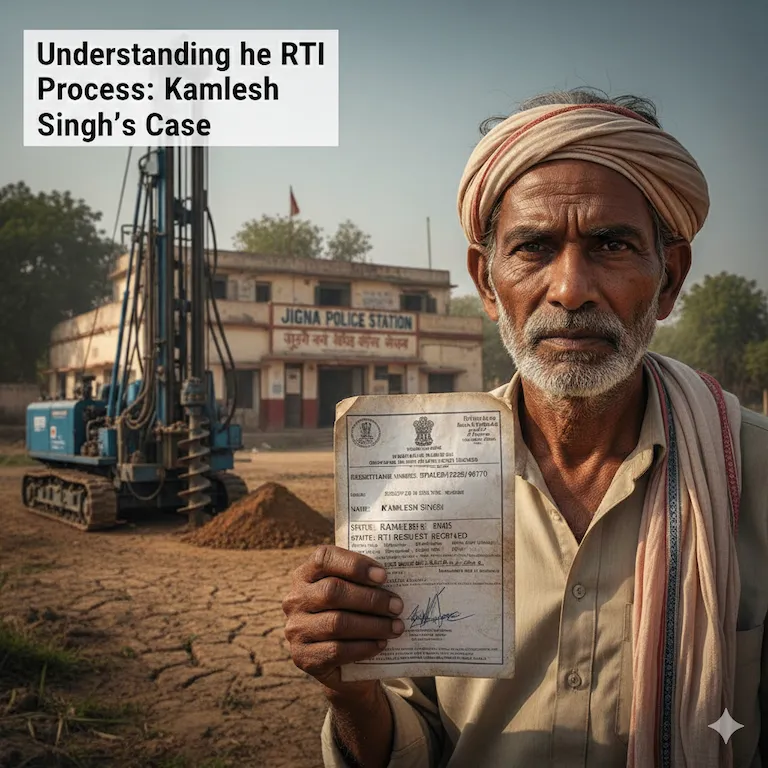
Here are the key takeaways from the blog post regarding Kamlesh Singh’s RTI application and the ongoing dispute in Mirzapur. Understanding the RTI Process is essential for making sense of the events discussed in this case.
- Systemic Inaction via “Dial 112”: The applicant’s son called the emergency helpline. Despite this, the police allegedly failed to stop the illegal boring on the disputed land. The applicant characterises the police as “mute spectators” to the violation.
- The Lis Pendens Conflict: The core of the grievance is a pending land mutation case. It is under Sections 34/35 of the Revenue Code 2006 before the SDM Sadar. Meanwhile, the opposing parties are using muscle power to change the physical status of the land.
- Undermining Judicial Authority: The blog emphasizes that allowing construction or boring to continue will undermine judicial authority. If this happens, the Revenue Court’s (SDM) future decision will become meaningless. “Criminal type” offenders will have already established physical possession.
- Specific Demands for Accountability: The RTI (Registration No. SPMZR/R/2025/60170) specifically demands:
- The names and designations of the officers who visited the site.
- The legal justification or “order note” that prevented police from intervening.
- An explanation of how the police can remain stagnant when court jurisdiction is being superseded.
- Identification of Key Officials: The matter is now officially directed toward Om Prakash Singh (ASP Operation). He serves as the Public Information Officer (PIO). The response from this office will determine if the administration acknowledges a lapse in duty by the Jigna Police. Understanding the RTI Process whether it is fixing accountability or not?
- The Human Element: The post highlights the frustration of a citizen. They feel that “anarchy” is prevailing. The opposition does not fear the law or wait for constitutional judicial processes.
Understanding the RTI Process: The Case of Kamlesh Singh and the Stagnancy of Local Law Enforcement
The legal principle of lis pendens signifies that no action should change a property’s status while litigation is pending. This principle holds significant importance. It is a cornerstone of the Indian judicial system. However, for Kamlesh Singh, a resident of Village Kothra Kantit in Mirzapur, this legal safeguard feels like a ghost. His recent RTI filing against the Superintendent of Police (SP) Office Mirzapur highlights a distressing trend. It demonstrates why fully grasping the RTI Process is essential to understanding how public accountability works. Local police allegedly cannot, or choose not to, intervene when powerful individuals bypass the court’s authority.
The Core Dispute: Illegal Construction During Litigation (Understanding the RTI Process)
The heart of the matter is a land dispute. It is currently pending before the Sub-Divisional Magistrate (SDM), Sadar. The case falls under Sections 34/35 of the Revenue Code 2006. The court is deliberating on the ownership and mutation of the land. Meanwhile, the opposing parties—identified as Raghuvar Dayal Singh and his associates—have allegedly begun “boring” operations on the site. The sequence of events is best analysed in the context of understanding the RTI Process, which can illuminate gaps in legal oversight.
This act of “boring” (drilling for water/construction preparation) is viewed as taking physical control of the land. It aims to create a fait accompli. If the land is fundamentally altered, the final court order could become irrelevant. The same applies if the land is occupied before the SDM reaches a verdict. Kamlesh Singh aptly describes this scenario as “anarchy.”
The Failure of the Emergency Response (Dial 112)
Perhaps the most striking detail in the RTI application is the failure of the 112 Emergency Service. According to the applicant, his son contacted the police via the emergency helpline. While the police reportedly arrived at the scene, the “boring” continued unabated after their departure. For anyone understanding the RTI Process, such outcomes highlight procedural shortcomings in emergency policing.
This raises a critical question regarding the Standard Operating Procedures (SOPs) of the Uttar Pradesh Police.
| Question | Issue Highlighted |
|---|---|
| Why was no “Status Quo” maintained? | Clear evidence of a pending revenue case was ignored. |
| What orders prevented halting construction? | Action was required to prevent the violation of lis pendens. |
The RTI Inquiry: Demanding Accountability (Understanding the RTI Process)
Through RTI registration number SPMZR/R/2025/60170, Kamlesh Singh is not just asking for a status update. He is demanding transparency regarding the “stagnancy” of the Jigna Police. His application seeks three vital pieces of information: For those invested in understanding the RTI Process, this inquiry is an important example of how transparency is sought from public agencies.
- Documentation of Inaction: There were specific orders or notes. These restricted the police from taking action. Meanwhile, the offenders continued their work.
- Legal Justification: Which “canon of law” supports this? Why do the police act as mute spectators while a sub-judice matter is being physically compromised?
- Personnel Accountability: The names and designations of the officers who visited the site on the day the illegal boring occurred.
The Role of the Public Information Officer (PIO)
The responsibility now falls on Shri Om Prakash Singh (ASP Operation), the designated PIO. In cases involving land disputes and police inaction, the PIO’s response is often a bellwether for administrative integrity. Police often claim the matter is “purely civil” to avoid intervention. If they do, they must explain why they allowed a breach of peace. They must also justify the violation of the status quo while present at the scene. The reply from the PIO will be crucial in understanding the RTI Process. It plays a significant role in contentious disputes. The response is expected by Date.
Conclusion: When the Court’s Importance is at Stake (Understanding the RTI Process)
The grievances of Kamlesh Singh reflect a larger systemic issue where “muscle power” is used to bypass “judicial power.” If individuals occupy disputed land while a case is in court, it undermines the authority of the Sub-Divisional Magistrate.
This RTI is a plea for the rule of law to prevail over local influence. Justice is not merely a decision delivered in a courtroom. It is the protection of the subject matter until that decision can be reached. The Mirzapur Police now have the opportunity to clarify their stance. Are they guardians of the law? Or are they silent witnesses to its evasion? For ongoing insight, readers can follow updates on this case. Those interested in understanding the RTI Process should check the RTI document File.
Your RTI application details and the current administrative hierarchy for the Mirzapur District Police serve as the basis. Here are the essential contact details. You will also find the web links you requested.
1. Key Application Details
- Registration Number:
SPMZR/R/2025/60170 - Application Date: 04/07/2025
- Status: RTI Request Received (as of July 2025)
2. Public Authority Contact Information
The primary office responsible for your inquiry is the Superintendent of Police (SP) Office, Mirzapur.
| Designation | Name of Officer | Mobile (CUG) | Official Email |
| DIG/SSP (District Head) | Shri Somen Barma (IPS) | 9454400299 | spmzr-up@nic.in |
| PIO / Addl. SP (Ops) | Shri Manish Kumar Mishra | 9454401105 | asp-op.mi@up.gov.in |
| Nodal Officer (RTI) | Om Prakash Singh | 9125608556 | aspopmzp@gmail.com |
| IG Vindhyachal Range | Shri Rakesh Prakash Singh | 9454400215 | digrmir@nic.in |
Note on PIO Details: Your application lists Om Prakash Singh as the PIO. However, official records for 2025-26 identify the Addl. SP (Operation) as the standard PIO for this unit. You can use the CUG (Closed User Group) numbers listed above for more reliable communication with the department.
3. Important Web Links (Understanding the RTI Process)
- UP RTI Online Portal: rtionline.up.gov.in(Use this to check your status or file a First Appeal if you don’t receive a response within 30 days).
- Mirzapur District Police Official Page: uppolice.gov.in/mirzapur
- UP Government Grievance Portal (Jansunwai): jansunwai.up.nic.in(If the RTI doesn’t stop the illegal boring, you can file a formal complaint directly. Submit it here to the Chief Minister’s office).
4. Recommended Next Steps (Understanding the RTI Process)
- Wait for the 30-Day Window: Since your filing date was 04/07/2025, the PIO has 30 days to respond.
- File a First Appeal: If you receive no response by August 4, 2025, file a “First Appeal” immediately. Do this through the UP RTI portal. Name the Superintendent of Police as the Appellate Authority.
- Physical Visit: Given the urgency of the “illegal boring,” you may visit the SP Office at Ramaipatti, Mirzapur (Phone: 05442-252578). Bring a copy of your RTI. Also, bring the court’s status quo documents.


Facing a similar challenge? Share the details in the box below, and our team of experts will do their best to help.