
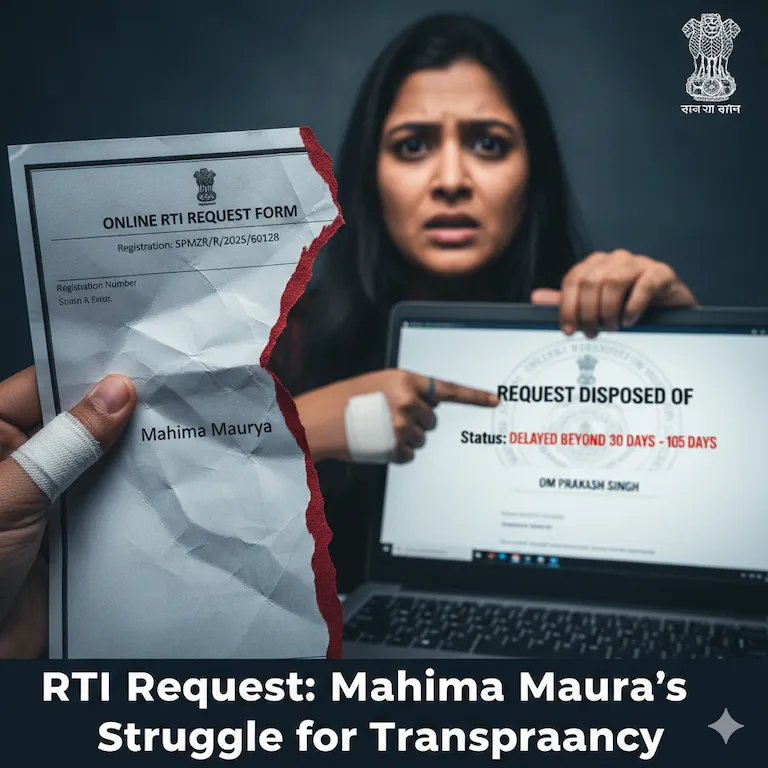
Key takeaways from this blog post is as follows
The case of Mahima Maurya vs. the Mirzapur Police highlights several critical failures in the implementation of the RTI Act. Here are the key takeaways from the analysis:
1. Violation of Statutory Timelines
The RTI Act mandates a response within 30 days. In this case, the application filed in November 2024 was not answered until March 2025—a delay of over 100 days. This constitutes a significant breach of Section 7(1) of the Act.
2. Information vs. Suggestion
A Public Information Officer (PIO) is legally obligated to provide existing records, not personal opinions or legal advice. By telling the applicant to “seek relief in court” rather than providing the specific legal provisions requested, the PIO overstepped their role and failed to fulfill the information request.
3. Systematic Omission of Victim Identity
A core grievance involves the “erasure” of the victim from official records. The failure to include the prime victim’s name in the Non-Cognizable Report (NCR) and the subsequent refusal to explain why this occurred suggests a lack of transparency in police documentation.
4. Weaponizing “Habitual Filing”
The police report labeled the applicant as someone “accustomed to giving applications again and again.” This is a common tactic used to stigmatize whistleblowers or victims. Under the RTI Act:
- There is no limit on the number of applications a citizen can file.
- Frequency of filing does not exempt the PIO from the duty to provide accurate information.
5. Medical and Investigative Gaps
The refusal to conduct an X-ray or a follow-up medical test, despite allegations of a fracture, points to a perfunctory investigation. The RTI response failed to provide the administrative “reasoning” for these decisions, which is a requirement for sound administration.
Summary of the Conflict
| Issue | Reality under RTI Act |
| Response Time | Must be 30 days; here it was ~105 days. |
| Content | Must be facts/records; here it was “suggestions.” |
| Tone | Must be objective; here it was accusatory toward the victim. |
RTI Accountability: When Procedural Delays and Vague Replies Obstruct Justice
The Right to Information (RTI) Act of 2005 was envisioned as the “sunlight” that would disinfect the corridors of Indian bureaucracy. It was designed to empower the common citizen, like Mahima Maurya, to demand transparency from public authorities. However, as seen in the recent case involving the Superintendent of Police (SP) Office in Mirzapur (Registration No: SPMZR/R/2025/60128), the bridge between filing an application and receiving meaningful information is often broken by systemic apathy and procedural non-compliance.
This case highlights a disturbing trend: Public Information Officers (PIOs) acting as “gatekeepers” rather than “facilitators,” providing evasive answers that raise more questions than they resolve.
The Core Conflict: Seeking Truth in the Face of Police Inaction
The heart of Mahima Maurya’s grievance lies in an incident dated September 14, 2024, involving an assault over a drainage dispute. While the police registered a Non-Cognizable Report (NCR), the victim alleges that her name was deliberately omitted from the records despite being the primary target of the violence.
When a citizen approaches the police, the First Information Report (FIR) or NCR is the foundational document of justice. By failing to include the victim’s name and allegedly tearing up her written representation, the authorities haven’t just committed a clerical error; they have effectively “erased” her legal standing in the eyes of the state.
Violations of the RTI Act: Delay and Deflection
One of the most glaring issues in this case is the violation of Section 7(1) of the RTI Act. The law mandates that a PIO must provide information within 30 days. In this instance:
- The original application was filed on November 23, 2024.
- The response was not disposed of until March 8, 2025.
A delay of nearly four months is a direct breach of statutory duty. Furthermore, the portal’s inability to allow a First Appeal due to the PIO’s late entry into the system creates a “digital dead-end” for the applicant.
The Duty to Inform vs. The Habit of Suggestion
The applicant rightly points out that the PIO’s duty is to provide recorded information, not to offer unsolicited legal advice. The police report suggested that the victim should “seek relief in the Honorable Court.” Under the RTI framework, a PIO cannot tell an applicant what to do; they must explain what was done (or not done) based on official records.
Analyzing the 6-Point Query: A Study in Evasion
The specific points raised by Mahima Maurya highlight the gap between police “counseling” and police “duty”:
1. The Omission of the Victim’s Name
The applicant sought the reason why her name was excluded from the NCR despite her being the prime victim. The police response merely restated that an NCR was filed based on her husband’s complaint. This is a classic “circular response” that ignores the specific question of the victim’s individual legal recognition.
2. Unauthorized Counseling
The police suggested the victim approach the court. The RTI query asked for the specific provisions under the Bharatiya Nyaya Sanhita (BNS) or Bharatiya Nagarik Suraksha Sanhita (BNSS) that authorize police to act as legal counselors instead of investigators. The response remained silent on the legal authority for such “suggestions.
3. Medical Negligence and Contradictions
A critical point of contention is the medical examination. The victim claims a fracture, yet the police report states that the doctor did not advise an X-ray.
“Right to reason is an indispensable part of a sound administrative system.
If a victim complains of severe pain and physical trauma, the failure to conduct a secondary medical test or an X-ray suggests a perfunctory investigation aimed at minimizing the gravity of the offense.
The “Habitual Applicant” Stigma: Chilling the Right to Ask
In points 5 and 6 of the police report, the authorities labeled the applicant as someone who is “accustomed to giving applications again and again” and accused her of making “false allegations.”
This is a dangerous precedent. The RTI Act does not limit the number of applications a citizen can file. Labeling a seeker of justice as “habitual” is an attempt to delegitimize her grievances. If the police have submitted reports according to the law, they should have no trouble providing the evidence; instead, they chose to attack the character of the applicant.
The Role of the ASP Operation (PIO) and Nodal Officer
The PIO, Om Prakash Singh (ASP Operation), and the Nodal Officer share the responsibility for this breakdown. When a PIO provides a report from a subordinate station (Vindhyachal Police Station) that is purely descriptive and fails to answer the “why” (the reasoning), they fail in their quasi-judicial capacity.
| RTI Point | Information Sought | PIO Response Quality |
| Reason for Omission | Why was the victim’s name left out? | Poor (Repeated NCR details) |
| Legal Authority | Provision for police counseling. | Non-existent |
| Medical Evidence | Why no X-ray was conducted. | Deflective (Blamed doctor’s advice) |
| Characterization | Evidence of “false allegations.” | Vague (Cited “repeated applications”) |
Conclusion: The Path Toward Accountability
The case of Mahima Maurya is not just an isolated incident in Mirzapur; it is reflective of a larger struggle where the police use the RTI process to delay rather than disclose. When a victim’s representation is “torn up” and their RTI queries are met with character assassination, the “Accountability” promised by the 2005 Act remains a distant dream.
For transparency to prevail, the First Appellate Authority must intervene to penalize the delay and compel the PIO to provide specific, point-wise reasons as required under the law. Justice delayed by a medical omission or a clerical deletion is, ultimately, justice denied.
For clarity and ease of follow-up, here are the validated contact and technical details for the public authorities involved in your RTI case.
1. Concerned Public Information Officer (PIO)
This is the official who provided the delayed and evasive response you shared.
- Name: Om Prakash Singh
- Designation: Additional Superintendent of Police (ASP) Operation, Mirzapur
- Mobile Number: +91-9125608556 / +91-9454401105
- Official Email: aspopmzp@gmail.com / asp-op.mi@up.gov.in
- Office Address: Superintendent of Police Office, Mirzapur, Uttar Pradesh – 231001
2. First Appellate Authority (FAA)
If the PIO’s response is unsatisfactory or delayed beyond 30 days, the First Appeal must be filed with their senior officer.
- Designation: Superintendent of Police (SP) / Senior Superintendent of Police (SSP), Mirzapur
- Current CUG Mobile: +91-9454400299
- Office Landline: 05442-252578
- Official Email: spmzr-up@nic.in
- Address: SP Office, Civil Lines, Mirzapur, UP – 231001
3. Nodal Officer Details
The Nodal Officer is responsible for the internal routing of RTI applications within the Mirzapur Police department.
- Name: Om Prakash Singh (ASP Operation)
- Mobile: +91-9125608556
- Email: addlspopmzr@gmail.com
4. Important Web Links for Tracking & Appeals
To take your case further, you should use the official Uttar Pradesh RTI portal:
- Online RTI Portal (Filing/Status): rtionline.up.gov.in
- Track Status: Use your registration number (SPMZR/R/2025/60128) on the “View Status” page of the portal.
- State Information Commission (For Second Appeals):upic.gov.in
- Note: If the First Appeal does not resolve the issue, you can file a Second Appeal here against the PIO for the 100-day delay.
5. Summary of Application Identifiers
- Current Application ID: SPMZR/R/2025/60128 (Filed 02/06/2025)
- Previous Application ID: SPMZR/R/2024/60221 (Filed 23/11/2024)
- Police Internal Ref Nos: 60000240216787 and 60000240226069
Would you like me to draft the “Grounds for Appeal” text for your First Appeal, specifically highlighting the legal breach of the 30-day timeline?


Facing a similar challenge? Share the details in the box below, and our team of experts will do their best to help.