
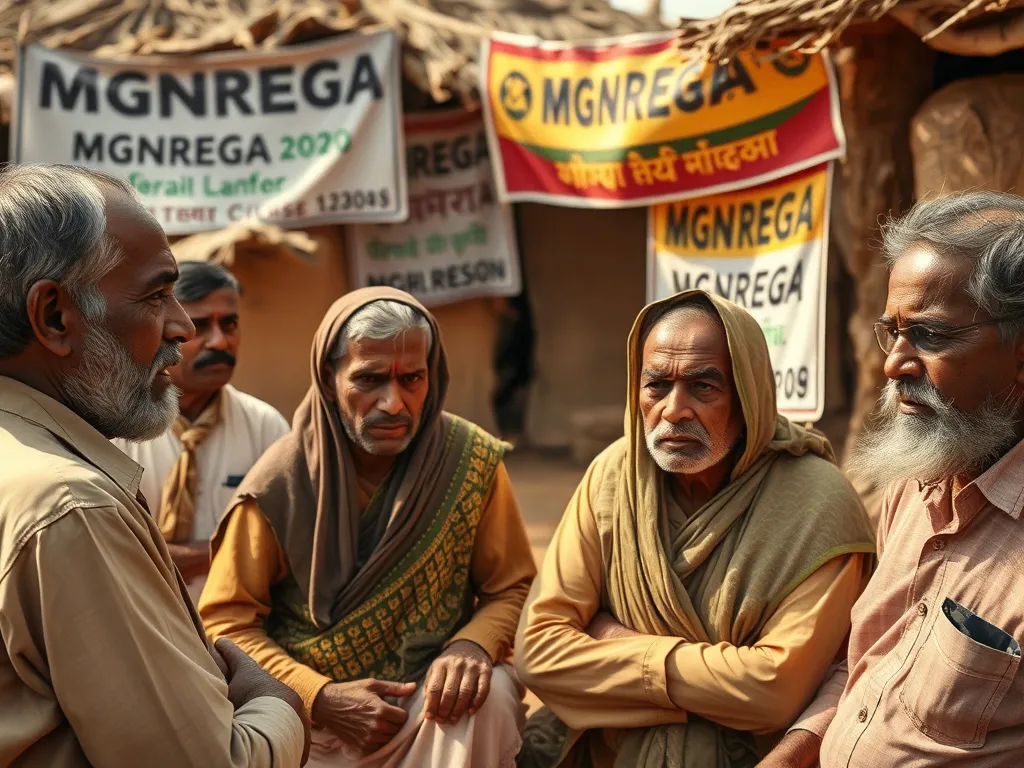
The Fight for Accountability: Corruption Allegations in Rajasthan’s MGNREGA Implementation
The Mahatma Gandhi National Rural Employment Guarantee Act (MGNREGA) was designed as a lifeline for India’s rural population, guaranteeing 100 days of wage employment to every household. However, in the heart of Rajasthan, specifically within the Nagaur district, this lifeline is allegedly being strangled by systemic corruption. A series of formal grievances, spearheaded by public-spirited individuals and residents of Phalki village, has brought to light a troubling disconnect between the central government’s “zero-tolerance” policy on corruption and the ground reality of administrative inertia.
At the center of this burgeoning legal and social battle is Grievance Registration Number: GOVRJ/E/2025/0001190, filed by Yogi M. P. Singh on behalf of local residents Ram Nivas and Mahipal. The complaint paints a grim picture of fund embezzlement and a machinery that seems more intent on “sweeping issues under the carpet” than delivering justice.
The Epicenter of the Dispute: Phalki and Mugdara
The grievances originate from Village Phalki, located within the Mugdara Gram Panchayat of Merta Tehsil, Nagaur. Local villagers allege that developmental works conducted under MGNREGA are riddled with irregularities. These are not merely administrative errors; the complainants suggest substantial evidence exists showing that funds intended for rural laborers and local infrastructure have been diverted or embezzled.
For the residents of Phalki, this is not just a matter of balance sheets. MGNREGA is a right-based framework. When funds are siphoned off, the “interests of vulnerable villagers are encroached upon,” directly impacting their livelihood and the physical development of their community.
A Paper Trail of Inaction: The Timeline of Grievances
One of the most damning aspects of this case is the sheer volume of ignored representations. This is not a single isolated complaint but a persistent campaign for transparency that has spanned several months. The record shows a trail of submissions to various departments, including the Prime Minister’s Office (PMO) and the Department of Rural Development (DORLD):
- December 2024: Initial reports of irregularities (MOPRJ/E/2024/0007172).
- January – February 2025: A flurry of filings (DORLD/E/2025/0000288, 0001772, 0001936) seeking investigation.
- Case Closure Without Resolution: Notably, one case (DORLD/E/2025/0001772) was closed within just three days of filing in February 2025, raising serious questions about the depth of the inquiry conducted.
- March 2025: The latest grievance (GOVRJ/E/2025/0001190) highlights that despite these repeated attempts, “no solid or strong action” has been taken by the Rajasthan administrative staff.
The recurrence of these filings suggests a systemic failure. When a citizen is forced to file nine separate grievances for the same issue within three months, it indicates that the grievance redressal mechanism itself may be broken.
The Constitutional Mandate: Article 51A
The complainants have taken a sophisticated legal stance by invoking Article 51A of the Constitution of India. By doing so, they frame their protest not just as a plea for help, but as the fulfillment of a Fundamental Duty. Article 51A encourages citizens to safeguard public property and to strive toward excellence in all spheres of individual and collective activity.
By reporting embezzlement, the villagers of Phalki argue they are performing their duty as citizens to protect public funds. They are demanding that the administration reciprocate by adhering to the principles of transparency and accountability. The core of their demand is a thorough investigation by a district-level committee appointed by the District Magistrate, rather than a cursory check by the very departments accused of negligence.
The Paradox of Policy vs. Practice
A significant portion of the grievance addresses a glaring political paradox. Prime Minister Narendra Modi has consistently campaigned on a platform of a “corruption-free India,” promising to eliminate the “middleman culture” that has historically plagued rural schemes.
However, the complainant argues that while the Prime Minister claims to overcome corruption at the national level, the “public staff” at the state and local levels are actively suppressing evidence. The grievance states:
“On the one side of the screen, our Prime Minister claims to overcome corruption… but on the other side of the screen, public staff are putting the matter of corruption under the carpet.
This creates a “precarious situation” where the stated intent of the highest office in the country is being undermined by the administrative machinery in Rajasthan. The inaction of the state administration in Jaipur—specifically regarding the forwarded concerns to the Deputy Secretary of the Department of Administrative Reforms—is cited as evidence of a lack of political and administrative will.
The Demand for Immediate Intervention
The current status of the grievance shows it has been received and forwarded to Mr. Shyam Lal Meena, Deputy Secretary in the Rajasthan Secretariat. The villagers are now looking to the state leadership to break the cycle of “forwarding and forgetting.”
The demands are clear:
- Independent Inquiry: A district-level committee must bypass local influences to investigate the Mugdara Gram Panchayat records.
- Audit of Works: A physical and financial audit of the developmental works cited in the “self-evident” data provided by the villagers.
- Accountability for Inaction: An explanation as to why previous grievances were closed or ignored without visible results.
Conclusion: A Test for the Administrative Machinery
The case of Phalki village is a microcosm of a larger struggle across rural India. When corruption enters schemes like MGNREGA, it doesn’t just steal money; it steals the dignity and the legal rights of the poorest citizens.
The persistent efforts of Ram Nivas, Mahipal, and Yogi M. P. Singh serve as a reminder that the “true character of the administrative machinery” is revealed not by its promises, but by its response to the cries of the vulnerable. If the Rajasthan government and the PMO fail to act on this mounting evidence, it will signal a significant blow to public trust and the government’s commitment to transparency.
The eyes of the Nagaur district are now on Room No. 8129 of the Jaipur Secretariat. Will the administration finally lift the carpet, or will the voices of Phalki continue to be silenced by bureaucracy?
To ensure you have the most direct path for following up on the corruption allegations in Mugdada Gram Panchayat, here are the structured details for the concerned public authorities.
1. Primary Nodal Authority (Rajasthan State)
This is the office where your current grievance (GOVRJ/E/2025/0001190) is officially registered.
| Detail | Information |
| Department | Department of Administrative Reforms (Group 3/Public Grievance) |
| Nodal Officer | Mr. Shyam Lal Meena (Deputy Secretary) |
| Contact Number | 0141-2922825 / 0141-2227801 |
| Email Address | DS.RPG@RAJASTHAN.GOV.IN (Alt: ard.ds3@rajasthan.gov.in) |
| Office Address | Room No. 8129, 1st Floor, North Western Building, Secretariat, Jaipur |
| Official Web Link | Rajasthan Sampark Portal |
2. MGNREGA Specific Authorities
Since the core issue involves the embezzlement of MGNREGA funds, these authorities have the power to initiate technical audits and appoint an Ombudsman.
| Authority | Contact Detail | Link / Email |
| NREGA Nodal Officer (Raj) | Shri Arvind Saxena | nrega.raj@gmail.com |
| MGNREGA Helpline | 1800-180-6127 (Toll Free) | NREGA Rajasthan Official |
| Social Audit Society (SSAAT) | 0141-2227033 | dir.socialaudit@rajasthan.gov.in |
3. Anti-Corruption Bureau (ACB) Rajasthan
If the administrative machinery is failing to act, you can escalate the matter as a criminal case of embezzlement to the ACB.
- Toll-Free Helpline: 1064
- WhatsApp Helpline: 9413502834
- Email for Complaints: complt.acb@rajasthan.gov.in
- Website: ACB Rajasthan Portal
4. District Authority (Nagaur)
As the complaints specifically mention the Merta Block in Nagaur District, the District Magistrate (Collector) is the ultimate coordinator for MGNREGA at the district level.
- Authority: District Collector & District Programme Coordinator (MGNREGA), Nagaur.
- Nagaur District Portal: https://nagaur.rajasthan.gov.in/
Summary Checklist for Next Steps:
- Check Status via 181: You can call the Rajasthan Sampark Helpline (181) and quote your registration number to get a verbal update.
- Email the Deputy Secretary: Send a formal reminder to DS.RPG@RAJASTHAN.GOV.IN referencing the 9 previous registration numbers to show the pattern of inaction.
- File with SSAAT: Since you mentioned transparency, requesting a Social Audit via the SSAAT (Social Audit Accountability and Transparency Society) is a powerful way to force a public hearing in the village.
Would you like me to draft a formal “Notice of Inaction” email that you can send to these email addresses simultaneously?


Facing a similar challenge? Share the details in the box below, and our team of experts will do their best to help.