
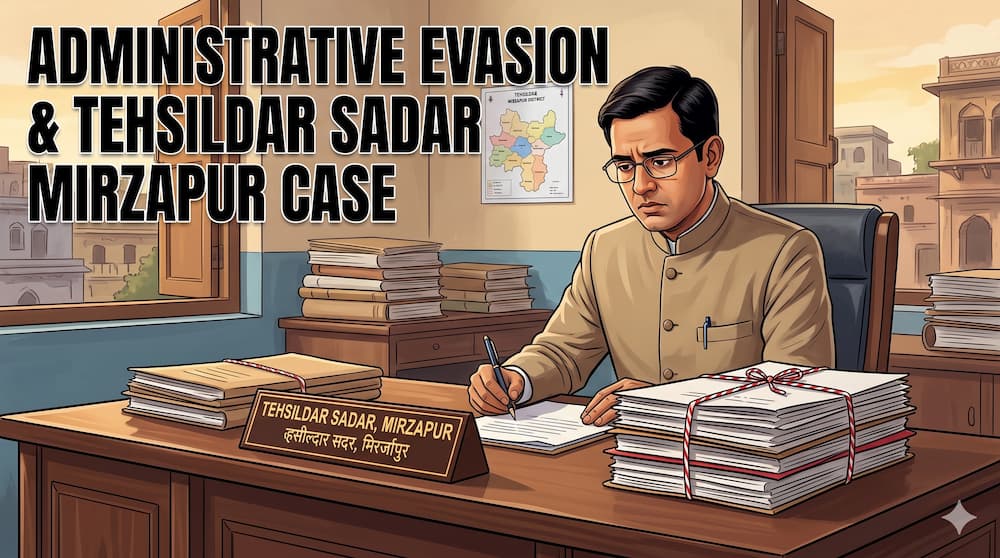
Administrative Evasion & Tehsildar Sadar Mirzapur is the historic focal point for RTI history. The region has seen significant challenges regarding transparency and accountability in governance. Tehsildar Sadar Mirzapur overlooked the repeated notices issued by the Chief Information Commissioner, Govt of Uttar Pradesh, highlighting a troubling disregard for the Right to Information Act. This act was designed to empower citizens by providing them access to governmental records. However, the tehsildar’s lack of responsiveness raises concerns about the efficacy of the RTI mechanism in combating bureaucratic inertia. The situation demands urgent attention from higher authorities to ensure that officials adhere to their obligations, thus fostering an environment of trust and cooperation between the public and the administration.
Key Takeaways
- The article highlights issues of Administrative Evasion & Tehsildar Sadar Mirzapur, focusing on the tehsildar’s non-compliance with the Right to Information Act.
- The delays in submitting essential reports demonstrate a blatant lack of accountability and transparency by local officials.
- Citizens face bureaucratic evasion despite filing RTI applications, which reveals deeper systemic issues in governance.
- The Uttar Pradesh Information Commission intervened, demanding compliance and proposing penalties for non-cooperation.
- For a genuine RTI accountability, enforcement of strict statutory remedies and transparency is crucial in public administration.
Administrative Evasion & Tehsildar Sadar Mirzapur: A Case Study from Uttar Pradesh
The Right to Information (RTI) Act, 2005, was a milestone in Indian democracy. Lawmakers designed it to dismantle bureaucratic opacity and empower the common citizen. However, two decades after its inception, the ground reality tells a different story. Systemic delays, deliberate misclassifications, and a persistent lack of accountability still plague the system.
Consequently, a striking example of Administrative Evasion is currently unfolding before the Uttar Pradesh Information Commission in Lucknow (Court Room S-1) under Appeal Number: S-01/A/1390/2025. This specific case highlights how the Office of the Tehsildar Sadar Mirzapur can weaponize procedural delays to shield negligent officials. Therefore, citizens must persistently fight to enforce judicial mandates.
The Genesis: Non-Compliance of a Revenue Court Decree
Initially, this entire dispute emerged from a local land matter in Village Babura, Post Babura, Tehsil-Sadar, District Mirzapur. The dispute involves partition proceedings under Section 116 of the Uttar Pradesh Revenue Code, 2006. Currently, authorities track it under computerized Case No. T202216530107209 (Atul Singh et al. vs. Ashok Kumar Singh alias Angad Singh).
On September 13, 2024, the Court of the Additional Sub-Divisional Magistrate (SDM), Sadar, Mirzapur, issued a preliminary decree regarding land division across Araji numbers 1012, 1271, and 1404. To finalize this division, the court ordered the local Lekhpal of Village Babura to submit a formal partition report, locally known as a Faat report.
Despite explicit judicial mandates and subsequent formal reminders, internal revenue records revealed a shocking delay. As of September 2, 2025, the Lekhpal had failed to submit the report for nearly twelve months. Thus, this year-long delay by a public servant effectively stalled a court decree. Furthermore, it demonstrated a blatant disregard for judicial authority.
Weaponizing Evasion: The RTI Application and Bureaucratic Runaround
Frustrated by this institutional inertia, the applicant filed a formal RTI application on June 3, 2025. He sought direct administrative accountability for the lapse. Rather than asking about the merits of the land dispute, the information seeker raised five pointed queries to confront the Administrative Evasion of local desk officers: (Administrative Evasion & Tehsildar Sadar Mirzapur)
- Identifying Misclassification: Why did staff push a revenue dispute onto the police ledger, and what are their names and designations? PDF
- Justifying Ignored Connections: Why did the PIO in the Chief Minister’s office fail to forward the grievance to the SDM Sadar? PDF
- Tracking Action: What specific actions did investigation officers take to ensure the Lekhpal complied with the decree?
- Exposing Arbitrary Approvals: Who in the administrative hierarchy accepted the inconsistent reports submitted by Circle Officer Vivek Jawla?
- Demanding Legible Records: Why did the District Magistrate upload unreadable, illegible document copies to the public Jansunwai portal?
Instead of providing point-wise disclosures, the PIO at the office of the Tehsildar Sadar Mirzapur resorted to classic bureaucratic evasion. In a response dated April 15, 2026, the PIO merely provided the operational status of the court case. He highlighted its temporary dismissal on October 13, 2025, and its subsequent revival under a restoration tracking number (D202616530000493).
By focusing entirely on court timelines, the PIO conveniently shielded the Lekhpal. Hence, he hid the fact that the official had willfully disobeyed a valid judicial decree for a full year while the case was active.
Tactical Delays and Deceptive Compliance Timelines
Beyond hiding facts, the case exposes the troubling logistical tactics deployed by public authorities to undermine transparency portals. For instance, a recurrent issue highlighted before the Hon’ble State Chief Information Commissioner, Dr. Rajkumar Vishwakarma, is the manipulation of delivery timelines. Authorities use these tactics to engineer an Administrative Evasion of responsibility.
Specifically, the PIO claimed that he dispatched the requested data via WhatsApp on February 17, 2026. However, digital metadata and timestamps conclusively proved that he transmitted the message on February 20, 2026. This was exactly one day after a crucial Commission hearing had already taken place. Clearly, this calculated backdating was a deliberate attempt to deceive the Commission.
Furthermore, public authorities under the Tehsildar Sadar Mirzapur have increasingly relied on informal communication channels. They use unverified WhatsApp numbers belonging to third-party individuals rather than using standard registered post. Sending illegible document scans less than 24 hours before a review effectively amounts to a “deemed refusal” under the RTI Act. Consequently, it deprives the citizen of their lawful right to examine records and submit timely counter-rejoinders.
The Commission’s Directive and the Path Forward
Recognizing this pattern of non-cooperation, the Uttar Pradesh Information Commission stepped in with a strict warning. In an order recorded on May 14, 2026, the Commission granted a final opportunity to the revenue administration. Specifically, the bench directed the Tehsildar Sadar Mirzapur to appropriately resolve the citizen’s formal objections. The bench mandated the official to produce the revised information cleanly structured in a tabular format. Crucially, the Commission warned that failure to comply would result in an immediate Show-Cause Notice.
Despite this warning, the public authority failed to upload or email the mandated action-taken report by the eve of the June 22, 2026 hearing. Therefore, the citizen logged an urgent formal representation under Diary Number D-210620260029.
To restore public faith in local governance and dismantle this culture of Administrative Evasion, the Commission must enforce strict statutory remedies: (Administrative Evasion & Tehsildar Sadar Mirzapur)
- Imposing Section 20(1) Penalties: The Commission should levy the maximum statutory penalty of ₹25,000 on the PIO to prove that stonewalling information carries financial consequences. PDF
- Enforcing Personal Accountability: The Commission must force the disclosure of names and designations of the specific desk officers within the office of the Tehsildar Sadar Mirzapur who validated misleading data. PDF
- Disciplinary Actions: The department must initiate formal inquiries against local Lekhpals who choose to sit on judicial orders. PDF
In conclusion, RTI is a vital mechanism to keep public administration accountable to the citizens. When local officials treat information requests as bureaucratic hurdles, they undermine the rule of law. Only swift, punitive actions by state commissions can curb this institutional defiance and preserve the power of the Right to Information.
Here is the cleanly structured directory of all application IDs, official emails, mobile numbers, and web portal links for the public authorities involved in your case:
🆔 Application & Tracking IDs (Administrative Evasion & Tehsildar Sadar Mirzapur)
- UP Information Commission Diary Number:
D-210620260029(Registered on 21/06/2026) PDF - RTI Appeal Registration Number:
A-20250902068PDF+ 1 - Commission File / Appeal Number:
S01/A/1390/2025PDF+ 1 - Commission Notice Number:
202606S01N200410PDF+ 1 - UPIC Welcome Portal Tracking ID:
UPICR20240000149PDF - Revenue Court Computerized Case ID (Partition Suit):
T202216530107209PDF - Revenue Court Computerized Restoration ID:
D202616530000493PDF
📞 Mobile Number Directory (Administrative Evasion & Tehsildar Sadar Mirzapur)
- Public Information Officer (PIO) / Tehsildar Sadar: Ajendra Kumar Singh — 9454411960 PDF+ 1
- Informal RTI Document Channel (Azad Alam): 79058 36020 PDF
- Appellant (Yogi M. P. Singh): 7379105911 PDF+ 1
✉️ Email Directory (Administrative Evasion & Tehsildar Sadar Mirzapur)
- UP Information Commission (S-1 Hearing Court):
hearingcourts1.upic@up.gov.inPDF+ 1 - PIO / Tehsildar Sadar Office:
shome.p11@up.gov.inPDF - District Magistrate (DM) Mirzapur Office:
dmmir@nic.inPDF - Regional E-Governance / VRC Contact:
vrc396mirzapur@gmail.comPDF+ 1 - Appellant Email:
yogimpsingh@gmail.comPDF+ 1
🌐 Official Web Portal Links (Administrative Evasion & Tehsildar Sadar Mirzapur)
[!NOTE] Use these official web links to track your case files, submit written arguments, or review uploaded order sheets.
- To verify official notices, check the cause list, and track your second appeal files, visit the Uttar Pradesh Information Commission Portal. PDF
- To track public grievances, check revenue report actions, and inspect documents uploaded by the District Magistrate, log into the UP Government Jansunwai Portal.


Facing a similar challenge? Share the details in the box below, and our team of experts will do their best to help.