
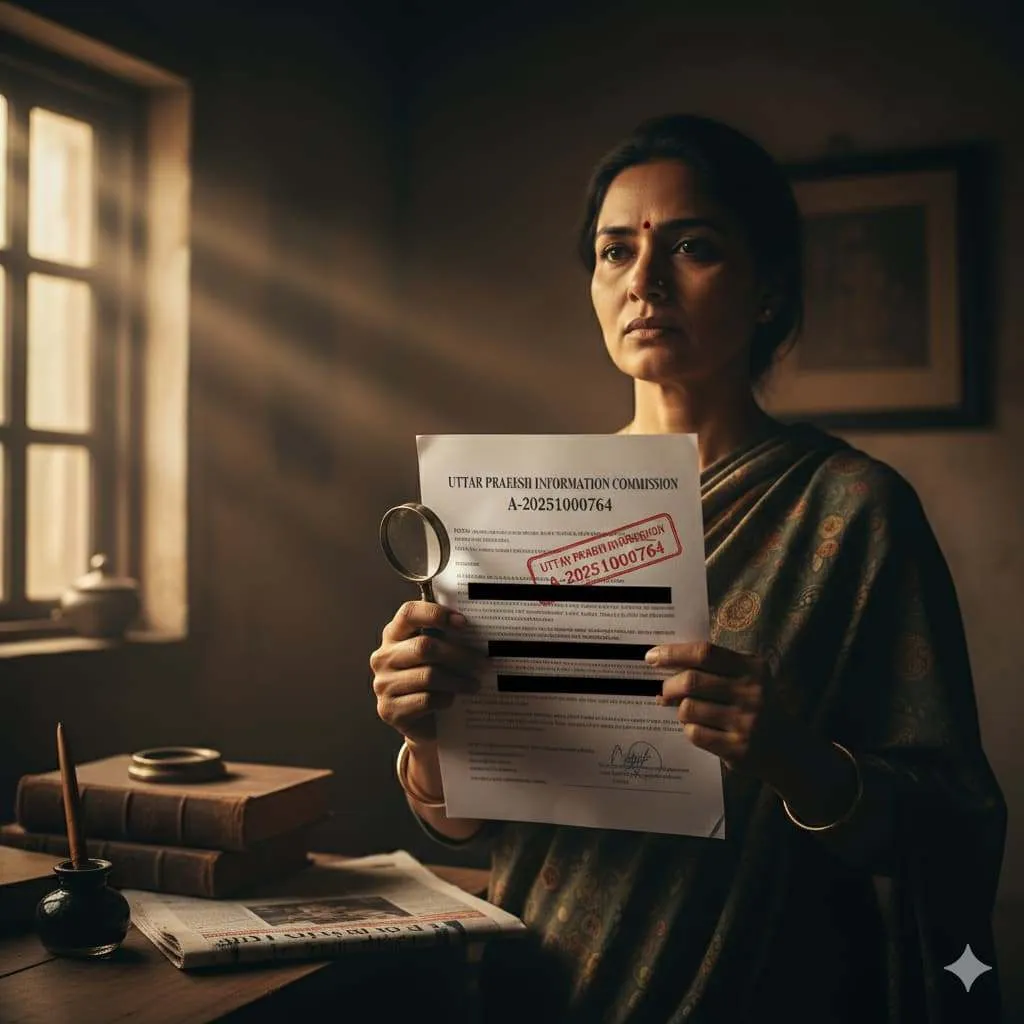
From Victim to ‘Habitual Applicant’: One Woman’s RTI Battle Against Police Evasion in Mirzapur
In the heart of Uttar Pradesh, a woman named Mahima Maurya, often regarded as a Habitual Applicant, is waging a battle that goes far beyond her personal grievance.
Armed with the Right to Information (RTI) Act, she is not just seeking justice for herself; she is also catalysing a movement that challenges a system entrenched in apathy and bureaucratic indifference.
Mahima’s quest for transparency is crucial, as it sheds light on the often obscured processes that affect the lives of countless citizens.
Her fight, detailed in a second appeal to the Uttar Pradesh Information Commission, serves as a masterclass in civic vigilance, illustrating how one individual’s tenacity can inspire others to stand up for their rights.
Each step she takes is a step toward empowering individuals who feel marginalised or unheard, emphasising the need for accountability from those in power.
Moreover, her persistent efforts serve as a stark reminder of why the RTI is often referred to as the “sunshine law,” illuminating the dark corners of governance that are often left unchecked and providing a beacon of hope for all who strive for justice and fair treatment within the societal framework.
This isn’t just a story about a complaint; it’s a story about the relentless pursuit of accountability. Such pursuit characterises a true habitual applicant’s resolve.
The Spark: A Simple Request for “Why?”
It all began on June 2, 2025. Mahima Maurya, a resident of Godasar village in Mirzapur, filed an RTI application (No. SPMZR/R/2025/60128) with the Superintendent of Police, Mirzapur. She wasn’t seeking state secrets. As a Habitual Applicant, she was asking simple, direct questions about the handling of her own case. She was the prime victim of an incident that left her with a fractured bone.
Her questions were pointed and born from a deep sense of injustice:
- Why was her name, as the main victim, not included in the official non-cognizable report (NCR)?
- Under what law can the police simply “counsel” a victim to go to court instead of taking action?
- Why was a crucial X-Ray, not performed during her initial police-led medical examination?
- Why was no follow-up action, taken even after she presented authentic X-Ray proof of her fracture?
These are not frivolous queries. They go to the heart of police procedure and accountability.
The Wall: Evasive Answers and Troubling Accusations
The response from the Public Information Officer (PIO), Shri Om Prakash Singh, arrived on July 4, 2025, after a long wait filled with anticipation and expectations.
However, much to Mahima’s disappointment, instead of receiving the clear and informative answers she was hoping for, the communication she obtained was lacking in substance.
Mahima’s appeal outlines that the provided information was “incomplete/unsatisfactory/false/misleading,” highlighting a disconcerting pattern of evasion and negligence in response to her enquiries.
This situation not only added to her frustration but also raised concerns regarding transparency and accountability within the administrative framework, leaving Mahima wondering about the underlying motives behind this inadequate response and prompting her to consider further actions to seek the truth.
The department didn’t just evade her questions; it went on the offensive. They allegedly labelled her a “habitual applicant” who makes “false accusations.”
Mahima’s appeal systematically dismantles the PIO’s response, highlighting a pattern of deflection:
- The Missing Name: When asked why her name was omitted from the report, the PIO allegedly provided an irrelevant answer about an FIR lodged by someone else. They completely sidestepped her specific question.
- The “Go to Court” Runaround: When asked to cite the specific legal provision in the new Bharatiya Nagarik Suraksha Sanhita (BNSS) or Bharatiya Nyaya Sanhita (BNS) that allows police to advise victims to approach the court instead of acting, the PIO provided no answer at all. There was a complete silence.
- The Ignored Injuries: Her questions about why an X-Ray was, neither conducted initially nor after she provided proof of a fracture, found in treatment with more evasion and silence. They failed to provide any reason for the apparent lapse in investigation.
- The Character Attack: To counter the department’s claim that she is a “habitual applicant,” Mahima cleverly used the RTI Act itself. She asked for just one single instance of a complaint she filed where the police report, was in accordance with the contents of the grievance. She also asked for details of any “false allegations” she had supposedly made. To these points, the PIO reportedly provided vague responses or complete silence. They failed to substantiate the very claims they used to discredit her.
Escalating the Fight: A Demand for Penalties
Unsatisfied with the outcome of her initial appeal, which had been resolved swiftly yet left her without the necessary relief she sought, Mahima filed a first appeal on July 13, 2025.
To her dismay, this appeal too was disposed of without addressing her concerns adequately.
Frustrated by the process, she found herself labelled once again as a Habitual Applicant, a designation she believed misrepresented her genuine attempts to seek justice.
Recognising the need for a more effective approach, she took matters into her own hands and decided to escalate her case further.
This determination led her to file a Second Appeal before the State Information Commission on October 9, 2025.
In her second appeal, Mahima aimed to emphasise the irregularities in her prior applications and the dismissive treatment she encountered, hoping for a thorough review and a resolution that would finally address her grievances.
Her prayer to the Commission is bold and clear. She is not just asking for the information any more. Mahima is demanding accountability. She has requested the Commission to:
- Direct the PIO to provide complete, point-wise information, free of cost.
- Initiate penalty proceedings against the PIO, Shri Om Prakash Singh, under Section 20(1) of the RTI Act for knowingly providing misleading information and obstructing her right to know.
- Recommend disciplinary action against the concerned officials for their failure to uphold the law.
Why This Case Matters to All of Us
Mahima Maurya’s case is a powerful testament to the spirit of the RTI Act, showcasing the relentless pursuit of justice and transparency by an individual.
It highlights how a single, determined citizen can challenge an entire department’s lack of transparency and accountability, ultimately reinforcing the foundational principles of democracy.
Her appeal argues that providing misleading information or no information at all is not just poor service; it is a serious breach of duty by public authorities.
This conduct undermines the rights of citizens to access critical information that directly affects their lives.
Mahima’s case emphasises that such actions constitute a “deemed refusal” and an obstruction of information, punishable by law.
By courageously standing up against bureaucratic negligence, Mahima encourages others to exercise their rights and reinforces the importance of civic engagement in demanding accountability from those in power.
Her story serves as an inspiration and a warning. It shows that the power of a citizen lies in asking “why” and refusing to accept silence or deflection as an answer. As Mahima’s appeal awaits a hearing, it stands as a crucial test for the principles of transparency and accountability in public service. Her struggle in Mirzapur embodies the habitual applicant’s fight for every citizen. This fight is for anyone who has ever been, made to feel, powerless by the system.
Mahima Maurya submitted petition before UPHRC Lucknow against SHO
Struggle of woman for justice in U.P.


Facing a similar challenge? Share the details in the box below, and our team of experts will do their best to help.