
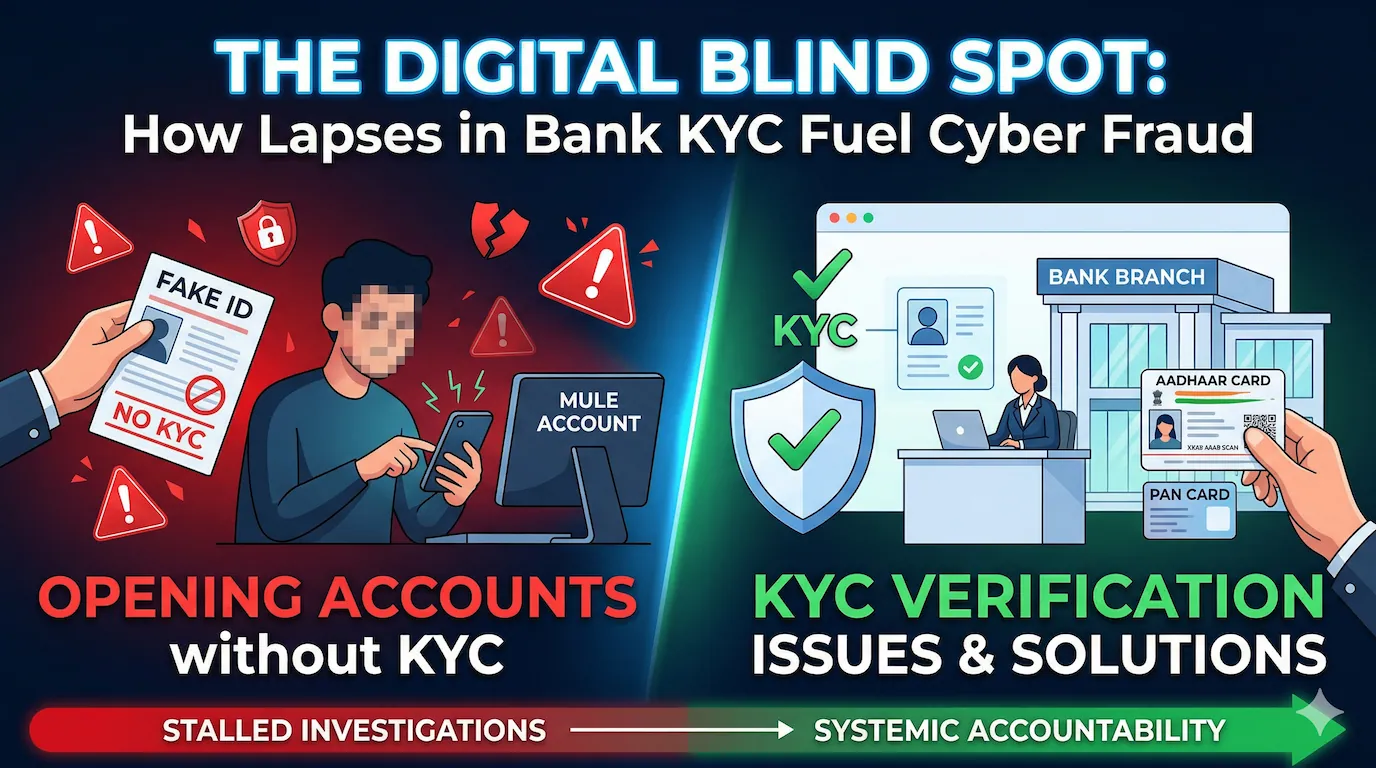
Here are the key takeaways from the analysis of the systemic failures between banking regulations and cybercrime investigation. One major concern is Opening Bank Account without KYC Verification, which creates vulnerabilities.
- The “Mule Account” Crisis: Cyber fraud investigations often hit a dead end. This happens because banks allow accounts to be opened with fictitious or unverified credentials. These “ghost” accounts serve as the primary infrastructure for laundering stolen money.
- Regulatory Breach as a Primary Cause: The failure of banks to comply with the RBI’s KYC Master Directions is significant. It also involves non-compliance with the Prevention of Money Laundering Act (PMLA), 2002. This is not just a clerical error. It is a legal offence that facilitates criminal activity.
- Police Limitations: Law enforcement agencies (like the case in Mirzapur/Meerut) often close cases. They do this because the “Customer Due Diligence” was so poor. As a result, the account holders cannot be physically traced, rendering digital evidence useless.
- RBI’s Liability Framework: As the regulatory body, the RBI has the authority to penalize banks for these lapses. Victims have the right to claim “Deficiency of Service.” They can do this if a bank’s negligence in KYC verification led to their financial loss.
- Systemic Accountability: The RBI must take significant action beyond minor fines. They should hold bank staff personally accountable for “Misbehaviour/Corruption” in the account-opening process. This is crucial, especially when those accounts are flagged by the Cyber Cell.
Recommended Action Plan
| Step | Action | Purpose |
| 1 | File via RBI CMS | Formally log the KYC failure as a regulatory violation. |
| 2 | Contact CEPD | Escalate to the Consumer Education and Protection Dept. |
| 3 | Demand Audit | Request an audit of the specific branch mentioned in the police report. |
Opening Bank Account without KYC Verification: How Lapses in Bank KYC Are Fueling India’s Cyber Fraud Crisis
The digital revolution in India’s financial sector has been a double-edged sword. While it has democratized banking, it has also opened a backdoor for cybercriminals. A growing and alarming trend in 2025–2026 reveals a systemic failure. Banks are performing incompetent or negligent KYC (Know Your Customer) verification. This negligence creates the infrastructure, specifically “mule accounts,” that allows fraudulent transactions to vanish into thin air.
Police investigations often hit a dead end. This occurs when “fraudulent elements cannot be traced.” The failure usually traces back to the point of entry: the bank account itself.
The Anatomy of a Failure: From Poor KYC to Traceless Fraud
A standard cyber fraud investigation follows the money. However, recent grievances, such as Case No. DEABD/E/2025/0061111, show that the trail often leads to accounts opened with fabricated information. It can also lead to third-party “mules” who have no real connection to the crime. (Opening Bank Account without KYC Verification)
The Reserve Bank of India (RBI) implements the KYC Master Directions. It also enforces the Prevention of Money Laundering Act (PMLA), 2002. This mandates that banks verify the identity and address of every customer. When a bank fails to conduct this “Customer Due Diligence” (CDD), it essentially provides criminals with a getaway vehicle. If banks do not verify the applicant’s physical presence, they cannot assist the police in locating individuals. This makes it difficult to find people at the given address. This situation is evident in the cases reported in Meerut and West Bengal.
Why Investigations Are Being Stopped
- Mule Accounts: Fraudsters use accounts of poor or unsuspecting individuals (money mules) to funnel stolen money.
- Verification Lapses: Banks sometimes outsource KYC to third-party agents who may cut corners or even collude with fraudsters.
- Fake Credentials: Accounts are often opened using forged documents that a robust bank verification system should have flagged.
The Regulatory Crackdown: RBI’s Role as the Watchdog (Opening Bank Account without KYC Verification)
The RBI is not a silent spectator. In the 2024–2025 financial year alone, the RBI imposed penalties exceeding ₹54 crore. These penalties were levied across hundreds of regulated entities for KYC lapses. Large institutions like HDFC Bank and ICICI Bank have faced substantial fines. These fines amount to multi-lakh and multi-crore figures for failing to maintain the integrity of their onboarding processes.
Key Regulatory Stand: The Supreme Court of India recently flagged bank laxity as a “deficiency of service.” The court emphasized that if a bank’s failure to follow KYC norms leads to cyber fraud, the bank can be held liable for the loss.
| Relevant Law | Scope of Action |
| PMLA, 2002 | Mandates reporting of suspicious transactions and strict identity proofing. |
| Banking Regulation Act, 1949 | Empowers RBI to penalize banks for operational failures. |
| Information Technology Act, 2000 | Provides the framework for investigating digital financial crimes. |
Steps for Victims: Holding Banks Accountable (Opening Bank Account without KYC Verification)
If you are a victim of fraud, your investigation might stall due to unverified bank accounts. In that case, use the “Prayer to RBI” as your strongest legal tool. You are not just a victim of a scammer. You are also a victim of a systemic regulatory breach by the bank.
1. Lodge a Formal Grievance with the RBI (Opening Bank Account without KYC Verification)
Don’t just stop at the police station. Use the RBI’s Complaint Management System (CMS) at cms.rbi.org.in. Specifically, highlight the “Deficiency in Service” regarding KYC non-compliance.
2. Escalate to the Nodal Officer
Every bank has a Nodal Officer for grievances. If corruption or staff negligence occurs, send a formal notice. Send this notice to the Consumer Education and Protection Dept (CEPD) at the RBI.
3. Demand a Suspicious Transaction Report (STR)
Under PMLA, banks must file an STR if an account shows unusual activity. If the bank failed to flag a “mule account” that received sudden, high-value fraudulent transfers, they have violated the law. (Opening Bank Account without KYC Verification)
Conclusion: A Call for Systemic Accountability (Opening Bank Account without KYC Verification)
The police cannot be expected to solve crimes when the primary gatekeepers—the banks—leave the gates wide open. Stopping an investigation “due to lack of information” is a symptom of a larger disease: the erosion of financial gatekeeping.
To protect the citizens of India, the RBI must do more than impose mere “monetary penalties.” It should enact “structural bans” on branches that repeatedly fail KYC audits. The cycle of cyber fraud will truly break. This will happen only when the cost of negligence exceeds the profit of rapid account opening.
To address your grievance effectively, take action by escalating the matter. Contact the designated regulatory authorities within the Reserve Bank of India (RBI). Additionally, escalate it to the Ministry of Finance.
Below are the specific contact details and links for the public authorities concerned with your case (Registration No: DEABD/E/2025/0061111).
1. Reserve Bank of India (RBI) – Primary Regulatory Body (Opening Bank Account without KYC Verification)
For complaints regarding KYC violations and Deficiency of Service by banks (Federal Bank, etc.), use the following:
- Online Portal (CMS): cms.rbi.org.in
- Centralized Email:
crpc@rbi.org.in - Toll-Free Helpline: 14448 (Operational from 9:30 AM to 5:15 PM)
- Nodal Officer Contact (CEPD):
- Designation: Chief General Manager, Consumer Education and Protection Department
- Address: RBI, Central Office, 1st Floor, Amar Building, Sir P.M. Road, Fort, Mumbai – 400001
- Regional Office (Uttar Pradesh):
- Address: Reserve Bank of India, 8-9, Vipin Khand, Gomti Nagar, Lucknow – 226010
- Telephone: 0522-2307948
2. Ministry of Finance – Department of Financial Services (Banking Division)
Since your grievance is already registered with the Banking Division, you can follow up with the senior officials overseeing bank conduct:
- Official Website: financialservices.gov.in
- Secretary (Financial Services): Shri Nagaraju Maddirala (Opening Bank Account without KYC Verification)
- Email:
secy-fs@nic.in - Phone: 011-23340222 / 23343478
- Email:
- Joint Secretary (Banking Operations): Shri Ashish Madhaorao More
- Email:
jsbo@nic.in - Phone: 011-23340673
- Email:
- Address: 3rd Floor, Jeevan Deep Building, Sansad Marg, New Delhi – 110001
3. Cybercrime Escalation (Opening Bank Account without KYC Verification)
Since the local police (Inspector Arvind Kumar Yadav) has stopped the investigation, you should escalate the lack of technical tracing to the National level:
- National Cybercrime Reporting Portal: [suspicious link removed]
- National Helpline: 1930 (Report the specific bank account numbers 15910200006073 and 50210037427541 as “Mule Accounts”).
Summary of Application IDs & References (Opening Bank Account without KYC Verification)
| Department | Reference/ID to Quote | Link/Method |
| Ministry of Finance | DEABD/E/2025/0061111 | pgportal.gov.in |
| RBI Ombudsman | Fresh Application | cms.rbi.org.in |
| Cyber Cell | PNO-072760241 | [suspicious link removed] |
Would you like me to draft a specific “Letter of Non-Satisfaction” to the RBI Ombudsman? The letter would explain why the current police closure resulted from the bank’s KYC failure.


Facing a similar challenge? Share the details in the box below, and our team of experts will do their best to help.